T cell receptor
3: T cells are involved in cell mediated immunity. They recognise antigens presented by MHC molecules on infected/abnormal cell surfaces. CD8^+ cytotoxic T cells directly kill infected/cancerous cells whereas CD4+ Th cells activate other immune cells through cytokine release.
B cells are key to humoral immunity and produce antibodies. Upon activation, usually via CD4+ T cells, B cells differentiate into plasma and memory B cells.
Together T and B cells form the core adaptive immune response.
4:
TCR | antibody/BCR |
alpha/beta chains formed from gene segments encoding V, D, J and C regions. There is another less common subset | heavy/light chains formed from gene segments encoding V, D, J and C regions |
resembles membrane bound Fab fragment | contains Fab regions |
membrane bound, no soluble forms | antibodies free in the blood with soluble forms |
only involved in antigen recognition | Igs have effector functions eg neutralisation and opsonisation |
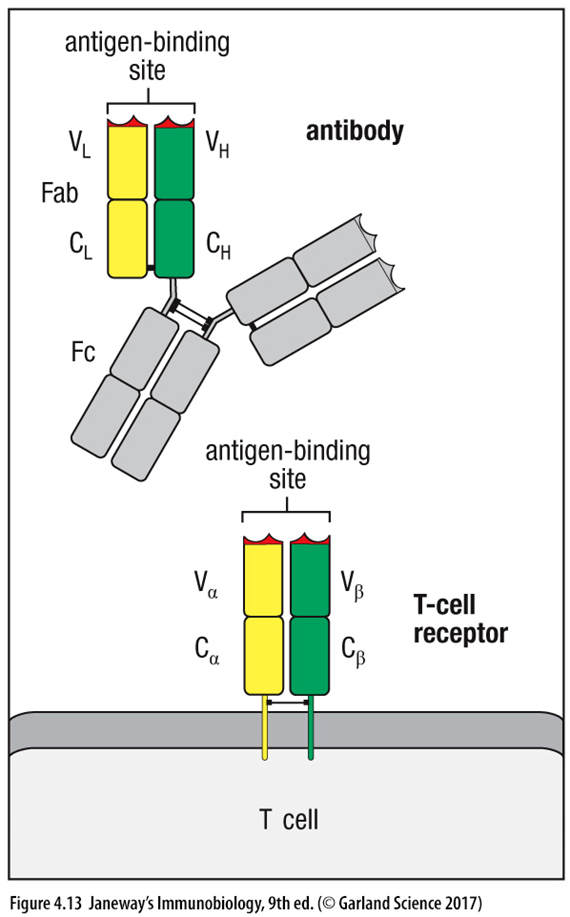
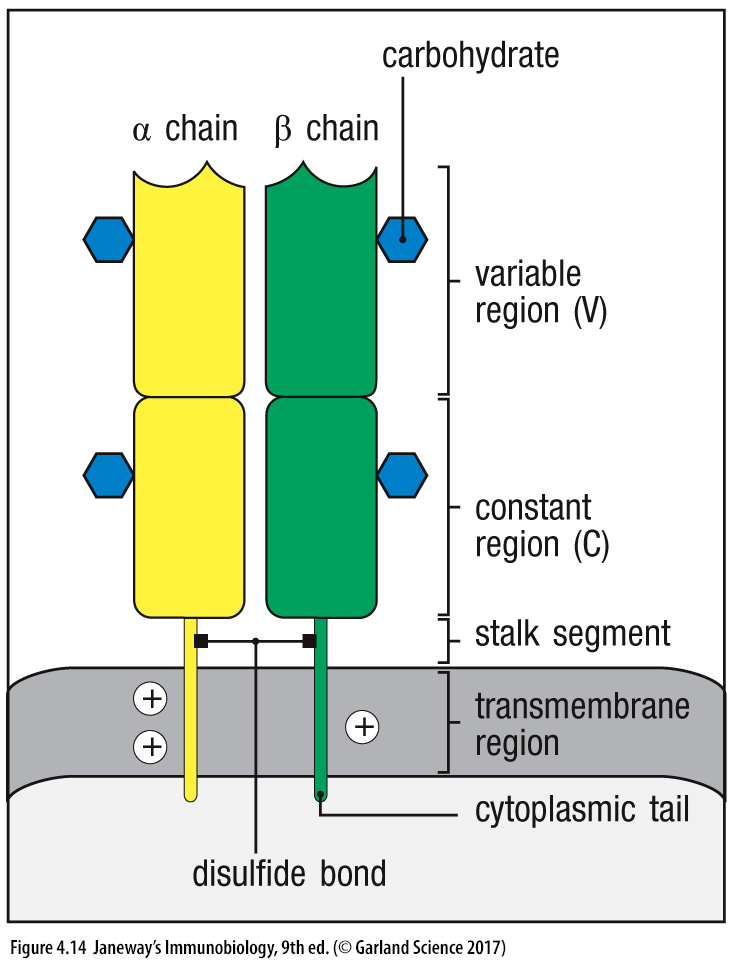
5: The TCR heterodimer is made up of transmembrane alpha and beta glycoprotein chains. Each chain’s extracellular region consists of 2 domains which resemble Ig V and C domains. Carbohydrate side chains are attached to each domain.
A short stalk region similar to Ig hinge connects the Ig-like domains to the membrane. The stalk also contains the cysteine residue which forms the interchain disulphide bond.
The transmembrane helices of the chains are unusual as they contain +ve residues in the hydrophobic transmembrane segment. The alpha chain carries two of these residues whereas the beta chain has 1.
Diagram missing CD3, and CD4/CD8
6: TCRs generally recognise PROTEIN antigens however in a very different way to antibodies. They recognise peptide epitopes derived from partially degraded proteins, only if the peptide is MHC bound. The TCR binds to the MHC-epitope complex. There’s no secreted TCR form so the TCR only acts to signal to the T cell that it’s antigen bound. Pathways of presenting on MHC I or II is different.
7: TCR alpha and beta chain genes consist of discrete segments joined by somatic recombination during T cell development (thymus).
RAG-1/2 generates functional alpha and beta chains.
alpha chain = V alpha gene segment rearranges → J alpha gene segment, making functional V region exon which is transcribed and spliced to join C alpha.
beta chain = variable domain encoded in 3 gene segments: V beta, D beta and J beta. Rearrangement forms functional VDJ-beta V region exon which is transcribed to join C beta
Resulting mRNA translated for both, alpha and beta chains pair soon after synthesis to yield alpha:beta TCR heterodimer
Extra slide:
TCR has low peptide affinity - very strong binding but low affinity
scanning by T cell on top of dendritic cell looking for MHC presented antigenic peptides on surface
has a fast on/off rate to only identify non-self
CD4/8 binding MHC increases affinity 10x
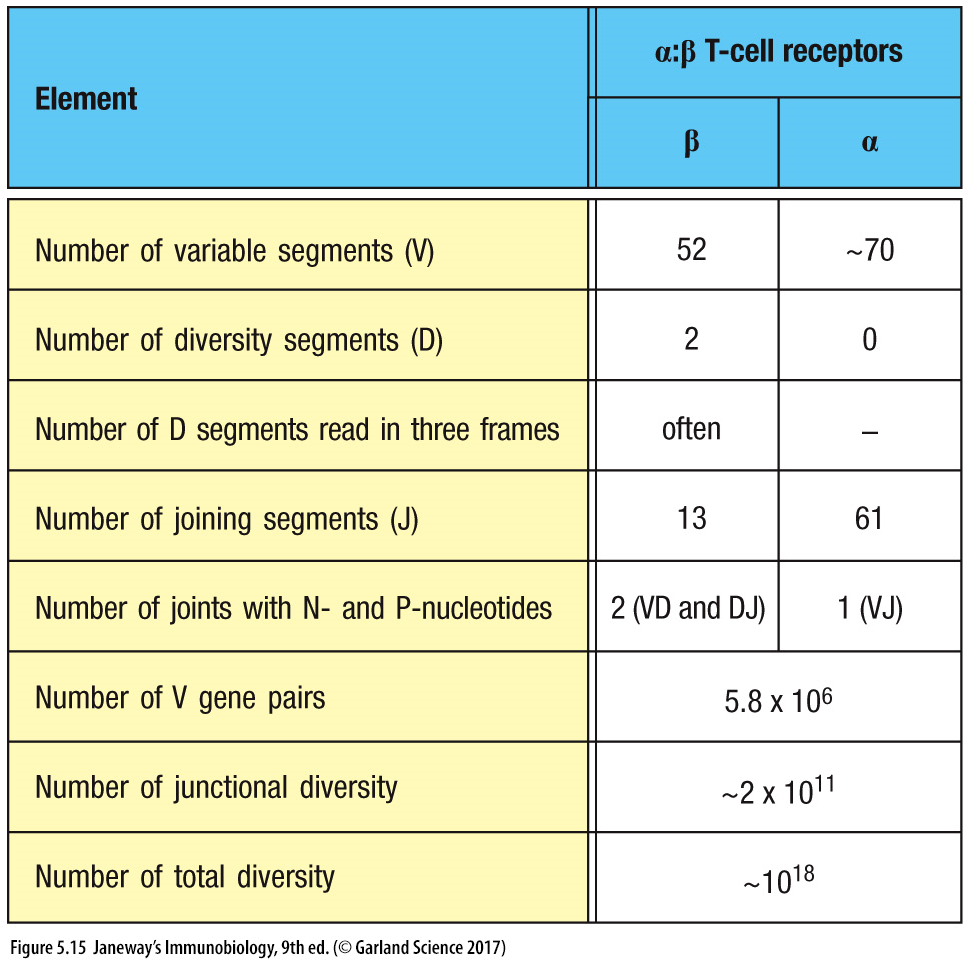
8: Generation of TCR diversity creates many antigen specific T cells - 10^18. However, selection must occur as some are specific to self cells or don’t recognise MHC
9:
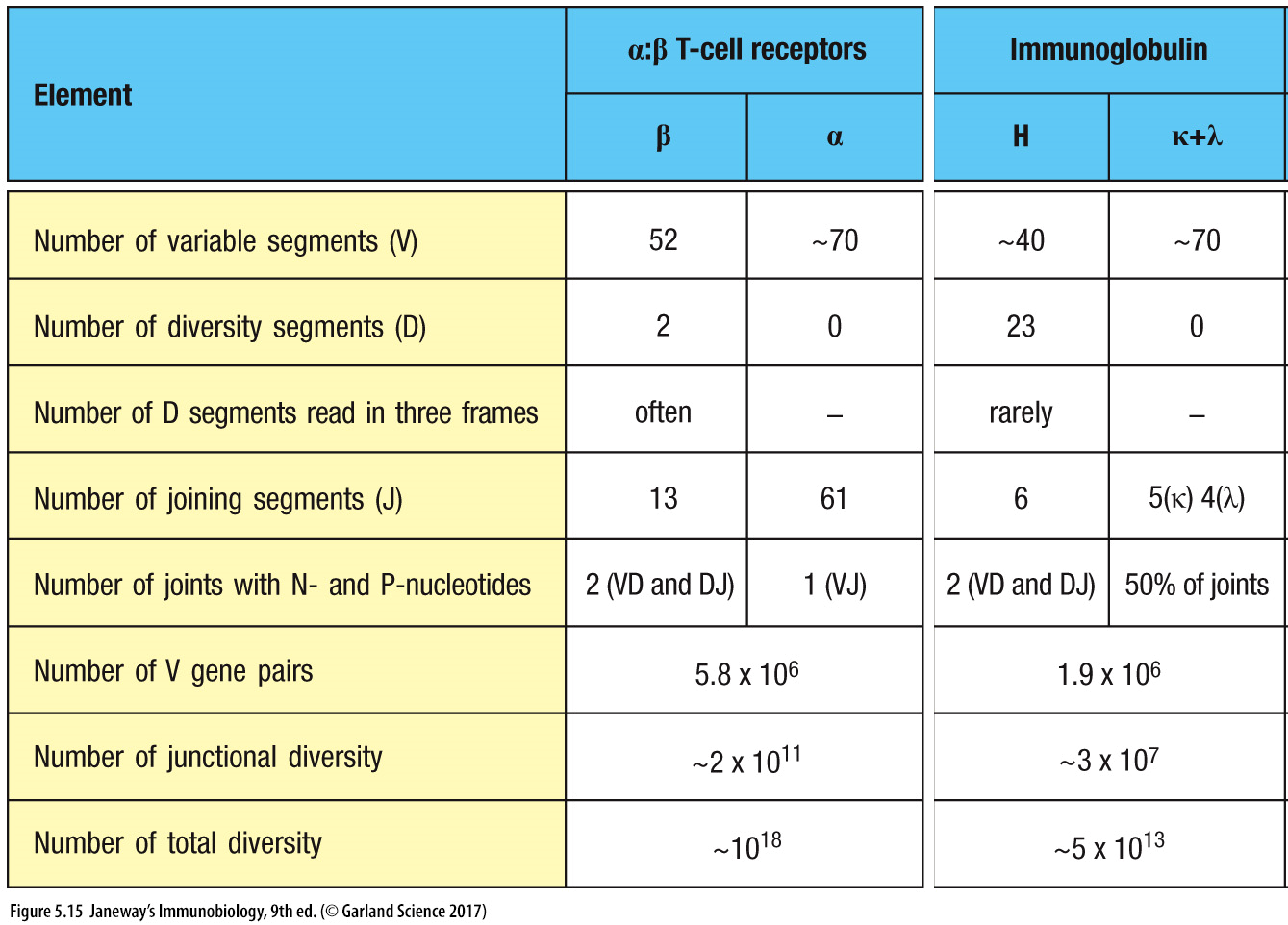
10: TCR genes are composed of variable (V), diversity (D) and joining (J) gene segments. During development the 3 different segments randomly recombine in the beta chain, and V and J recombine in the alpha chain. Process is mediated by RAG1/2 enzymes.
11: junctional diversity = addition or removal of nucleotides at V(D)J junctions by TdT increases variability
combinatorial diversity = different combinations of alpha/beta chains further enhance diversity
Somatic hypermutation does not occur in T cells. Initial diversity retained in the activated T cells
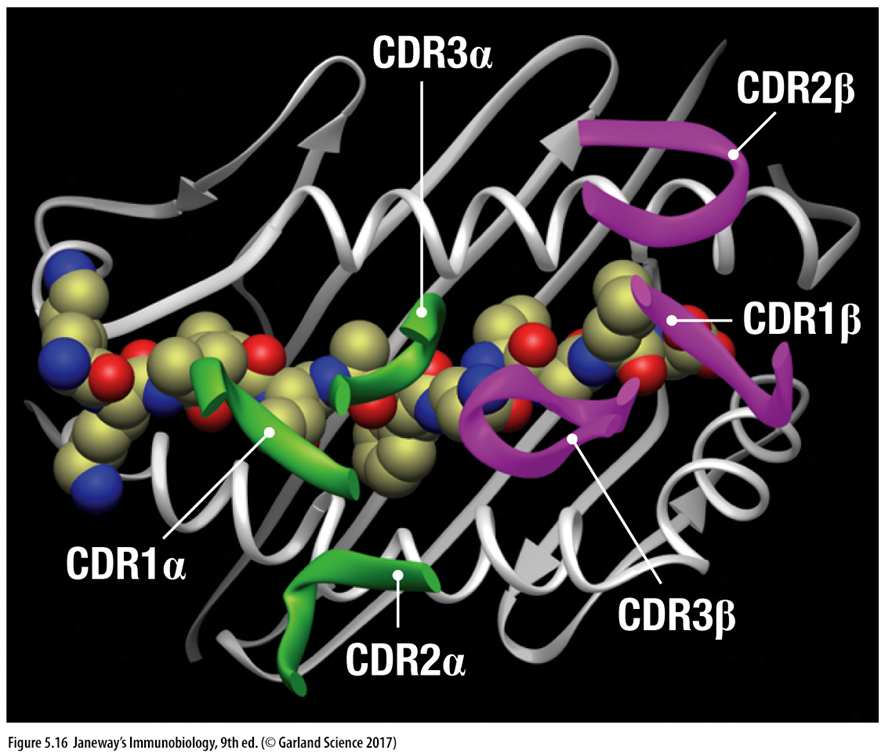
12: TCRs have hypervariable regions critical for antigen recognition characterised by high variability, concentrated in CDR1, CDR2 and CDR3. CDR1 and 2 are derived from V gene segments and CDR3 is the most diverse region created from a combination of V, D and J gene segments during rearrangement. This is important as the CDR3 loops are found in the centre of the interface between the TCR and peptide:MHC complex meaning they make direct contact with the antigen.
below = crystallography
Extra reading REQUIRED:
TCR structure
TCR recognition mechanism
generation of TCR diversity
mechanisms of TCR diversity
TCRs concentrate diversity in the 3rd hypervariable region
answer questions on last slide