Unit 2: The Circular Flow of Income and Spending
2.1 Introduction
In any society, no matter how advanced or primitive, this problem of scarcity arising from limited resources and unlimited wants exists. Resources must be efficiently used to find answers to the following basic economic questions:
What should be produced? Or what are the needs/wants of our society, and how much should we produce?
How should these goods be produced? Or what methods of production must we use given existing resources?
For whom should the goods be produced? Or how will the goods be distributed?
1. What goods and services and how much?
Scarcity of resources prevents us from producing every good and service we want. Hence, there is a need to choose what to produce. In our economic system (mixed market) the price mechanism does this for all goods produced by the private sector. Consumers indicate whether they need the goods and whether they can pay for them. The price consumers are willing to pay acts as a signal to producers whether to continue production or not. The demand or lack of it tells producers what to produce or not to produce.
2. How to produce?
Having decided on what to produce, the question is how should the scarce resources be combined to make the most efficient use of these resources. The main issue is around the use of existing capital and labour (human resources). Again in the market system the price mechanism will decide this. The principle is to keep the cost of production at a minimum given the price of all inputs. The forms (producers) choose the most technically efficient and economically efficient methods of production.
3. For whom to produce?
How will the goods and services produced be distributed in society? In the market economy this is done by the price mechanism. The consumers spend their income on the goods and services they need/want. This is regarded as the consumers voting for their choice of goods. Incomes depend on how many resources individuals own or whether an individual possesses scarce skills. Higher incomes mean greater ability to pay for goods. Consumers demand tells the producers who will buy what goods and how much of these goods.
2.2 The Three major flows in the Economy: Production, Income and Spending
The circular flow demonstrates the interaction between the two microeconomic decision making units, the household and the firm (producer). The interaction between the households and firms forms the foundation of the market economy at the microeconomic level. There are two sets of markets in this circular flow, the factor market and goods market.
The circular Flow of Income shows the flow of inputs, outputs and payments between households and firms within an economy. This model captures the essential essence of macroeconomic activity.
The economy is seen as nothing more than:
A revolving flow of goods,
Production resources, and
Financial payments
The three major flows are (Mohr, 2015):
Figure 3: The three major flows in the economy
 | Video Activity 2.1 |
The circular flow model illustrates the mechanism by which income is generated from goods and services and how this income is spent. This is best understood by analysing the diagram below:
A Simple Circular Flow Model of Income and Spending
Figure 4: The Circular Flow In The Economy
Source: Mohr, 2015
Contemplate households who are consumers, and firms who are manufacturers and sellers of goods and services in the goods and services market: Firms are purchasers of factors of production and households turn out to be sellers of factors of production in the factor market. The government, who is also a partaker, is responsible for providing public goods and services, such as roads, bridges, etc. for usage by households and firms.
According to Mohr (2010) “For the government to deliver these public goods and services, it collects tax revenue from households and firms. Therefore, we have movement of income in the form of tax paid by firms and consumers and tax collected by the government. In addition, government provides subsidies to firms and households - flow of income. Next, is the financial sector, which mostly includes of financial organisations, where consumers and firms deposit funds and earn interest on savings”. Mohr (2015) further states that “Firms and consumers take loans to invest in capital goods and assets, and have to pay interest on loans. Finally, we present the foreign sector. In the foreign sector, importing countries pay using foreign exchange for imported goods and services, and exporting countries earn foreign currency for exporting goods and services”.
The circular flow model of income, output and spending characterises the mechanisms of a simple economy, and demonstrates the significance of economic interdependence. In addition, it shows the mutual dependence between the micro economy and the macroeconomy.
 | Knowledge Check Question 2.1 What are the leakages from the circular flow? Submit Your Answer View Correct Answer |
 | Think Point 2.1 What are goods and services markets? |
|
Factor market
This is the market for factors of production (our scare resources). The households own the factors of production. Through the factor market they make these resources available to the firms to produce goods and services. The firms in turn pay for these factor services. This payment becomes income in the hands of the households. They use this income to buy goods and services they need from the firms.
| Knowledge Check Question 2.2 What is a factor market? Submit Your Answer View Correct Answer |
Goods and services market:
This is the market where firms sell their output to the consumers (households). The firms use the factors of production to produce goods and services which the consumers buy. They pay for the goods and services with the income they receive for the factors services to the firms. The firms use these payments they receive to buy more factors of production.
 | Activity 2.1 Explain the difference between the goods and services market and the Factor Market. Submit Your Answer View Correct Answer |
In each case there are two flows:
In the factor market there is a flow of resources to firms (called a real flow) and a corresponding monetary flow to the households as income.
In the Goods and services market there is a flow of goods and services from the firma to households (a real flow) and an opposite monetary flow to the firms as payment for the goods and services.
| Think Point 2.2 What is your definition of a virtual organisation? Does it have any advantages? |
|
2.3 The Factors of Production
There are four basic factors of production:
Land: Land refers to all natural resources, including minerals, air, water, land etc.
Labour: Labour refers to physical labour and skills.
Capital: Capital refers to final finished goods produced for use in further production, e.g. a factory machine to produce shoes.
Entrepreneurship: Entrepreneurship refers to the assembling of resources to produce new or improved products and technologies.
| Knowledge Check Question 2.3 What are the four factors of production? Submit Your Answer View Correct Answer |
| Video Activity 2.2 What are the four basic types of factor markets? Submit Your Answer View Correct Answer |
| Think Point 2.3 How are the factors of production remunerated? |
|
 | Case Study 1 Transformation of the Paradigm of the Economic Entities Development in Digital Economy. Introduction Today, under the influence of digitization, the success of a company is measured not by the size of its capital, its many years of existence, but by its level of flexibility to respond to these changes and adapt the business to a new environment. As noted by a group of scientists, a modern enterprise is a complex integrated organisational and production system which components are constantly changing, interacting with each other. Achieving these goals in the context of increased competition among enterprises leads to an increase in the volume and complexity of the production processes, analysis, planning, management, internal and external relations with suppliers, intermediaries, etc. Digitization implies significant development of innovative technologies using artificial intelligence, automation processes and digital platforms. Using the Internet, you can save time and money on goods delivery by using rich information flows to streamline and optimise the flow of physical goods in the supply chain. Experts of the Boston Consulting Group say that by 2020, about 25% of the global economy will be digitised, allowing the state, business and society to function more efficiently. Digitization changes models of the enterprise management and transforms the classic enterprise into digital one – the enterprise that uses the information technology as a competitive advantage in all areas of its activity, changing product chains, consumer relationships and marketing strategies; causes the emergence of new products and innovations; affects the provision of business resources; reduces the cost of organisation, management and communication, as well as the cost of obtaining, processing and storing information, etc. The difference between the classic and digital enterprise is presented in Table 1. Table 1 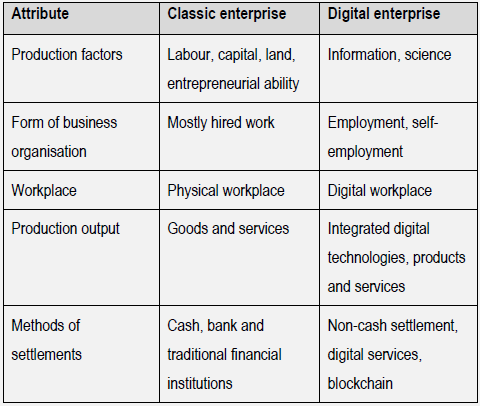 Production factors. Rapid development of the digital economy is associated with widespread use of digital-information and communication technologies that have been able to transform a traditional resource-consuming economy into a resource-creating economy. Therefore, the emphasis on traditional factors of production (labour, capital, land and entrepreneurship) has shifted to information (electronic and virtual data), providing electronic communications with electronic devices, tools and systems) and science (availability of certain necessary knowledge, skills, individual competencies of the employee, such as talents, creativity, experience, etc.), and ways to access them). With the development of science and technology, physical work has been transformed into brainwork. In addition, experts predict that in the future, all tasks will be completed by robots. Capital is no longer a determining factor in starting your own business; now you can do it with minimal investment. Land has ceased to be a major factor in production, as new types of products (devices) that do not need it have emerged. Entrepreneurial capabilities (i.e., strategies for purely economic effect - profit) are no longer working in pure form, instead, businesses are investing in social projects, which are first and foremost beneficial to the population (provide useful information, the services you need for free, and usually with environmental concerns), thus providing social and environmental effects that can eventually create an economic impact for the company. For example, one company that has been operating in the market for a long time is ready to invest in the implementation of a specific social action project, acting only as a sponsor of the project. If the project is useful and gains popularity, the sponsoring company’s rating can automatically rise and increase the number of its clients. It is much easier for digital enterprises than traditional businesses to find co-organisers, volunteers, material suppliers to implement such projects, and invite a target audience for the event. Form of business organisational. As a result of the society digitization, there is a tendency to increase the number of self-employed persons, including those engaged in entrepreneurship. At the same time, one person can be the business owner, the manager, and the executor of all stages of the company’s operation. Internet development provides unlimited opportunities for e-business (business services, online sales, etc.), and this means that business processes are carried out instantly anywhere and in any direction. The purpose of this virtual organisational form of business is to ensure competition for scarce resources and finance to meet customer needs as quickly as possible. This form of employment significantly reduces the cost of starting and running a business; significantly reduces time for communication with consumers; does not depend on the location of the consumer; gives the opportunity to cooperate with other specialists; reduces significantly the cost of premises, because many types of economic activity can be carried out from home; allows you to plan and organised your working hours independently; accelerates order fulfilment. Questions 1. By making reference to the case study, illustrate the paradigm shift on the following traditional factors of production as a result of developments in science and technology. a. Labour b. Capital c. Land Submit Your Answer View Correct Answer 2. What are some of the benefits of a virtual organisation? Submit Your Answer View Correct Answer |
These resources are the inputs required to produce the desired outputs. With the concept of scarcity in economics, it is implied that, at some stage, a decision or choice must be made on how to use the scarce resources. In making this choice, we decide on the most efficient and effective allocation of resources.
The concept of opportunity cost arises when we choose to use a scarce resource in one way and give up the opportunity to use them in other ways.
See Examples of Factors of Production uses in various companies below:
Figure 5: Factors of Production use at Nike
Source: Shamase, 2018
 | Practical Example 2.1 One of the factors of production is Land which includes natural resources. Diamonds constitute natural resources used by the manufacturers of diamond rings. |
7Figure 6: Factors of Production use at Pepsico
Source: Shamase, 2018
Figure 7: Factors of Production use at Coca-Cola
Source: Shamase, 2018
2.4 Remuneration of the Factors of Production
'Land' - all natural resources including water, land, soil, minerals. The remuneration for land is rent
'Labour' – includes all the skills and experiences of the people. The remuneration for labour is wages
'Capital' – These are the investments that owners of the business make such as buildings and machinery. The remuneration for capital is interest
'Entrepreneurship – These are the people who are the driving force behind production and ideas generators. The remuneration for enterprise is profit
| Practical Example 2.2 Capital is a factor of production which manifests itself in the form of machines, computers, plant, equipment, etc. |
 | Reading Activity |
| Activity 2.2 Explain how the owners of the factors of production are remunerated. Submit Your Answer View Correct Answer |
2.5 The Four Spending Entities of an Economy
Economies comprise the exchanges of large numbers of people and firms. These economic participants form one of four classifications: business, households, government, and the foreign sector. These categories form sectors of the economy (Conspecte, 2017).
Figure 8: Four Spending Entities in the economy
Source: Conspecte, 2017
 | RevisionQuestion 2 1. Briefly discuss the main components of total spending in the economy. Submit Your Answer View Correct Answer 2.Identify the main injections into and withdrawals (or leakages) from the circular flow of income and spending in the economy. Submit Your Answer View Correct Answer 3. Use diagrams to illustrate how goods and services, income and spending flow between households and firms. Submit Your Answer View Correct Answer 4. Use a diagram to summarise the circular flow of income and spending between households, firms, the government and the foreign sector. Submit Your Answer View Correct Answer 5. These economic participants form one of four classifications, name and discuss these. Submit Your Answer View Correct Answer |
2.6 Summary
All interactions in the marketplace involve the exchange of either factors of production or finished goods. Although actual exchanges can occur anywhere, they take place in product markets (markets where finished goods are bought and sold) or factor markets (markets where factors of production are bought and sold), depending on what is being exchanged. Figures 4 & 8 above, illustrates the importance of interdependence between participants in the economy.
-- Select PDF Type -- Color Black And White
Undo Highlight/Comment (Undo changes are seen after page refresh)
-- Select Undo Type-- Highlight Comment