Oscillations
Exam definition of SHM
There is a restoring force acting that is proportional to the displacement from equilibrium position.
The restoring force is in the opposite direction to the displacement The restoring force is in the opposite direction to the displacement from equilibrium position.
Notes
The restoring force is always towards the equilibrium position and away from the displacement.
F=-kx
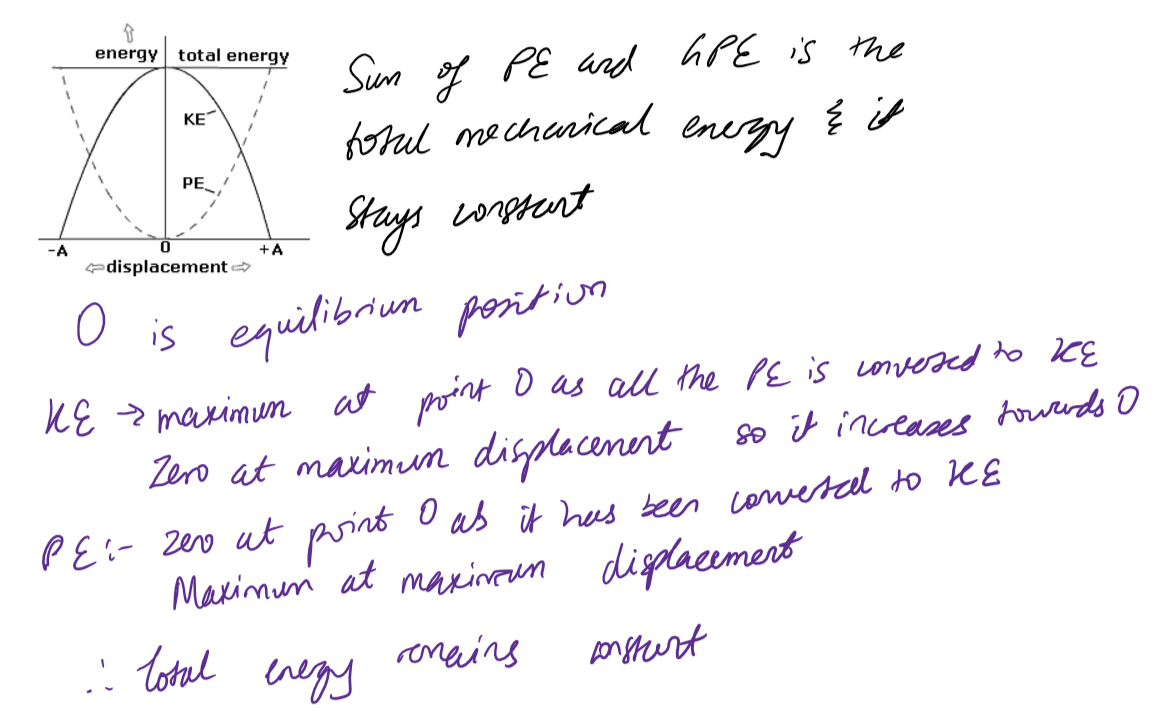
Kinetic and potential energy in SHM
Simple pendulums
For a motion to be SHM. the angle should be less than 11°
T=2\pi\sqrt{\frac{l}{g}}
Factors that affect a pendulum
Length of pendulum
Acceleration due to gravity
Note: gravity provides the restoring force in simple pendulums
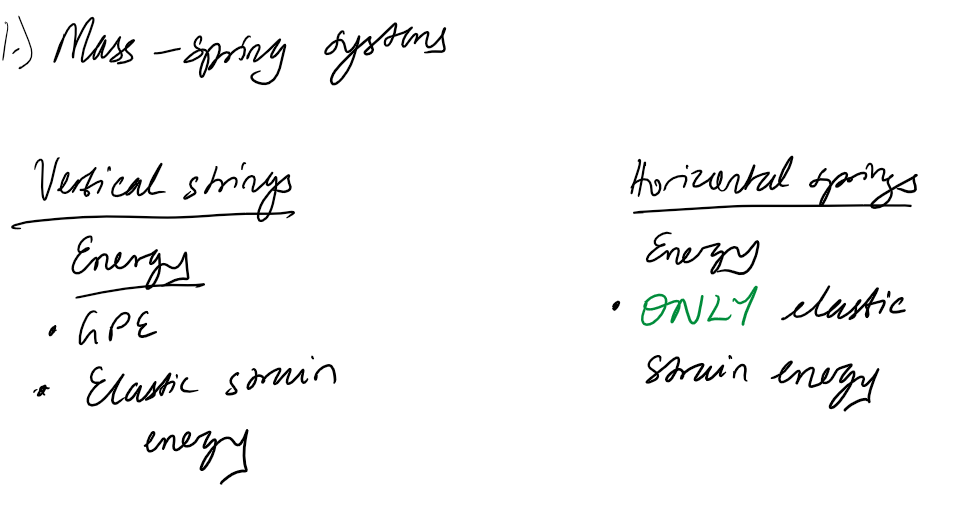
Mass - spring system
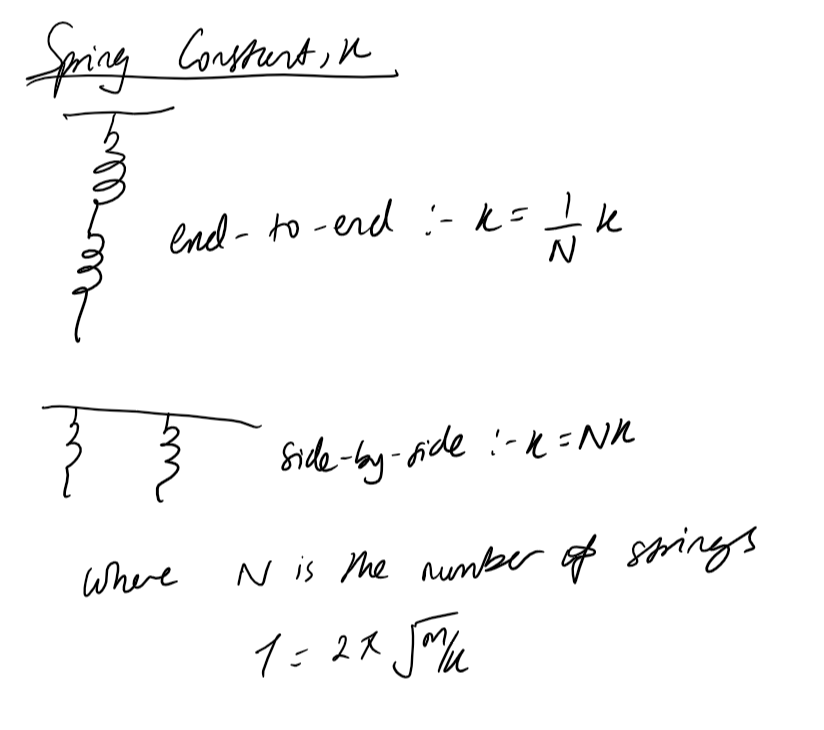
Spring constant, k
SHM Equations
x=A\cos(wt)
v=-wA\sin(wt)
a=-w^2A\cos(wt)
A is maximum displacement from equilibrium position.
Note: calculator must be in radian mode.
Free and forced vibrations
Free vibrations
Displacing a pendulum from equilibrium position and leaving it to bob on its own. It will oscillate at its natural frequency.
If there is no transfer of energy, the pendulum will oscillate with the sane amplitude forever
There is continual exchange of PE and KE within the system
Forced vibrations
Think of pushing a child on a swing. The amplitude of the displacement increases.
A driving force which has a driving frequency has been added to the oscillating system.
Energy α Amplitude2
Scenarios
Driving frequency < natural frequency: Oscillating system can keep up with the driving force as displacements in phase.
Driving frequency = natural frequency: system gains more energy so it vibrates with increased amplitude. This happens when the system is in resonance. The phase difference between the driver and oscillator is 90°. There is maximum transfer of energy and displacement.
THE ABOVE ARE THE FEATURES OF RESONANCE
Driving frequency > natural frequency: The oscillator cannot keep up with the driver as they are completely out-of-phase.
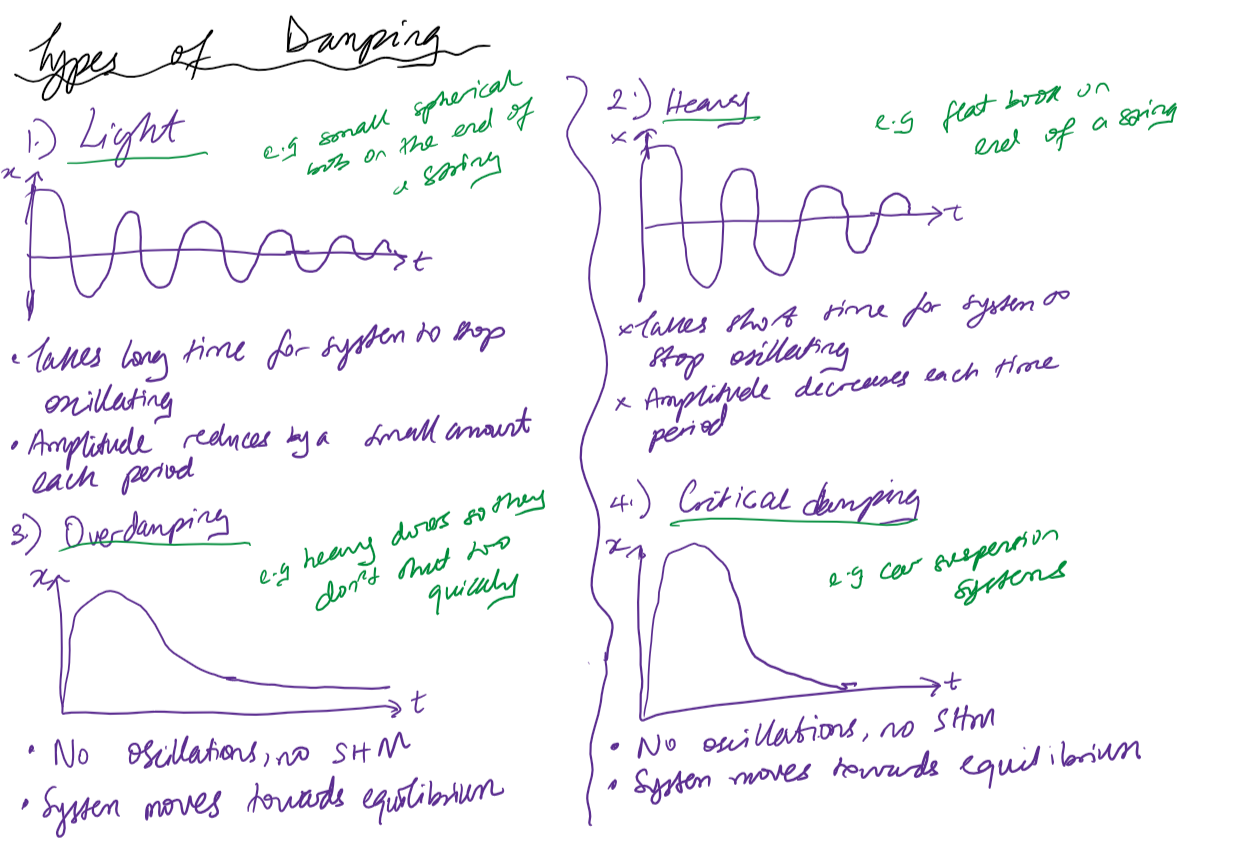
Damping
Occurs when resistance is added to an oscillating system so amplitude decreases over time.
Due to external forces acting on the system.
Damping causes resonance to happen at a lower frequency.
Anything that removes energy from a system damps it.