Copy of Rhetorical Terms 2024
Rhetorical Analysis Terms to Know
Rhetoric-the art of being a critical reader in order to find the ways that a writer or speaker uses language to shape people’s thoughts and actions in a given situation
Analysis-a detailed examination of anything complex in order to understand its nature or to determine its essential features; explains how the parts work together to create the whole
Rhetorical Analysis-explains how the rhetorical choices made by the author (the parts) work to create the purpose of the text (the whole).
Annotations-notes taken while reading a text including rhetorical choices, shifts in tone, topic, or appeal, and anything to clarify meaning
Rhetorical Choice-the strategies an author uses to engage with the intended audience
Methods-capture the big picture of what is happening in each section of the text; what the author does in each section of a text
Style-an author's unique way of communicating with words
Embedding-Quotations from your sources should fit smoothly into your own sentences; full sentences are not quotes and dropped into your essay
Rhetorical Situation-speaker, audience, context, exigence, purpose
Speaker-the person who composed the text you are reading
Audience-the original intended group the speaker is addressing
Context-the circumstances that form the larger setting for a piece of text
Exigence-an issue, problem, or situation that causes or prompts someone to write or speak
Claim-an assertion of the truth of something; a claim is a debatable statement
Evidence-information that might lead one to believe something to be real or true
Reasoning-the commentary a writer uses to explain how a strategy and evidence support the topic sentence and thesis statement
Line of Reasoning-the way that claims and evidence are intentionally chosen and arranged to lead to the conclusion
Thesis-a combination of methods and purpose statement. Template:Author + type of text +title of text + method 1 + method 2 + method 3 + in order to + rhetorically accurate verb + what the audience should do, know, think, or believe.
Purpose-What the audience should do, know, think, or believe after receiving the message from the writer/speaker
Topic Sentence-the first sentence of a body paragraph that focuses on a method listed in your thesis (not word for word)
Transition- a word or phrase that connects ideas in a paragraph or paragraphs themselves
Appeals
Logos-logical
Ethos-credibility
Pathos-emotional
Counterargument-acknowledging standpoints that go against your argument and then re-affirming your argument
Concession-the act or an instance of conceding-accepting something as true
Rebuttal-a form of evidence that is presented to contradict or nullify other evidence that has been presented by an adverse party
Refutation-statement that proves, or attempts to prove, that another statement is false. Often requires evidence or logic that contradicts the original statement the speaker wants to disprove
Fallacy-the use of invalid or otherwise faulty reasoning in the construction of an argument
Shift in tone, appeals, content (a change is evident in the writing)
Diction-choices that are related to selection of specific words
Syntax-choices that are related to the structure of the sentences
Some Common Rhetorical Strategies
Allusion-A reference to something real or fictional, to someone, some event, or something in the Bible, history, literature, or any phase of culture
Analogy-a comparison between two things
Anaphora-succeeding clauses or phrases start with the same word or phrase
Anecdote-a short interesting story about a real incident or person (sometimes amusing)
Antithesis-Direct contrast of structurally parallel word groupings
Aphorism-a concise observation that contains a general truth
Asyndeton-the omission or absence of a conjunction between parts of a sentence
Euphemism- the substitution of an agreeable or inoffensive expression for one that may offend or suggest something unpleasant
Expert testimony-an expert in a field of study is quoted in an article to support the author's opinion
Facts and statistics-use of statistics and facts to make a point and persuade
Hyperbole-extravagant exaggeration
Hypophora - a figure of speech in which the speaker poses a question and then answers the question.
Imagery-language that evokes one or all of the five senses
Irony-when a person says something or does something that departs from what they (or we) expect them to say or do
Juxtaposition-placing of two items side by side to create a certain effect, reveal an attitude, or accomplish some other purpose
Metaphor-figure of speech that compares two subjects without the use of “like” or “as” (simile uses like or as)
Oxymoron-a figure of speech in which apparently contradictory terms appear in conjunction
Parallel Structure-repetition of the same pattern of words or phrases within a sentence or passage
Paradox-a self-contradictory statement or proposition that when investigated or explained may prove
to be well founded or true
Personification-the attribution human characteristics to something nonhuman
Polysyndeton- device in which several coordinating conjunctions are used in succession
Repetition-literary device that repeats the same words or phrases a few times
Rhetorical Question-a question asked in order to create a dramatic effect or to make a point rather than
to get an answer (it is not merely used to “make the audience think”)
Symbol-something that stands for something else
Tone-Writer or speaker’s apparent attitude toward the subject matter and/or issue
Modes of Organization
Narration Stories the author shares about themselves, about people they know, people they’ve heard about to illustrate an argument, to offer evidence or counter-evidence, and sometimes even to substitute for an argument.
Description When writers describe a person, place, or thing, they indicate what it looks like and often how it feels, smells, sounds, or tastes.
Definition involves telling the reader what something means—and what it does not.
Problem Solution First a problem is presented in a detailed manner along with the causes that have led up to the problem. This is followed by a detailed explanation of a solution to the problem.
Types of Sentences
Simple - a sentence with only one independent clause (subject and verb that creates a complete idea)
Compound - a sentence made up of two or more simple sentences
Complex - contains one independent clause and one or more dependent clauses (dependent clause
contains a subject and verb but cannot stand alone)
Compound/Complex - contains two or more independent clauses and one or more dependent
clauses
Inductive vs Deductive Reasoning
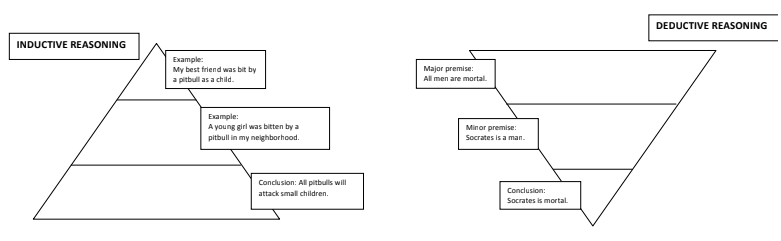
Inductive moves from specific to general. Deductive moves from general to specific.
Inductive reads from top to bottom: My best friend was bit by a pitbull as a child; a young girl was bitten by a pitbull in my neighborhood; all pitbulls will attack small children.
Deductive reads from top to bottom: All men are mortal; Socrates is a man; Socrates is mortal.