Water
A1.1.1 → Water as the medium of life
Students should appreciate that the first cells originated in water and that water remains the medium in which most processes of life occur.
There is good evidence that life has probably existed on Earth for most of Earth’s history. Fossils of blue-green algae found in Australia are the oldest fossils of life forms on Earth. They are at least 3.5 billion years old.
The human body is made up of 70% water rendering water essential for our survival and basic existence
Water is a polar molecule; oxygen is more electronegative than hydrogen.
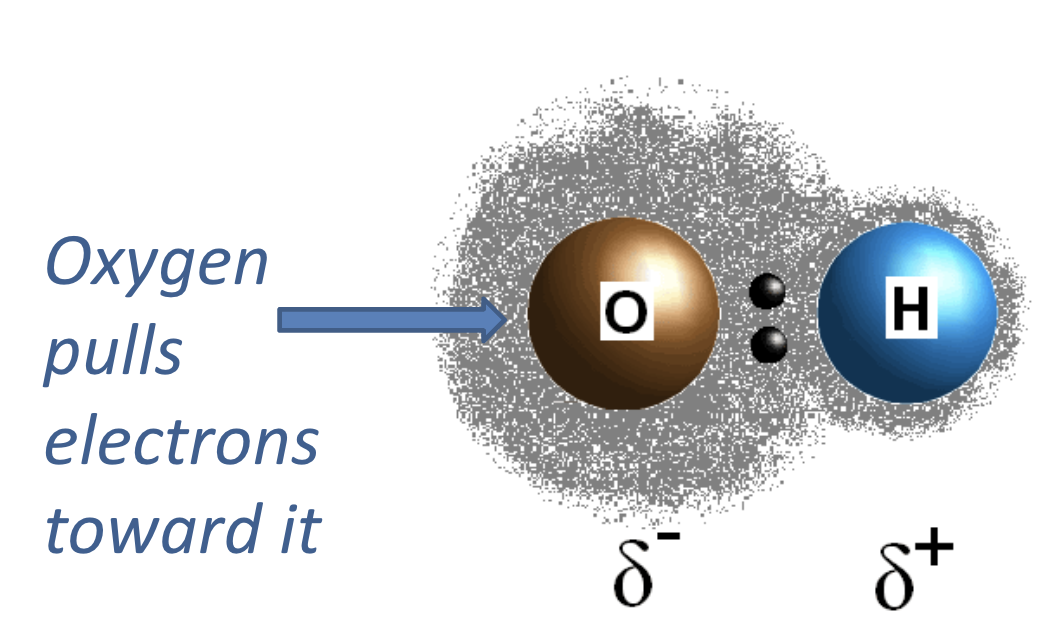
Oxygen acquires a partial negative charge (δ-); hydrogen acquires a partial positive charge (δ-)
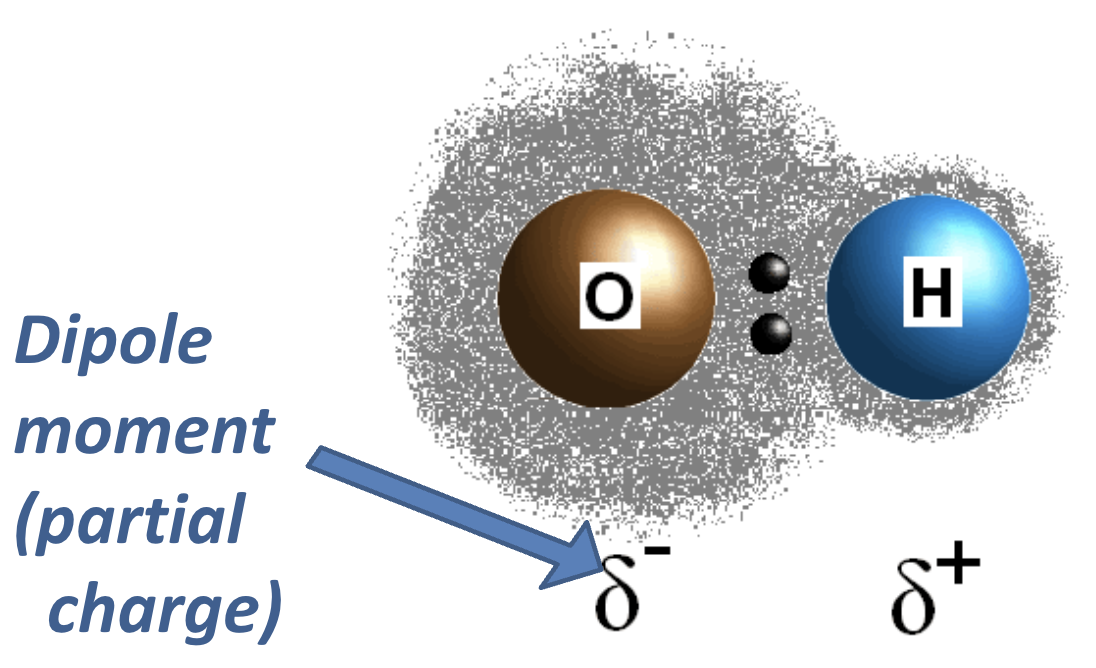
The polarity of water results in hydrogen bonding (H-bonds)
A.1.1.2 → Hydrogen bonds as a consequence of the polar covalent bonds within water molecules
Students should understand that polarity of covalent bonding within water molecules is due to unequal sharing of electrons and that hydrogen bonding due to this polarity occurs between water molecules. Students should be able to represent two or more water molecules and hydrogen bonds between them with the notation shown below to indicate polarity.
Water (H2O) is made up of two hydrogen atoms covalently bound to an oxygen atom
While this bonding involves the sharing of electrons, they are not shared equally
The number of protons in each atom is different; oxygen atoms have 8 whilst hydrogen atoms have just 1
having more protons the oxygen atoms attract the electrons more strongly
Thus the oxygen atom becomes slightly negative and the hydrogen atoms become slightly positive (i.e. the oxygen has a higher electronegativity)
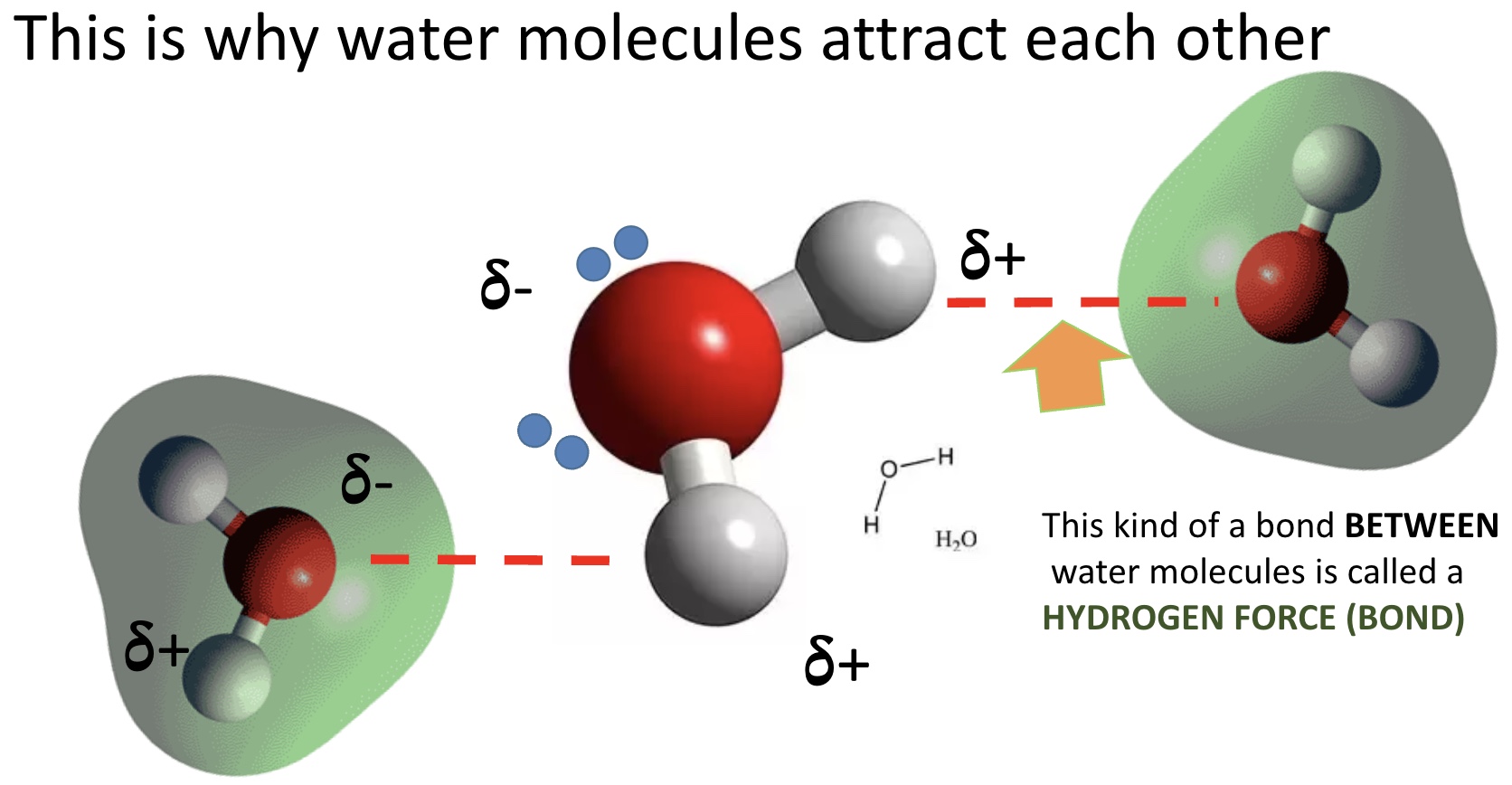
A.1.1.3 → Cohesion of water molecules due to hydrogen bonding and consequences for organisms
While a single bond of hydrogen isn’t strong, multiple hydrogen bonds are very strong. Each water molecule bonds with four others in a tetrahedral arrangement.
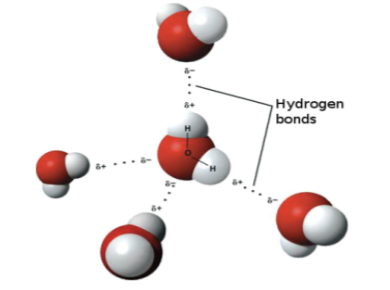
Due to these hydrogen bonds, water is
→ Cohesive: water molecules stick to each other
→ Adhesive: water sticks to other surfaces

These properties lead to:
Capillary action → water will move up xylem against gravity

Surface tension → the surface of the water is strong enough to support insects and causes water droplets to form