Module 14 - Moral Development
What is Moral Development?
Moral Development → involves changes in thoughts, feelings, and behaviors regarding standards of right and wrong
the intrapersonal dimensional pertains to a person’s activities when she or he is not engaged in social interaction
the interpersonal dimension pertains to social interactions, including cooperation and conflict
note that in social-cognitive domain theory, cheating resides in the moral domain, along with lying, stealing, and harming another person
Moral Though: Piaget’s Theory
Piaget concluded that children go through two distinct stages of moral development
from 4 to 7 years of age, they display heteronomous morality — they think of justice and rules as unchangeable, removed from people’s control
from 10 years on and older, children show autonomous morality — they are aware that rules and laws are created by people, and in judging action, they consider both intentions and consequences
Moral Though: Kohlberg’s Theory
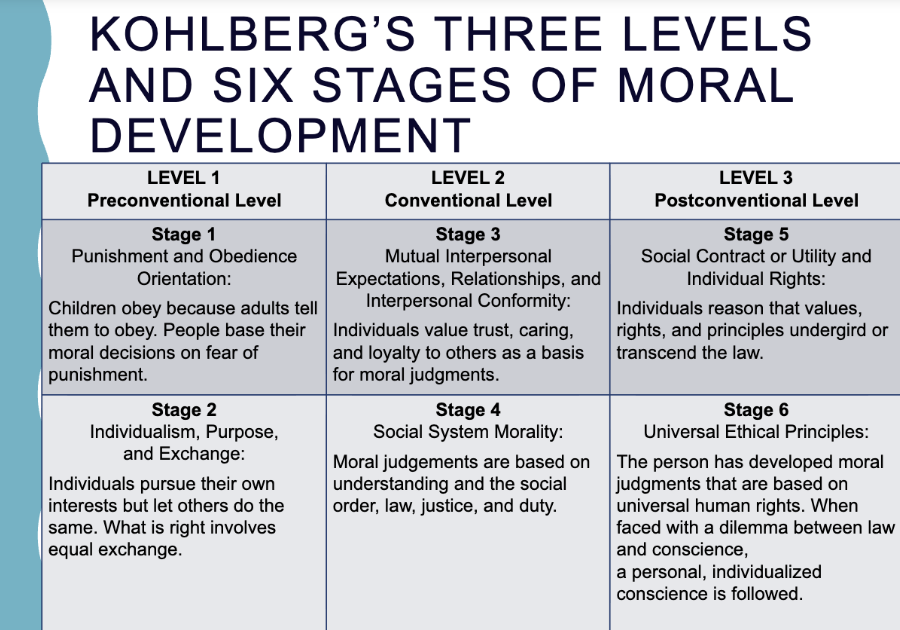
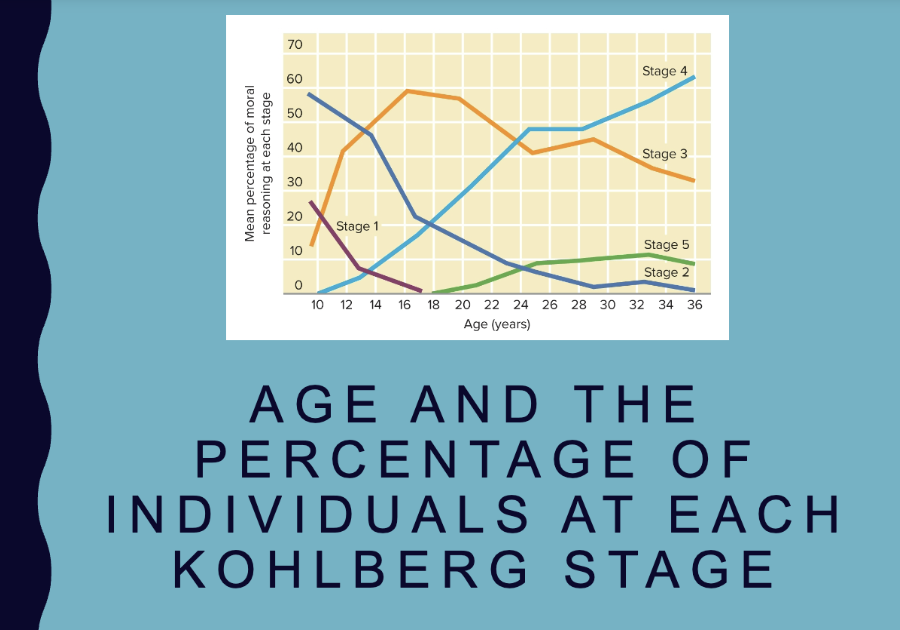
Kohlberg proposed three levels of moral development
Development from one level to the next is fostered by opportunities to take the perspective of others and to experience conflict
Kohlberg developed stages in these three levels through interviews in which children are presented with a series of stories of characters faced with moral dilemmas
he noted that interaction is a critical part of the social stimulation that challenges children to change their moral reasoning
Preconventional Reasoning: the lowest level, at which good and bad are interpreted in terms of external rewards and punishments
Conventional Reasoning: intermediate level, at which individuals apply certain standards that are set by others, such as parents or government
Postconventional Reasoning: the individual recognizes alternative moral courses, explores options, and then decides on a personal moral code
Moral Thought: Kohlberg’s Critics
some key criticisms of Kohlberg’s theory:
it places too much emphasis on moral though, and not enough on moral behavior
culture influences moral development more than Kohlberg thought
Kohlberg suggests emotion has negative effects on moral reasoning, but evidence indicates emotions play an important role
Kohlberg suggests moral thinking is deliberative, Haidt suggests it is more often an intuitive reaction
Kohlberg places too much emphasis on peer relations and not enough on family relations
The most publicized criticism has come from Carol Gilligan
Kohlberg’s theory is based on male norms that put abstract principles above relationships and concern for others
the heart of morality in his theory is a justice perspective
a Care Perspective emphasizes connectedness with others, interpersonal communication, social relationships, and concern for others
Gilligan and her colleagues found that girls consistently interpret moral dilemmas in terms of human relationships
other analyses suggest girls use both moral orientations and needed — as can boys
Moral Behavior
The processes of reinforcement, punishment, and imitation affect how individuals learn moral behavior
the effectiveness of reward and punishment depends on consistency and timing
the effectiveness of modeling depends on the characteristics of the model and the cognitive skills of the observer
behavior is situationally dependent
Moral Behavior: Social Cognitive Theory
the social cognitive theory of morality emphasizes a distinction between moral competencies and moral performance
Bandura has stressed that moral development is best understood as a combination of social and cognitive facts — especially those involving self control
Moral Feeling
According to Freud, guilt and the desire to avoid feeling guilty, are the foundation of moral behavior
Researchers have examined the extent to which children feel guilty when they misbehave
empathy: reacting to another’s feelings with an emotional response that is similar to the other’s feelings
it is an emotional state but has a cognitive component — the ability of perspective-taking, discerning the inner psychological states of others
changes in empathy take place in early infancy at 1 to 2 years of age, in early childhood, and at 10 to 12
Moral Personality
Thoughts, behaviors, and feelings can all be involved in an individual’s moral personality
moral identity: the aspect of personality that is present when individuals have moral notions and commitments central to their lives
moral character: involves having strong convictions, persisting, and overcoming distractions and obstacles
moral exemplars: have lived exemplary lives
Social-Cognitive Domain Theory
Social-cognitive domain theory states that there are different domains of social knowledge and reasoning
social conventional reasoning focuses on conventional rules established by social conensus and convention
The rules themselves are arbitrary
in contrast, moral reasoning focuses on ethical issues and rules of morality
recently, a distinction has also been made between moral/conventional issues and personal issues, which are more likely subject to personal discretion
Contexts of Moral Development: Parenting
research reveals siblings, peers, parents contribute to children’s moral maturation
parent-child relationships introduce children to the mutual obligations of close relationships
secure attachment may play an important role
Discipline techniques used by parents are significant
in love withdrawl, a parent witholds attention or love, such as refusing to talk to the child
in power assertion, a parent attempts to gain control over the child or the child’s resources, such as with spankings or removing privileges
in induction, a parent uses reasoning and explains how the child’s actions are likely to affect other people
child developmentalists recommend induction
Contexts of Moral Development: Schools
Hidden curriculum: conveyed by the moral atmosphere that is part of every school
it is created by school and classroom rules, the orientation of teachers and administrators, and text materials
Character Education: a direct education approach that involves teaching students a basic ‘moral literacy’
every school should have an explicit moral code that is clearly communicated to students
any violations of the code should be met with sanctions
Cognitive moral education: education based on the belief that students should learn to value things like democracy and justice as their moral reasonings develops
service learning: a form of education that promotes social responsibility and service to the community
the goal is for adolescents to become less self-centered and more strongly motivated to help others
benefits include higher grades, increased goal setting, higher self-esteem, an enhanced sense of empowerment, and an increased likelihood of volunteering in the future
engagement must be voluntary and supported in adolescence for it to have lasting effects
One important moral education concern is whether students cheat and how to handle cheating
among the reasons given are pressure to get high grades, compressed schedules, poor teaching, and lack of interest
the context affects whether or not students cheat
strategies for decreasing cheating include making sure students are aware of what constitutes cheat and emphasizing academic integrity
Prosocial Behavior
alturism: unselfish interest and voluntary effort in helping another person
learning to share is an important aspect of prosocial behavior
research indicates that sharing is initially done for non-empathic reasons
by about 4 years of age, empathic awareness and adult encouragement produce a sense of obligation
what is important developmentally is that the child sees sharing as an obligatory part of a social relationship and involves a question of right and wrong
Carlo and colleagues (2010) confirmed the presence of six types of prosocial behavior in young adolescents in Mexican American and European American families
alturism
Public
Emotional
Dire
Anonymous
Compliant
Antisocial behavior
conduct disorder: age-inappropriate actions and attitudes that violate family expectations, society’s norms, and the personal or property rights of others
children with conduct problems show a wide range of rule-violating behaviors
about 5% show serious conduct problems, best explained by a confluence of risk factors operating over time
Antisocial Behavior: Juvenile Delinquency
juvenile delinquency: a great variety of behaviors by an adolescent, ranging from unacceptable behavior to breaking the law
index offenses: criminal acts, such as robbery, rape, and homicide, whether committed by juveniles or adults
Status offenses: juvenile offenses that are not as serious as index offenses: they may include acts like underage drinking, truancy, and sexual promiscuity
one issue in juvenile justice is whether an adolescent who commits a crime should be tried as an adult
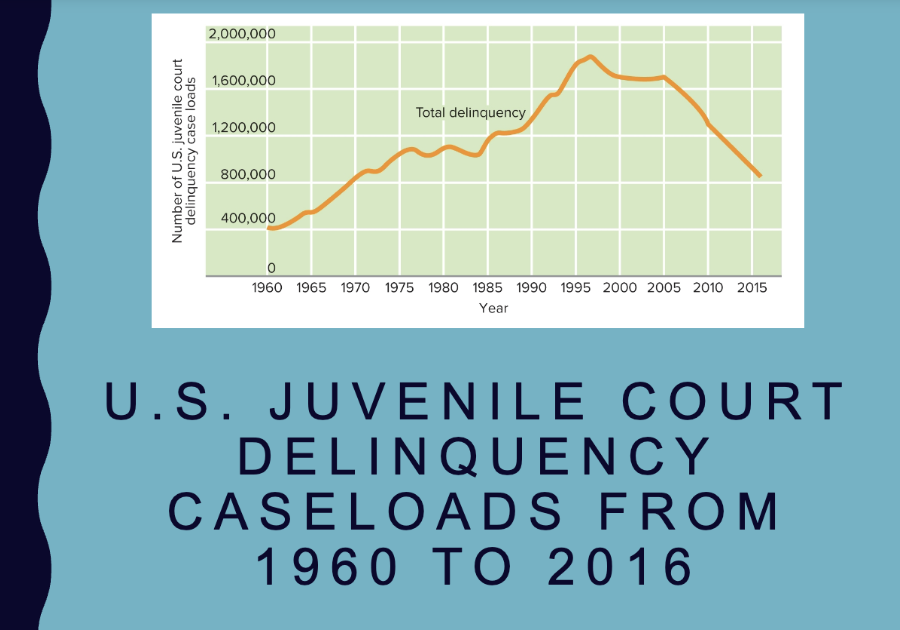
juvenile court delinquency caseloads have decreased — but the numbers do not include those who were arrested but not assigned to caselods, or those who committed offenses but were not caught
males are more likely to engage in delinquency than are females
theft, property damage, and physical aggression peak at 18 years of age
the peak for violence is 18 to 19 years of age for males, and 19 to 21 years of age for females
early-onset antisocial behavior (before 11) is associated with more negative developmental outcomes than late-onset (after 11)
Religion and Spiritual Development in Childhood
societies use many methods of religious socialization to ensure people will carry on a religious tradition
children usually adopt the religious beleifs of their parents
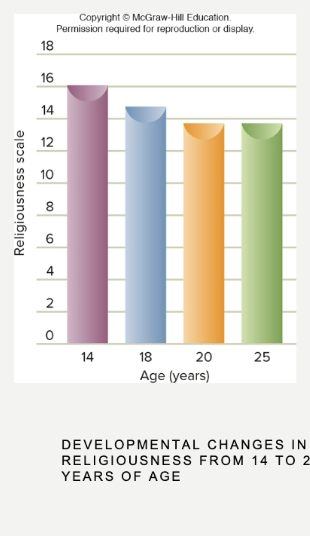
parents’ religiousness is positively related to adolescents’ own religiousness
Religious issues are important to many adolescents and emerging adults; nevertheless, a decrease in religious interest among millennials has occurred
there are vast differences between regions of the world
adolescence and emerging adulthood can be especially important developmental periods in religious identity and behavior
religion also plays a role in adolescents’ health and well-being
l