DNA, Genes and Chromosomes
DNA and Chromosomes
A diploid cell has 2 pairs of each chromosome
Homologous chromosomes have the same genes in the same location
Transcription is copying a gene (using it as a template) to make mRNA
Translation is when mRNA is being read by a ribosome to give the order of amino acids which are the primary structure of a protein
Non-Coding DNA
It exists between genes
They have multiple repeats; they do not code for a protein
Involved with gene expression; help turn on and off genes
The Genetic Code
DNA is combined with histones, and both of them together make chromatin.
A chromosome is 1 strand of DNA wrapped around a histone protein.
A gene is a short section of DNA that codes for a protein

3 bases code for a amino acid (codon)
Characteristics of the Genetic Code
Degenerate → many codons code for 1 amino acid
Universal → any ribosome from any organism can read it
Non-Overlapping → Each base is only part of 1 codon
The 4 Nitrogenous Bases
A=Adenine
C=Cytosine
G=Guanine
T=Thymine (DNA only)
U=Uracil (RNA only)
Splicing
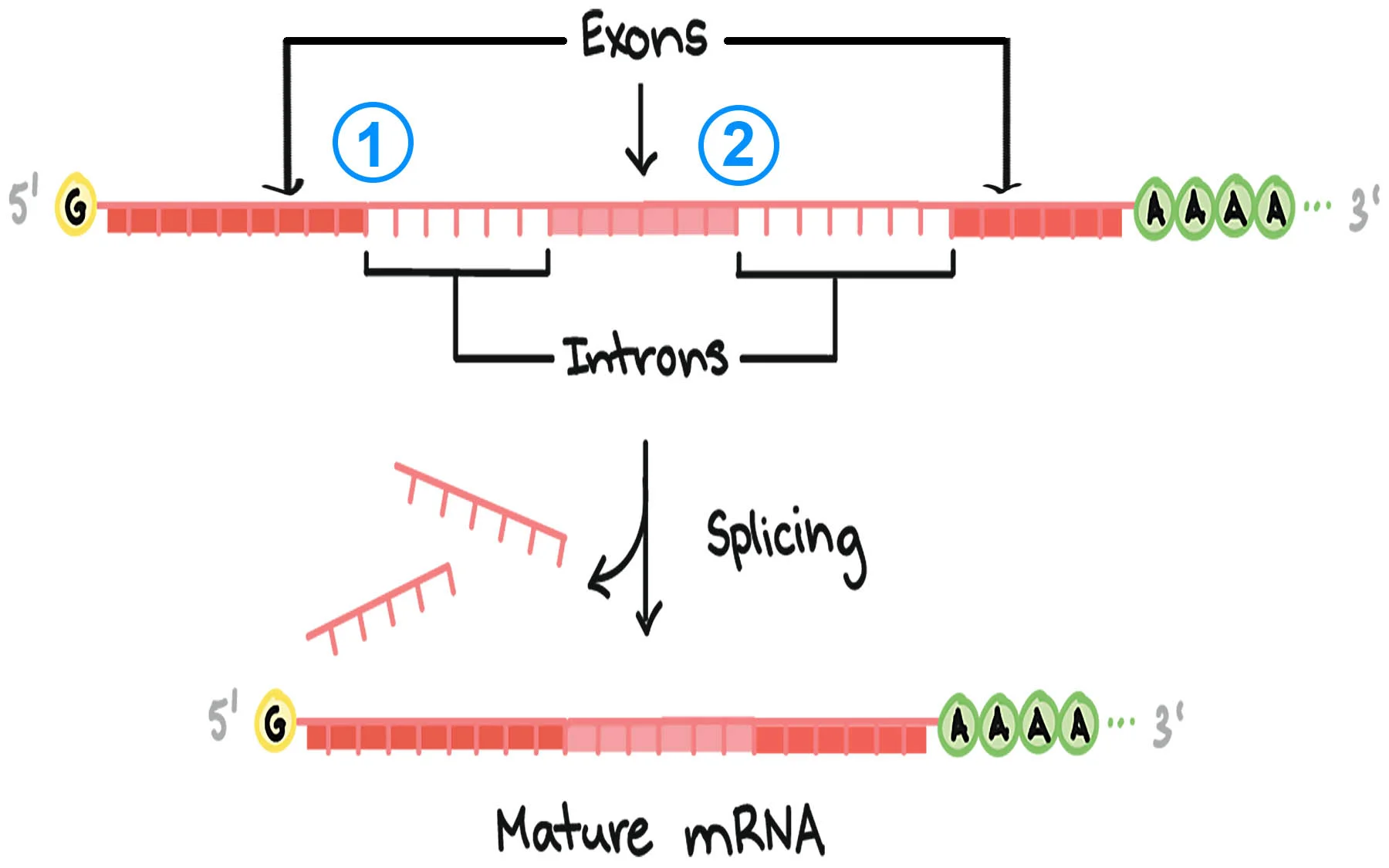
Non-coding DNA ca be in the middle of a gene
Coding sequences of genes are called “exons” while non-coding sequences of DNA inside a gene is called an intron
Splicing is the process where introns are removed and exons are joined together.
Differences in DNA between Nucleus and a Chloroplast
A chloroplast has no introns, while nucleic DNA has introns
A chloroplast has circular DNA while nucleic DNA is linear
A chloroplast has no histones in its DNA while nucleic DNA has them
Alternative Splicing
Making Proteins
Transcription
Transcription is the process of copying a gene's DNA sequence to make messenger RNA (mRNA) using the DNA as a template.
Transcription is under the control of RNA polymerase
RNA Polymerase moves along the template strand of DNA, beginning at promoter region
Free-floating complementary RNA nucleotides are joined together to form RNA
Thymine is replaced by uracil in RNA
When transcription is complete, mRNA strand leaves the nucleus via nuclear pores in the nuclear membrane
Translation
Translation is the biological process in which messenger RNA (mRNA) is decoded by a ribosome to synthesize proteins. During translation, the sequence of bases in mRNA is read in sets of three, called codons, each of which corresponds to a specific amino acid.
Translation occurs at a ribosome
Ribosomes can be free-floating in the cytoplasm or on the RER (Rough endoplasmic reticulum)
3 bases on the single-stranded mRNA is called a codon
3 bases code for 1 amino acid
tRNA molecule has an anticodon and an amino acid
tRNA
Has an amino acid binding site and an anticodon
Synthesising a Polypeptide
Transcription Initiation: RNA polymerase binds to the promoter region of the gene, unwinding the DNA strands to expose the gene sequence.
Transcription Elongation: RNA polymerase moves along the DNA template strand, adding complementary RNA nucleotides to the growing mRNA strand, replacing thymine with uracil.
Transcription Termination: RNA polymerase reaches a terminator sequence, signalling the end of the gene, and the mRNA strand is released.
mRNA Export: The processed mRNA leaves the nucleus through the nuclear pores and enters the cytoplasm.
Initiation of Translation: The ribosome attaches to the mRNA at the start codon (AUG). The tRNA with the corresponding anticodon carries the first amino acid (methionine).
Elongation of Polypeptide Chain: tRNA molecules bring amino acids to the ribosome according to the codon sequence on the mRNA. Peptide bonds form between amino acids, elongating the polypeptide chain.
Termination of Translation: When the ribosome reaches a stop codon on the mRNA, translation ends, and the completed polypeptide chain is released to fold into its functional protein shape.
Gene Mutations
Gene mutations can occur due to various factors, including environmental influences, errors during DNA replication, or inherited genetic changes, which may lead to alterations in the amino acid sequence of the polypeptide.
They can be beneficial, neutral or harmful.
Substitution Mutation
This type of mutation involves the replacement of one nucleotide in the DNA sequence with another, potentially resulting in a different amino acid being incorporated during protein synthesis.
In some cases, substitution mutations may lead to a silent mutation, where the amino acid remains unchanged, or a missense mutation, which results in a different amino acid that could affect the protein's function.
Deletion Mutation
A deletion mutation involves the loss of one or more nucleotides from the DNA sequence, which can lead to a frameshift if the number of nucleotides deleted is not a multiple of three, drastically altering the reading frame for protein synthesis. This results in a completely different sequence of amino acids being produced, potentially impacting the protein's structure and function.
Insertion Mutation
An insertion mutation, conversely, occurs when one or more nucleotides are added to the DNA sequence. Similar to deletion mutations, if the number of nucleotides inserted is not a multiple of three, it can also result in a frameshift, leading to an entirely altered amino acid sequence and potentially disrupting the protein's normal function. Both types of mutations can have significant biological consequences, including genetic disorders or increased susceptibility to diseases, highlighting the importance of precise DNA replication and repair mechanisms.
Types of Mutations
Silent Mutation
A silent mutation is a change in the DNA sequence that does not alter the amino acid sequence of the protein due to the redundancy in the genetic code. Despite the alteration at the nucleotide level, the resulting protein remains functionally unchanged, which often means that silent mutations are thought to have minimal physiological effects. However, some silent mutations can influence gene expression or splicing, illustrating the complexity of genetic regulation.
Missense Mutation
A missense mutation occurs when a single nucleotide change results in the incorporation of a different amino acid in the protein. This can affect the protein's function to varying degrees, potentially resulting in benign variations or, conversely, causing severe dysfunction, depending on the role of the affected amino acid within the protein structure.
Nonsense Mutation
A nonsense mutation happens when a nucleotide change creates a premature stop codon within the coding sequence. This truncation can lead to incomplete proteins that are often nonfunctional, significantly impacting the organism's phenotype and potentially leading to various genetic disorders.
How Mutations in the DNA Affect Function of Proteins
Randomly, a single base is substituted for another
This changes the base sequence of the DNA
The DNA is transcribed
In the nucleus
To produce pre-mRNA
Then the introns are removed and the exons are spliced together, through splicing
The mature mRNA produced has an altered codon
The mature mRNA moves via nuclear pores to the ribosomes, and attaches to one
The process of translation begins
A different tRNA is able to complementary base pair with this new codon
So, a different amino acid is brought to the polypeptide than normal
This gives a different primary structure to the polypeptide
As a result, the overall protein structure may be altered, potentially affecting its function and stability.
Active site is a different shape
This change can lead to reduced enzyme efficiency or complete loss of activity if the active site no longer accommodates the substrate effectively.