Week 1 Lecture
Lecture Part 1
Overview of what we’re looking at in class
Current Ling Theory
Phonetic, Morphology, syntax
First Language Acquisition
Sociolinguistics
How we actually use language
Data from Multiple Languages
Understanding Human Language
How we learn language in our daily lives
Objectives
think critically about language
know about areas of linguistics
develop methods to study language
Little Quiz
English DOESNT have five vowels (more)
There are about 6000 languages spoken today
Languages contain grammar!
Aint is a word
In sentence like i didnt see nobody two negatives cancel each other out
What is Linguistics → Scientific study of Language
Making observations
Forming hypotheses
Testing hypotheses
Revising Hypotheses
Develop Theory matching results
Here we are applying the scientific method
What is Language?
A lot of properties of language are subconscious
The language system runs on its own and you cant just stop understanding something
you can’t just stop yourself from understanding something
Two Approaches to Language Usage
Language is a Tool
A Tool for Communication
Meanings are made into sounds where the listener is able to make sense of the sounds into a meaning
Speakers can also encode meanings into hand shapes
Language is a Knowledge
You had a finite set of building blocks and rules
Can do this to create complex structures
You know how to use the knowledge of language and use it in the world (tell a story, make a person laugh)
We want to focus on characterizing the knowledge that we have
Unconscious Knowledge
Unconscious Knowledge in Language→ Expletive Infixation
Expletive Infixation: where an expletive is inserted in the middle of another word
Expletive: Think of it as a filler
We have intuition about the proper way to do expletive infixation such as where certain insertions could be
We were never taught how to do expletive infixation but we know how to!
We have a rule system that is unconscious and at play
Building Blocks and Rules
Phonetic: inventory of sounds in your language
we know what belongs and doesn’t belong
B is an English sound while H is a Spanish sound
McGurk Effect: We intuitively know the mouth shape of a particular sound
Video: perception of sound changes depending on the way the sound looks, an illusion, such as seeing the f movement on the mouth but bah is playing and interpreting FAH
Phonology: Understanding the sound patterns that are possible in your language
Ex. English words start with ‘tr’ but none with ‘rt’ → this is part of our English language
When know which sound patterns are not possible in our language
We know how the plural S is pronounced
Eels has the z sound and Caps has the ss sound why tho?
Part of our english knowledge is that we know when theres a difference between the sound
When we encounter a new word the knowledge system is at play despite never having encountered the word and never having actually memorized the word
Jean Berk Video → The Wug Test
People can make plural forms of novel words and sounds
Children could apply language rules to words they have never heard
he was about to make the plural forms and past tenses to words he never heard before
The same thing applies to a young child
The rule system of phonology applied to where the child knew how to apply it even to foreign words
Morphology (word structure)
Knowledge of the variety of words in your language
knowing the potential words
how to form complex and less complex words
Lexicon: mental dictionary of the words you know
it allows us to build more complex words such us getting talk and forming talked, talks, talking
We know that there are constraints on how a word can be built and when a form is ungrammatical
We know words that are not even in the dictionary
How do speakers create new words?
Speaker subconsciously analyze words and build phrases and sentences
We divided alcoholic in some way to form words like shopaholic and workaholic we did this subconsciously
We can use already existing words and combine them to form new ones
Syntax:
We know how to build good phrases and sentences
We know where to place certain adjectives in a sentence, this is subconscious
ex. all of the new stars are really solar systems but we cant say that all of the stars new are really solar systems
We know how to place the adjectives where the nouns are
We know where adjectives are places according to certain nouns
For specific we know the fixed order for specific sentences and we know that if they were placed in another order then it would be ungrammatical
Why do we share similar judgements about the grammaticality of these sentences? ( a similiar rule system)
Sematics:
You know how to assign meaning to words in a given sentence
The bear promised the monkeys to dance
The bear persuaded the monkey to dance
We know the individual meanings of words
* everything we just discussed is what knowledge of language is
What is not knowledge of language?
Reading and writing abilities don’t change the knowledge of language from a linguistic standpoint
historically a lot of languages are unable to be written and those individuals were unable to read it
Word History: this is because native speaker of the language may know nothing of the history of their language
Individuals still know how to use words without knowing the history of the word
No knowledge of the history of individual words
knowing history of language depends on external factors and is not associated with knowledge of language
Education: being a fully competent native speaks of a language is independent of your level of education
having more education doesn’t influence your knowledge of english
Two Types of Linguistic Knowledge
Linguistic Competence:
What you know in your mind
What you can do
Our systematic Knowledge of the building blocks
Linguistic Performance
What you actually do
what comes out of your mouth → limited to physical limitations such as slips of the tongue or being out of breath
Some limitations of what’s actually spoken but doesn’t directly affect one’s actual knowledge
Performance doesn’t effect our knowledge
Summary:
What you know about language is mostly subconscious
Phonetics (sounds)
Phonology( how sounds interact)
Morphology (word structure)
Syntax (sentence structure)
Semantics (how to interpret words and sentences)
Different kinds of linguistic knowledge
competence → our linguistic system
performance → what we actually do in the world
Lecture Part 2:
Features of language (set of properties that all human languages share)
Arbitariness
The relationship between a word and its meaning is arbitrary, the relationship between form and meaning is arbitrary → applies to sign language as well
Different sounds are used to name the same object across language
Certain objects have different sounds
It is impossible to guess the meaning of the word just from hearing the sound of the word across different languages
there is no relationship between word meaning and word pronunciation
There are some cases where it is not arbitrary such as through onomatopoeic words even then its not arbitrary cause sounds are different in different languages
ASL Example
You wouldn’t be able to guess the words just from the signs
Example of non-arbitrariness (kinda)
Onomatopoeic Words
woof woof, however they’re still arbitrary since you wouldn’t be able to guess the meaning of the sound across different languages
Language Creativity → Fundamental
The usage of language building blocks (sounds, words) to create an infinite set of novel sentences
Sentences can’t be memorized or learned by imitation
We can create and understand novel sentences without effort
Children also show this property by creating sentences that were not exposed to them in their environment
ex. they create ungrammatical sentneces that are not shown to them in their environment
There is no limit to how long a sentence can be
Universal Language → the set of universal properties possessed by all languages (laws)
The principles of structure that determine human language
All languages have a lexicon, phonetic system, phonological system, morphological system, syntax, semantics
All language have ways of…
forming questions
Negating an utterance
indicating when an action takes place
possessing a set of discrete sounds or gestures
We can find differences but they don’t go very deep, they’re more the same than they are different
We consider dogs different but they are still considered dogs
Development of Grammar (Language Acquisition)
Common Traits
All Children
Acquire the language of their language from their environment
Will acquire their language spontaneously
Show linguistic creativity
will pass through similar stages when building their grammar
babbling
babbling with specific sounds
single word utterances
two word utterances
Overgeneralization
Mostly acquire the language by age 5 (native speakers)
Shows that there is a strong biological component to language development/learning since this development in children usually occurs at the same time
Children development supports universal grammar
Language acquisition is also constrained due to this development
Small Summary of the Feature of Language
Properties
Arbitrariness
form and meaning
Linguistic Creativity
create and understand an infinite number of sentences
Universal Grammar
Languages are built from the same set of principles
Types of Grammar
Descriptive Grammar: Linguists description of model of mental grammar
The speakers grammar or the linguist grammar
the focus on what people actually say
describes how people actually talk
Doesn’t mean that all sentences are acceptable either
we will be focusing on this since we are making observations of language, how english speakers use their language
Prescriptive Grammar: Rules of grammar used by teachers
What the speaker’s rules should be!
Can you understand people when they break these rules?
You can but why are there correct forms
Prescriptive rules aren’t usually universal if you take into consideration the double negatives
in english double negatives are frowned up
in french/spanish it is accepted and is the norm
Kinda wrong because the rules don’t remain true for all languages
Prescriptive Rules: Double Negatives
Two negatives don’t make a positive because they were not intended to be interpreted that way in the first place
They don’t cancel each other out
You’re not supposed to use double negatives in english
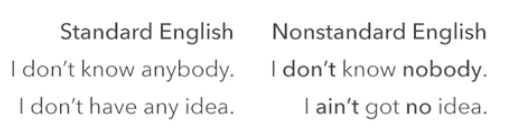
Spanish and some nonstandard varieties of English exhibit negative concord where you have to make the entire sentence negative
Double negatives aren’t really a problem and are used all the time
Double negatives are acceptable in other languages
Small Quiz
Acceptable sentences in Descriptive Grammar:
He dont like it
he doesnt like nothing
she is taller than me
you and me have been inivited to a wedding
these sentences are acceptable becasue they’re sentences that are actually used by native english speakers
Not acceptable
he it like dont
woman the ground on fell
these aren’t sentences that would be produced by native english speakers
Prescriptive Rules : Stranded prepositions
preposition is left at the end of the sentence, a rule
Examples
wheres the party at
thats the mechanic that i talked to
what did you buy this for
Under descriptive grammar we can end off sentences this way since it is the way we speak
There are some instances where is more grammatically correct to end off sentences this way
Summary (again)
We had universal properties of human language
Arbitrariness
creativity
they are structured by universal grammar
We looked at the differences between prescriptive and descriptive grammar
Prescriptive → what we should say
Descriptive → what we actually say
course focus, we make observations of language not on how it should be
Discovering the Human Language : Colorless Green Ideas
Beginning Questions:
How do you know so much from so little?
Common core of languages?
Questions are made about how we use language and how language fills the human mind
How there’s rules why we say things a certain way
Interactions with Language?
people don’t think a lot about language
There are rules about language that we have learned unconsciously
Language Portion of the Brain
Invariant to the rest of the species
3 Language Revolutions
Discovery that sound changes are regular → language reconstruction
the way we talk about language and the language itself
Languages are systematic and there are language rules
Chomsky, used the question what is a possible human language? and moved linguistics into looking at human potential of making sentence
You cant understand things that were never said before
shift the way we thought about language
Creativity in Language is Infinite
Words are like atoms
building blocks where you can take them together to form sentences
you can take them to form new words and theres no limit to the length of sentences
You can create an infinite number of sentences
Language System
starts with words
what is a word? → People struggle to define it
Possible Definitions
the smallest separate piece of language that can convey a meaning itself
can also be thought of being made of small units
a sequence of letters between two blanks
Words are made up of smaller portions
like kicked
There are words that don’t have meanings in other languages
A single word can be used instead of a sentence
How do we know word breaks between sentences?
A child is able to understand speech and break it apart into words
There are machines that aren’t able to do this, its hard for even the mind to do so
What is a concept?
The word Tree stands for a the concept of a tree
There are concepts that we are born with without knowing them
The box example, where children know that the marble inside the box is not near the box
Abstract concept since the child doesn’t know that the box itself is a surface
a concept is fixed by the mind
we know that the box has an interior regardless of whats inside of it
Unique Sentences:
Likely that a heard sentence is usually a unique one
Language is about putting words together to make a sentence
You have a large amount of possibilities of words to use to create a sentence which increase the likelihood of creating a new sentence
There is no longest sentence cause there is no limit in how long a sentence can be
The property that allows for creativity is the one that allows for a sentence to be put into a larger sentence
Short Sentences:
can be use over and over
can also be improbable
Syntax:
Rules used to create sentence but allow freedom when constructing them as long as you follow the rules
Sound and Meaning Getting Linked Together:
Grammar linked the two together
1st Task: Links words in a line one after another
Puzzles of Syntax: the form of the sentence is independent of its meaning regardless of what came first
We have to arrange it in a certain way to speak about it
We arrange a sentence in a way to make different points not in the order to why they came first
Arbitrariness:
The form of the sentence can be separated from meaning
“Colorless Green Ideas” is used as an example for this
Shows that syntax can be separated from semantics, shows that there more to a sentence than whether is makes sense or not
A sensible sentence makes sense if it follows the rules of syntax rather than if the words that are used make sense
Universal Grammar:
We inherit principle and processes of our language
Languages are very similar, we are actually more similar than we are different
Difference are trivial
Language Building
1. Relaying in the order of words to convey general words (english)
2. Changing the ending of words and shuffling them around (latin) (inflections)
Some language use a bit of both
Warlpiri (type 2)
All languages are sophisticated
Some languages, it doesn’t matter what the order the words are in the sentence will convey the same meaning
Language
Are examples of the same system , but are not the same same
Think of it like a human face that is created of the same features but are each unique, they are cut from the same fabric
How well is Language at completing its job?
There are limitations to language at conveying messages
Explaining what a spiral is
explaining what leafy is when mentioning that a tree is leafy
giving out direction verbally, it is better to write them out
Some thoughts are not expressible due to its structure and design
Gives capacities and limitations
Like a tool (a hammer) that is used for a purpose and prevents it from being used for another purpose
There are still useful things that we can do using language
Language is useful for thinking abstractly and conveying messages
We can express complete thought using language
System used to express our thoughts without any effort
Language is Arbitrary
Can be anything you want
the word itself doesn’t control the meaning
Allows us to give words to our thinking
using words might in some cases be better than gestures or images to express a certain thought
the thing and what you call the thing have nothing to do with each other
gives us the ability to think abstractly
make art
create
Concluding Thoughts
Language is simple for those who are evolved enough to use it
human brain is evolved to use the complex system in a simple way
A child will develop language from their environment as they do with the growth of their limbs
Language provides a gateway into the human mind
Language can be studied from many points of view
structure of words
structure of sentence
structure of connected discourse
Homework Article: Are Philly court reporters accurate with black dialect?
A defense attorney: Qawi Abdul-Rahman thinks that people don’t interpret sentence in their intended way
Such as “I don’t fool with them” being misinterpreted by someone who isn’t in the black community
There are also noted biases in the way african americans speak
The DA was right about there being misinterpretation as..
40% of sentences transcribed by court reporters have something wrong
67% has wrong paraphrasing
11% has gibberish translations
Phrases from the Test
The inaccuracy of translations and being misunderstood has implications for the justice system
African American English is associated with poor grammar
Still follows its own grammatical rules
Words in the dialect will act differently in comparison to mainstream English
Individuals believe/think they are being understood properly and don’t know that they’re not
There is a struggle to be understood since word distinctions of mood and tense are different than American English
ex. Tenses can be misinterpreted as the present tense instead of their intended past tense
Black Lawyers and court reports were able to more accurately understand/paraphrase what was being said
Court Impacts
Court reporters feel discouraged to ask for clarity when misunderstanding what was said
Misinterpretations could lead to pivotal changes in the justice system
such as correctly assigning an individual the proper counsel
Accurate transcriptions are dire
can change meaning → someone’s alibi
Societal differences can impact ability for comprehension
language variations is different amongst their communities
there is also the possibility of stigma discouraging individuals from adapting that language
Translations
There is a need for more educated court reporters
It is the attorneys job to properly translate those misconceptions by repeating their question to get more mainstream responses