PS219 - T2W6 - Brain Structure: "Female" and "Male" Brains?
OBJECTIVES
To gain a critical understanding of research into sex and gender differences
To understand the basic concept of hemispheric specialisation and its relation to sex and gender differences
To understand the basic paradigms of research into hemispheric specialisation
Part 1. Female and Male Behaviour
Brain & Behaviour
Some basic assumptions:
All complex behaviour depends on processes in the brain - Anything mnore complex than a simple reflex arc requires a ‘brain’.
Which processes a brain can perform depends on its structure (the braijn structures mediate the processes that occur within them):
different Systematically different structures give rise to
systematically different processes, resulting in
systematic behaviours - if there are systematic differences in the structures, this causes systematic differences in the processes that occur within them, then causing systematic differences in the behaviours exhibited.
Some further conclusions:
If two groups differ systematically in their behaviour, then this suggests corresponding differences in their brain structures
Systematic differences in male & female (sexual) behaviour suggest systematic differences between males’ & females’ brains (specifically: in those parts controlling sexual behaviour)
(BUT REMEMBER: ENVIRONMENT SHAPES BRAINS!) - example in rats, an isolated rat and a rat that had experience living with other rats within the same environment as them. The rat in the isolated environment had a cortex half the size of that of the rat that had experienced living with other rats.
(systematic differences refer to differences in behaviour that are observable across cultures and across time. E.g., applying this to humans, female behaviour in the UK now would not be the same as female behaviour 2000 years ago in Greece.
Systematic differences in male and female sexual behaviour??
Common Assumptions (examples only):
“Men are more attracted by physical signs of fertility than woman“
“Men have their first sexual experience at a younger age than women”
“Men have more sex than women”
Are any of these valid?
All of these studies are self-report-based
Social pressures can lead to biased values in the studies looking into the sex drives of both men and women.
The vast majority are Anglo-American
Recall: large inter-cultural differences in sexual behaviour!
Study on Swedish college students: results opposite to several of the above assumptions (Weinberg, Lottes & Shaver (1995), Archives of Sexual Behaviour, 24, 409-437)
This means that the common assumtions do not really line up with the truth about the sexual behaviours of humans.
Look at animal evidence first…
Part 2. Structural Differences – Animal Evidence
Mating behaviour: SDN-POA in rats (e.g., Paredes, 2003)
Behavioural: Sex-specific movements and postures during mating
Anatomical:
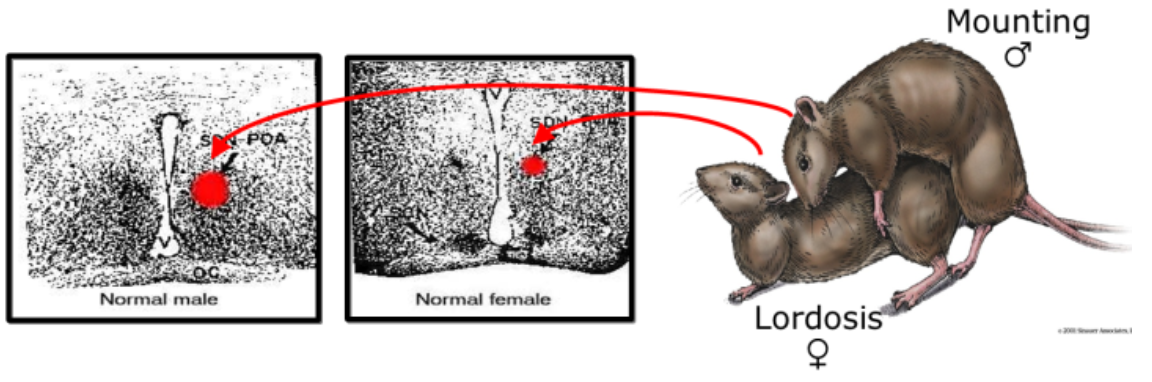
SDN-POA larger in males than in females
controls male-typical sexual behaviour
Empirical Evidence:
Measuring the electrical activity of this area - Male sexual activity increases the firing rate of SDN-POA neurons
Electrical stimulation of this area triggers male sexual behaviour
Volume of SDN-POA correlates directly with the level of sexual activity
Treat female rat embryos with androgens:
SDN-POA develops to male size (organisational effect)
male-typical sex. behaviour as adults (mounting behaviour) (only after androgen therapy -> activational effect)!
Courtship behaviour: HVC in songbirds
Behavioural: Singing is sex-specific (male-typical) behaviour
Anatomical:
In the songbird’s brain, some areas much larger in males than females
These are precisely the areas controlling song production (HVC)
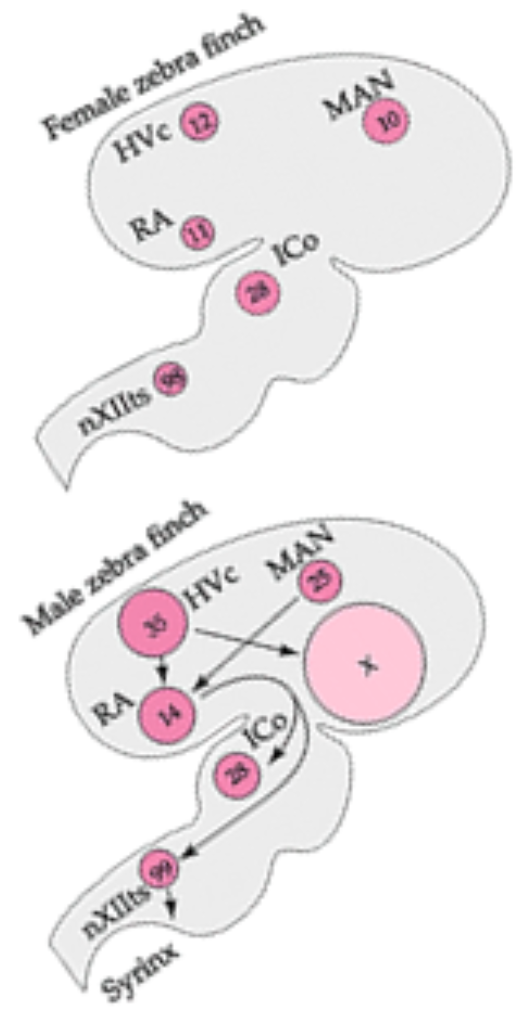
Experimental evidence:
Treat female hatchlings with sex hormones (androgens into the bloodstream, or estrogens directly into the brain – cf aromatisation hypothesis, lecture 3):
HVC develop to male-typical size (organisational effect)
This results in singing behaviour just like males
but only after androgen therapy (activational effect)
Sex Differences – Animals v Humans
In most animals, sexual behaviour is automatic:
Triggered by specific signals (whenever conditions are right)
These are generally controlled by ‘lower’ (non-cortical) brain areas (brainstem, midbrain, hypothalamic nuclei)
(empirical evidence: electrical stimulation of these areas and you will find the behaviour being displayed by the animal)
These behaviours are (relatively) sex-specific
(Relatively) uniform within each sex - the behaviour doesn’t change within the species
BUT: evidence for social learning of sexual behaviour even in rodents (recall lecture 4!)
In higher primates, sexual behaviour is even less automatic:
Less sex-specific - less clear to say that one behaviour is sex-specific to male or female monkeys
Less uniform within each sex - males and females have a variety of different sexual behaviours to exhibit
More under the control of ‘higher’ (i.e. cortical) brain areas (or so we like to think…) - less controlled by nuclei in the lower areas, e.g. brainstem
Human sex behaviour is most varied. → so most difficult to study.
Are there any other (more easily studied) differences between men and women?
Part 3. Non-Sexual Sex Differences
Potential areas of human cognitive sex differences:
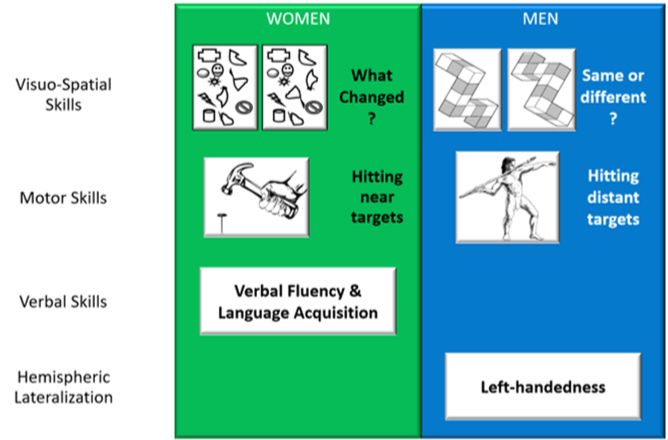
Are these differences ‘real’?
Very small!
Large role of culture, socialisation, learning:
Differences have become even smaller in recent years (e.g., Estes & Felker, 2011)
These differences are often context/experience dependent - females tend to do better in these tasks when the tasks are administered by a female experimenter than a male experimenter
Potentially instruction dependent - Wording of instruction affect the performance of the task.
At least for handedness and language development (and possibly some visuo-spatial tasks?), differences seem stable & similar across different cultures.
If these differences are therefore not as pronounced as they appear to be, then what exactly remains that is concrete?
It is found that only a few of these differences that are lasting and seemingly concrete are that left handness tend to be more present in men than in women, and that hitting distance targets is also more present in men than in women (but this is not really cognitive and is more physiological due to strength differences).
Part 4. Hemispheric Specialization
Different functional specialisation of the cerebral hemispheres - either side of the brain specialises in some tasks(“functional asymmetry”):
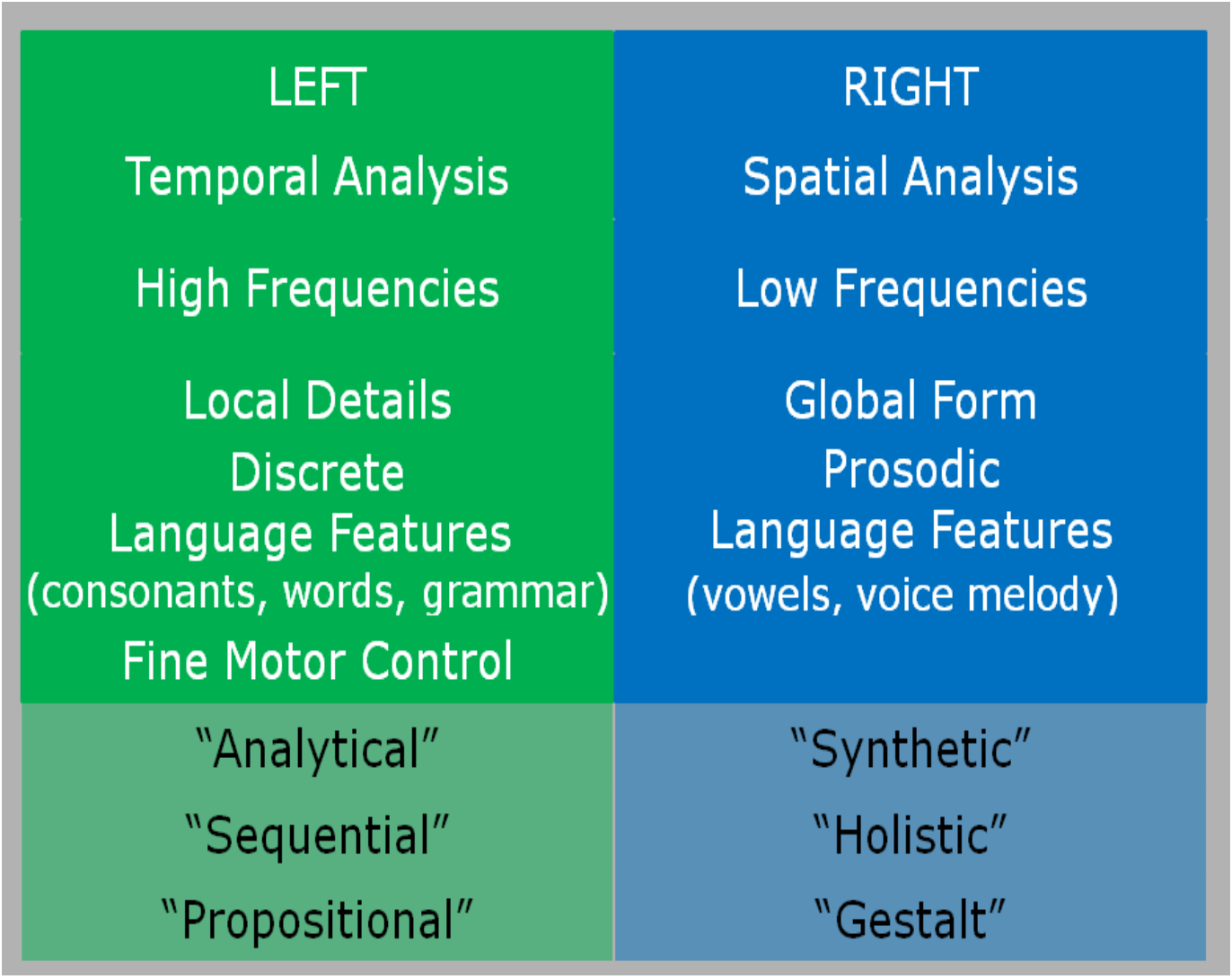
In the spatial domain, high frequency means rapid chang contrasts (rapidly changing from black to white to black to white and so on), whereas the low frequencies refer to slowly changing contrasts (an extended period of black, then an extended period of white, and then so on).
Discrete language features refer to consonants, whereas prosodic refers to vowels.
Empirical Evidence I: Invasive Procedures in Humans (not experimental - and is in the context of brain surgery where the brain surgery is required).
Wada test
Inject an anaesthetic into left or right internal carotid artery (to ‘knock it out’)
Assess each hemisphere’s language & memory functions with behavioural tests (e.g., picture naming)
Result (among others):
In most people, language functions almost exclusively in the left hemisphere
Split-brain surgery
Cutting the corpus callosum disconnects the hemispheres
Behavioural effects (examples):
patient cannot name objects presented in the left visual field, but can name objects presented in the right visual field
cannot name objects (without looking) by touching them with the left hand, but can name them when touching with the right (largely word processing and discrete language functions are done in the left hemisphere, and due to the brain and body operating contra-laterally, this means that when the two hemispheres are split, the right side of the brain does not have access to the language functions that the left does, resulting in the left hand not helping in naming objects because the right hemisphere of the brain just doesn’t have access to the words).
Empirical Evidence – Stimulation & Lesion Studies (experimentally induced only in animals!):
Electrical stimulation
Conducted during brain surgery
Stimulating particular areas interferes with particular tasks
For example, getting patients to talk while their brain has been exposed, and the professional will poke their brain in a specific area. When poking the brain in Broca’s area, the patient will stop talking. This is done to locate where this particular area of the brain is not in the exact same place for all patients, and the professional needs to know where it is for this particular patient in order for them not to damage key areas of the brain.
Lesion studies
Removal (partial or total) of one hemisphere
Behavioural tests to assess remaining functions
Patient studies (i.e., lesion studies)
Behavioural tests
Brain-imaging methods
Methods suitable for testing healthy participants:
Visual hemifield presentation (e.g., in a lexical decision task)
Dichotic listening (e.g., in the shadowing task) - participants wearing headphones hear nonsense syllables, and are then asked to repeat what they hear back. If the word enters the right hemisphere, reaction time will be slow, and if it enters the left hemisphere, reaction time will be fast. This is because of the contralateral wiring of the body. Right ear, left hemisphere, left ear, right hemisphere. Signals entering the right ear will enter the left hemisphere. This means that the word centres in the left side of the brain will be quicker in responding, as this is where the word centres are. The words entering the left ear will go to the left hemisphere, and will then have to communicate with the language centres in the left hemisphere of the brain, meaning the process is longer and thus reaction time is slower.
Part 5. Cognitive Sex Differences & Hemispheric Specialisation
Empirical Evidence – Sex-Specific Results:
Behavioural studies: 🚩🚩 (rewatch)
Women often show less behavioural asymmetry than men:
Especially at the end of the menstrual cycle (high levels of female sex hormones (estradiol & progesterone)
Brain-imaging studies:
Women ‘use’ both hemispheres in tasks where men ‘use’ mainly one hemisphere
(n.b.: ‘use’ = to show particularly highly correlated activity – obviously, the whole brain is used in each task!)
Clinical Evidence:
After a stroke, women recover language skills more quickly than men
Hypothesis: Women’s brains are less functionally lateralized:
More language functions in the right hemisphere (RH) than in men:
1. Women’s RH contains more language functions than men’s
Language processing of rVF words in LH, but language processing of lVF words (at least partially) in RH.
After a stroke, women can use remaining language functions in the undamaged hemisphere to ‘bootstrap’ speech
Right hemisphere less specialised for visuo-spatial task
Men outperform women in mental rotation tasks etc.
Possible reasons:
More equal development of both hemispheres in women? (go to 2)
Better interconnection of both hemispheres in women? (go to Part 6, 1.)
Galaburda-Geschwind Model🚩🚩
(Note: discussed here mainly because it’s historically interesting and shows what neuroscientists are looking for, not because it’s still believed to be correct!):
"Grand Theory“, integrating handedness - sex hormones - cerebral lateralization - cognitive skills and deficits - disorders of the immune system
Originally proposed in the early 1980s by Geschwind and Behan (Geschwind, N., & Behan, P. (1982). Left- handedness: Association with immune disease, migraine, and developmental learning disorder. Proceedings of the National Academy of Science, 79, 5097-5100)
Developed throughout the 80s by Geschwind and Galaburda (culminating in Geschwind, N., & Galaburda, A. S. (1987). Cerebral Lateralization. Cambridge, MA: MIT Press)
Today no longer discussed as a major model of cognitive differences
Hypothesis:
Pre-natal testosterone slows development of left hemisphere
Newborns’ brains differ due to pre-natal testosterone levels:
High levels (mostly boys): ‘asymmetrical hemispheres’ (LH less mature than RH)
Low levels (mostly girls): ‘symmetrical hemispheres’ (both hemispheres mature equally)
Evaluation:🚩🚩
Sex hormones influence brain development (at least in other animals)
But cognitive functions might not be as strongly localised! (this will make any model difficult to evaluate)
The model can account for
Larger number of male left-handedness
Superior visuo-spatial skills in men (e.g., mental rotation)
Faster language acquisition in girls
It cannot (directly) account for
Superior visuo-spatial skills in women (e.g., spatial memory)
Some special relationships between, e.g., visuo-spatial giftedness and reduced lateralisation
Part 6. Structural Sex Differences
Main candidates:
Overall brain size
Corpus Callosum🚩🚩
Corpus Callosum as a whole larger in women?
Splenium more bulbous in women?
Isthmus relatively larger in women?
Probably most frequently cited structural gender difference!
Mixed evidence – possibly only artefact? (e.g., Ardekani Figarsky, & Ssidtis, 2013, vs. Luder, Toga, & Thompson,2014)
Other candidate structures
Cortical:
Posterior temporal cortex: higher neuron density in women?
Temporal plane: larger size asymmetry in men?
Evidence as yet not totally convincing...
Sub-cortical candidate structures
INAH-3 of hypothalamus larger in men?
Summary:
As yet no clear evidence for gender difference in the anatomy of the forebrain
BUT: Anatomical differences might be too subtle to be detected easily & reliably!
Perhaps differences in local patterns of connectivity?
Or differences in the relative density of different neuron types in some brain areas?
Or differences at the level of neurotransmitter and receptor molecules?
Or we might be hunting for something that doesn’t exist…
The brain mosaic
Proposed by Daphna Joel and coworkers in 2015 (Joel et al. (2015). Sex beyond the genitalia: The human brain mosaic. PNAS, 112, 15468–15473)
Main findings of their study:
Several brain structures do show sex difference on average
But these differences are not distributed in an internally consistent way (i.e., in an individual’s brain, some of these structures might be female-typical, some male-typical, and some in-between):