16.4 Tropisms in plants
Plant growth responses to stimuli from one direction as known as tropisms.
The growth of plants in response to light which comes from one direction - phototropism
The response to gravity - geotropism
The response to chemicals - chemotropism
The response to touch - thigmotropism
Tropisms involve differential growth of plants cells triggered by chemical messages produced in response to a particular stimulus.
Tropisms as a response to environmental cues
To be able to make the maximum use of the environmental conditions, plants must grow and response to variations in those conditions.
For example, once a seed begins to germinate in the soil, the shoot and root must keep growing in the right direction if the developing plant is to survive. The shoot must grow upwards towards the light source for photosynthesis to take place, the roots must grow downwards into the soil which will provide support, minerals and water for the plant. The movements of the root and shoot take place in direct response to environmental stimuli. The direction is related to the direction in which the stimulus comes, these are examples of tropisms.
Much of the research on tropisms uses germinating seeds and very young seedlings.
They are easy to work with and manipulate as they are growing and responding rapidly, any changes show up quickly. Changes also tend to affect the whole organism rather than a small part (as with mature plant) and this makes nay tropisms much easier to observe and measure.
The seedlings of monocotyledonous plants - usually cereals like oats and wheat - are most commonly used as the shoot that emerges is a single spike with no apparent leaves known as a coleoptiles. It is easier to manipulate and observe than a dicotyledonous shoot. However, coleoptiles are relatively simple plant systems so it is important to remember that the control of the responses to light in a intact adult plant may be more complex.
Phototropism
Phototropisms are the results of the movement of auxins across the shoot or root if it is exposed to light that is stronger on one side than the other.
The basic model of the way plants respond to light as they grow was based on experiments where shoots were kept entirely in the dark or in full illumination.
If plants are grown in bright, all-round light in normal conditions of gravity they grow more or less straight upwards. If plants are exposed to light which is brighter on one side than another to unilateral light that only shines from one side, then the shoots of the plant will grow towards that, the lights and roots if exposed will grow away.
It helps to ensure that shoots receive as much all round light as possible, allowing for maximum amounts of photosynthesis to take place. Also, if the roots should emerge from the soil, they will rapidly turn back to the soil.
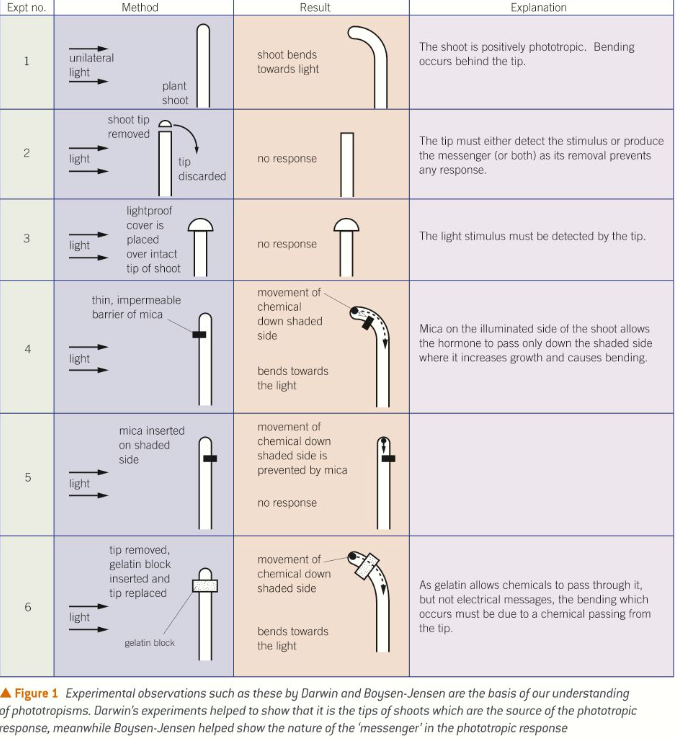
The effect of unilateral light
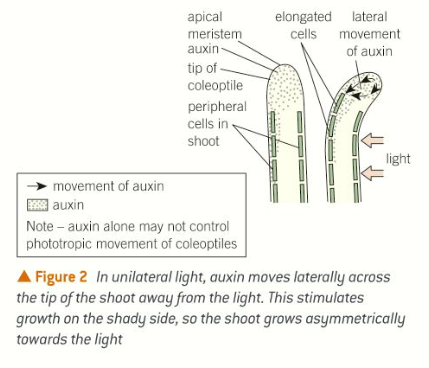
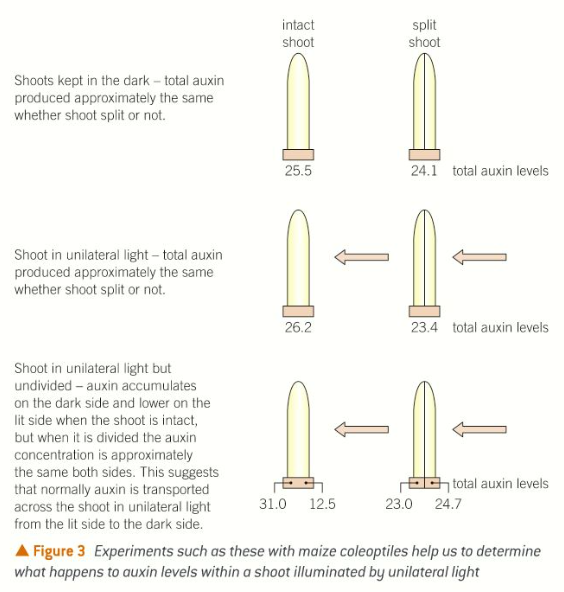
This shows the side of a shoot expose to light contains less auxin than which is not illuminated. It appears the lights causes to auxin to move laterally across the shoot, so there is a greater concentration on the unilluminated side. This in turn stimulates cell elongation and growth on the dark side, resulting in observed growth towards the light. Once the shoot is growing directly towards the light, the unilateral stimulus is removed. The transport of auxins stop and the shoot then grown straight towards the light.
Original theory - light destroyed the auxin, but this had been disproved by experiments showing that the levels of the auxin in shoots are much the same regardless of whether they have been kept in the dark or under unilateral illumination.
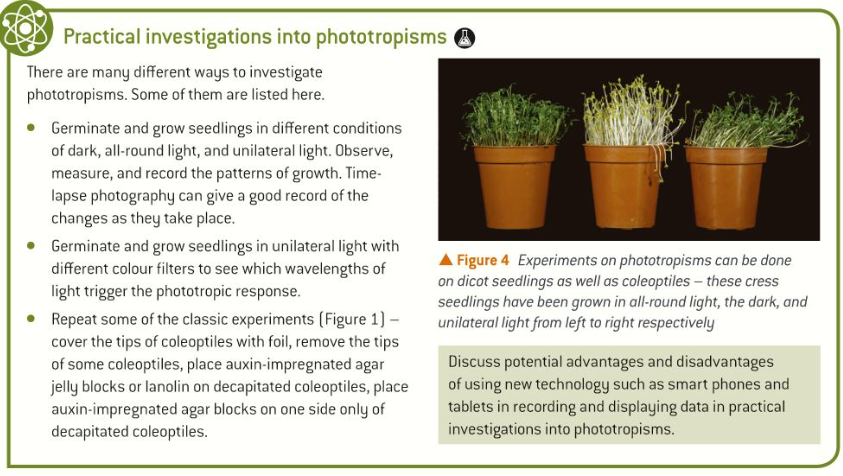
Growing in the dark
Fact of plants growing more rapidly in the dark than when they are illuminated can at first seem illogical. If a plant, however, is in the dark the biological imperative is to grow upwards rapidly to reach the lights to be able to photosynthesise. Th seedlings that break through the soil first will not have to compete with other seedlings for light.
Evidence suggests that it is gibberellins that are responsible for the extreme elongation of the internodes when a plant is grown in the dark.
Once the plant is exposed to light, a slowing of upwards growth is valuable. Resources can be used for synthesising leaves, strengthening stems and overall growth. Scientists have demonstrated that levels of gibberellin fall once the stem is exposed to light.
Gardeners sometimes use this response to force growth in plants - early rhubarb is famously grown in the dark sheds of Yorkshire. The rapid upward growth which takes place in a plant grown in the dark is known as etiolation. Etiolated plants are pale and thin - because they are deprived of light little chlorophyll develops in their leaves.
Geotropisms
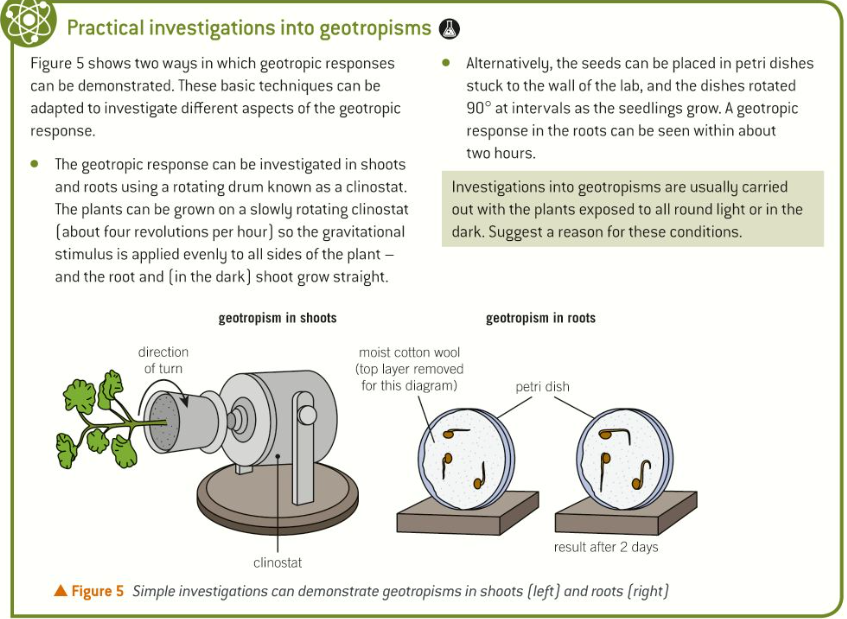
In normal conditions, plants always receive a unilateral gravitational stimulus - gravity always acts downwards. The response of plants to gravity can be seen in the laboratory using seedlings placed on their sides either in all-round light or the dark.
Shoots are usually negatively geotropic (grow away from gravitational pull) and the roots are positively geotropic (grow towards gravitational pull) This adaption ensures that roots grow down into the soil and shoots grow up to the light, Geotropisms are also known as gravitropisms.