AP Precalculus Unit 3
3.1 - Periodic Phenomena
Periodic Relationship - occurs between two variables when the output values demonstrates a repeating pattern over successive equal-length intervals. (Cyclical)
Period of a Periodic Function - the length of the x - values that it takes for the function to complete one cycle.
3.2 - Sine, Cosine, and Tangent
Standard Position - an angle is in standard position when its vertex is at the origin and one ray lies of the positive x - axis
Terminal Ray - the second ray of an angle in standard position
Sine, Cosine, and Tangent
Sin -
The ratio of the vertical displacement of P from the x - axis to the distance between the origin and point P.
Cos -
The ratio of the horizontal displacement of P from the y - axis to the distance between the origin and point P.
Tan -
The slope of the terminal ray - the ratio of the vertical displacement to the horizontal displacement of P
or
where point P is where the terminal ray intersects the circle.
Radian Angle Measure
Positive angles - counterclockwise direction
Negative angles - clockwise direction
Measuring Angles
arc length / radius radians
Arc length can be found by using circumference
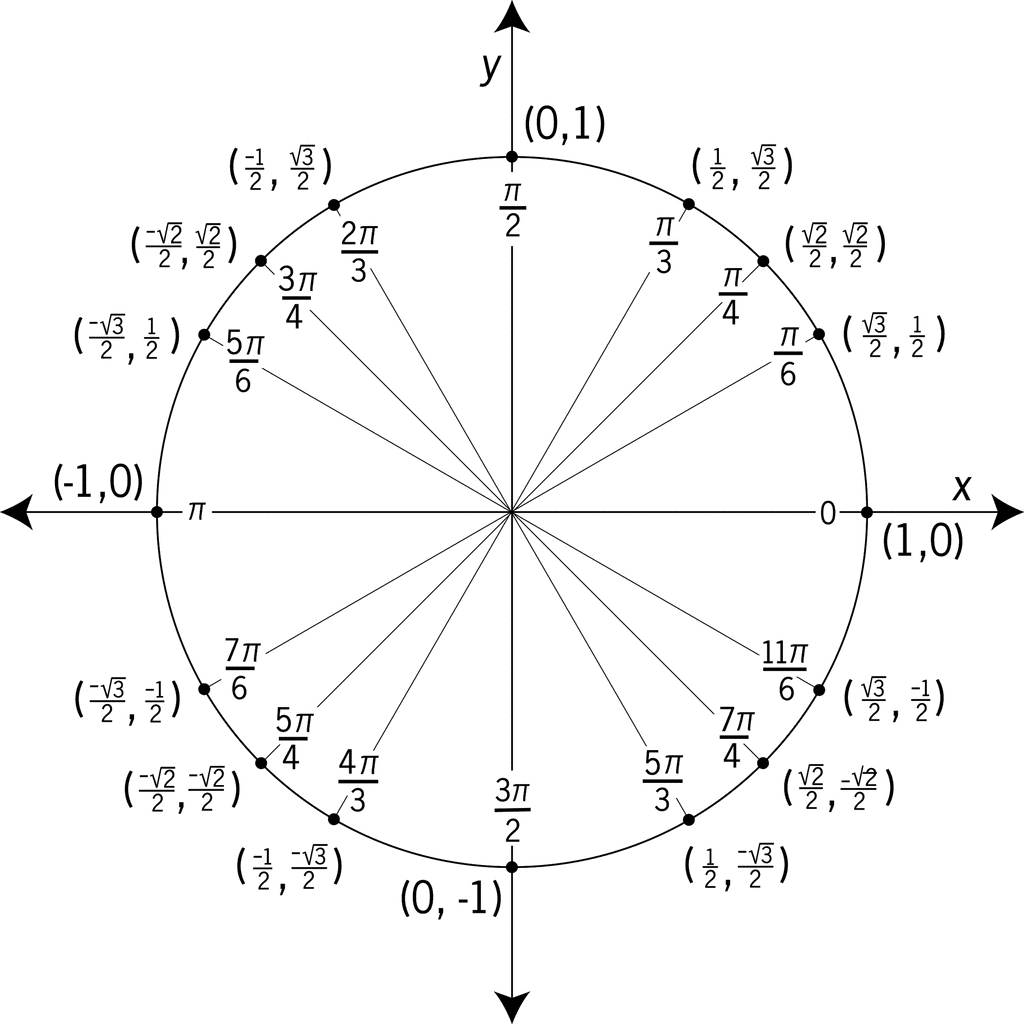
Unit Circle
Radius is 1
Sine and cosine values of an angle are simplified
sin = y
cos = x
3.3 - Sine and Cosine Function Values
The coordinates of a point where a terminal ray intersects a circle will be
Finding Sine and Cosine Function Values
when working with the unit circle, pythagorean theorem can be used to find the x/y-coordinate or a point when already knowing the other coordinate
3.4 - Sine and Cosine Function graphs
Properties of the graph for
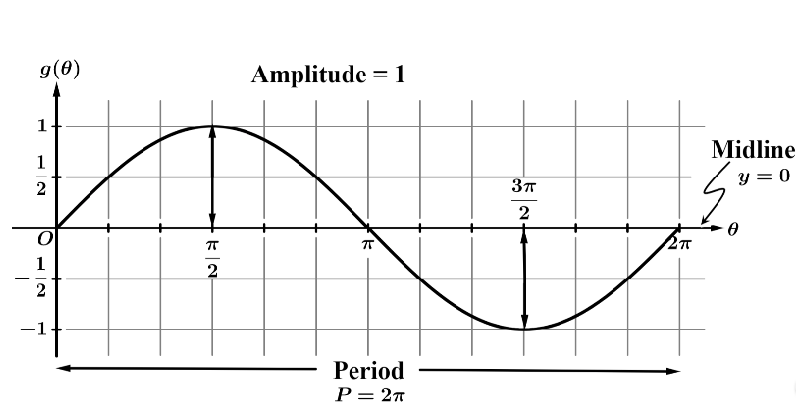
Midline - halfway between the max and min values
y = 0
Amplitude - distance from the midline to the max or min
a = 1
Period
P = 2
Frequency - the reciprocal of the period
Properties of the graph for
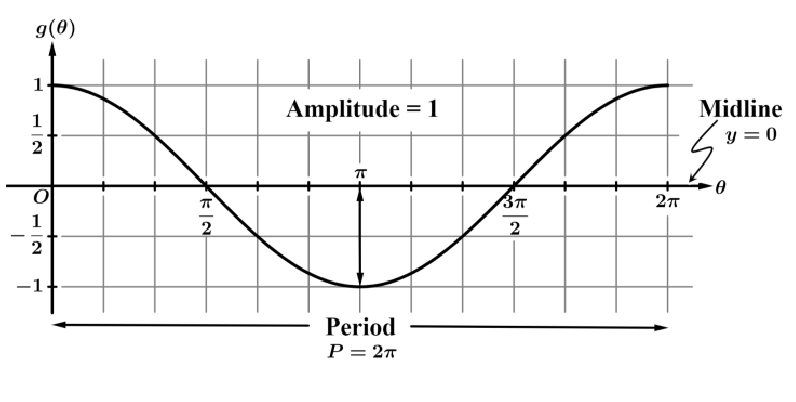
Midline - halfway between the max and min values
y = 0
Amplitude - distance from the midline to the max or min
a = 1
Period
P = 2
Frequency - the reciprocal of the period
3.5 - Sinusoidal Functions
any function that involves additive and multiplicative transformations of
both sine and cosine functions are sinusoidal functions because
3.6 - Sinusoidal Function Transformations
using either function or the graphs will have the following transformations:
Vertical Dilation by a factor of (amplitude of the graph)
Vertical Translation by units (midline of the graph)
Horizontal Dilation by a factor of (period is given by)
Phase Shift of a Sinusoidal Function
horizontal translation of a sinusoidal function by units
Parent Functions
cosine is an even function, with reflective symmetry over the y - axis
cosine is a transformation of sine to the left
sine is an odd function, with rotational symmetry about the origin.
3.7 - Sinusoidal Function Context and Data Modeling
literally just interpreting properties of a function to make construct a sinusoidal model
3.8 - The Tangent Function
, gives the slope of the terminal ray
as long as
at and there is a vertical asymptote
Properties of the Tangent Function
vertical dilation by a factor of
Period
Phase shift of units
Vertical Translation by units
3.9 - Inverse Trigonometric Functions
Sine Function
Trig Function
Domain:
Range:
Inverse Trig Function
Domain:
Range:
the range must be restricted or else the inverse is not a function
Graphs:
Cosine Function
Trig Function
Domain:
Range:
Inverse Trig Function
Domain:
Range:
the range must be restricted or else the inverse is not a function
Graphs:
Tangent Function
Trig Function
Domain: when where is an integer
Range:
Inverse Trig Function
Domain:
Range:
Writing Inverse Functions
Switch the domain and the range
Sometimes you must restrict the domain
3.10 - Trigonometric Equations and Inequalities
Writing the General Solutions to a Trigonometric Equation
, where is an integer
, where is an integer
, where is an integer
, where is an integer
, where is an integer
Solving Trigonometric Equations
Isolate the trigonometric functions on one side of the equation
Find the corresponding angle measures on the unit circle that satisfy the given equation
Consider any domain restrictions in the problem
Write the solution and/or general solution
Solving Trigonometric Inequalities
Set f(x) = 0 and solve for x
Create a sign chart with the solution from step 1, include any domain restrictions
Test a value in each of the intervals
Label the remaining intervals as positive or negative
Interpret the sign chart to answer the inequality
3.11 - Secant, Cosecant, and Cotangent Functions
Reciprocal Functions
Cosecant
, where
vertical asymptote at where is an integer
Secant
, where
vertical asymptote at where is an integer
Cotangent
, where
, where
vertical asymptote at where is an integer
3.12 - Equivalent Representations of Trigonometric Functions
The Pythagorean Identity and Equivalent Forms
Trigonometric Identities
Sum and Difference Identities
(-+ means - or +, vs + or -)
Double Angle Identities
3.13 - Trigonometry and Polar Coordinates
*WHEN USING POLAR GRAPHS MAKES SURE CALCULATOR IS ON POLAR GRAPH*
Polar Coordinates -
- radius of the circle
- angle in standard position whos terminal angle includes the point
Converting from Polar to Rectangular Coordinates
and
Converting from Rectangular to Polar Coordinates
and
Complex Numbers
rectangular coordinates →
polar coordinates →
Converting Rectangular Complex Numbers to Polar Form
Converting Polar Complex Numbers to Rectangular Form
3.14 - Polar Function Graphs
Circles
positive - opens right
negative - opens left
Cycle:
positive - opens up
negative - opens down
Roses
starts on the polar axis
is odd - = # of petals
cycle:
is even - 2 = # of petals
cycle:
Limaçon
or
- Cardioid
distance from origin will be a + b
height will be = a
, Dimpled Cardioid (one loop limaçon)
a + b is distance from origin
point at origin will be shifted by a - b
height will be = a
- Inner Loop Limaçon
b - a will be inner loop
same rules as the cardioid
3.15 - Rates of Change in Polar Function
Distance from the Pole
r is positive | r is negative | |
is increasing | increasing (further away) | decreasing (closer) |
is decreasing | decreasing (closer) | increasing (further away) |
Average Rate of Change
the rate of change for is given by
to find a point using the rate of change use the following equation _ roc ( _ )