Judges: Abimelech to Samson
Gideon Defeats Zebah and Zalmunna
The men of Ephraim were upset that they had not been called out when Gideon went against the Midianites. Gideon told them that they had done a great thing by capturing the princes of Midian. This calmed them down.
Gideon and his three hundred men crossed the Jordan River and came to Succoth. There, Gideon asked the men of Succoth for bread for his army. He told them that they were chasing Zebah and Zalmunna, the kings of Midian. The men of Succoth taunted Gideon and asked why they should give bread to his army since he did not have Zebah and Zalmunna. Gideon became angry and said that when he did capture Zebah and Zalmunna, he would return to beat these men of Succoth with thorns and briers. Gideon then went to Penuel, and they gave him the same answer. He told them that he would tear down their tower when he came back through there.
Zebah and Zalmunna were in Karkor, and Gideon attacked them. Gideon captured Zebah and Zalmunna, and the Midian army panicked. When Gideon returned from battle, he came across a young man from Succoth and captured him. After questioning the man, Gideon obtained a list of Succoth's officials and elders. There were seventy-seven men on the list. When Gideon returned to Succoth, he beat the men with briers and thorns—just as he had said he would—and in Penuel, he tore down the tower and killed the men.
Gideon asked Zebah and Zalmunna the location of the men they had killed at Tabor. They answered that all of the men had looked like Gideon and resembled the son of a king. Gideon told his two captives that these men were his brothers and that if they had saved these men, he would have spared them. Gideon then called Jether, Gideon's oldest son, to kill the men. However, Jether was still young and did not draw his sword. So, Gideon killed Zebah and Zalmunna and took the crescent-shaped ornaments from their camels.
The men of Israel called for Gideon and his sons to be their rulers. Gideon told them that their ruler was God. Gideon instructed the men to give him all their captured earrings, and he added in the gold from the kings and the cloaks and made an ephod (a type of apron worn by Jewish priests). The land was at peace for forty years.
Gideon Dies and Abimelech Rises
When Gideon died, he had seventy sons by many wives and other women. Around this time, the people of Israel returned to the worship of the Baals and made Baal-berith their god. They forgot God and did not show love to Gideon's family.
Gideon had a woman in Shechem who bore him a son named Abimelech. Abimelech went to Shechem and asked the people there if it was better to have the seventy other sons of Gideon rule over them or to have him rule over them—especially since he was from Shechem. They gave Abimelech money, and he used it to hire some men. They went to his father's house in Ophrah and killed all seventy of his brothers except Jotham, Gideon's youngest son, who hid. All of the leaders of Shechem came together and made Abimelech king.
Jerubbaal is another name for Gideon in the Bible. This lesson will use Gideon to avoid confusion.
Jotham's Curse and the End of Abimelech
Jotham went to Mount Gerizim and cried out to the leaders of Shechem. He compared the rise of Abimelech to trees wanting to elect a ruler. In this scenario, most of the trees refused the position of king over the other trees, but the bramble said that if the trees were making it king in good faith, then its shade would protect the other trees. If not, a fire would come out of it and consume the trees.
Using this analogy, Jotham said that if the people had acted in good faith when they made Abimelech king and had not forgotten all that Gideon had done for them, then it was not a problem to kill seventy of Gideon's sons and make the son of Gideon's servant a king because he was kin to them. However, a fire should consume them if they had not acted in good faith. After he said this, Jotham ran away to Beer to live.
Abimelech was king over Israel for three years. After those three years, God sent an evil spirit to divide Abimelech and the leaders of Shechem. The leaders of Shechem plotted against Abimelech. They set up an ambush for him. A man named Gaal came into Shechem and took over. He asked why Abimelech should lead the people. Another man, Zebul, overheard this, sent word to Abimelech, and told him what Gaal had said. Zebul told Abimelech that he should ambush Gaal when he came out of the city.
Zebul was with Gaal as they stood at the gates. Gaal saw Abimelech's attack coming from the mountain, but Zebul assured Gaal that it was just shadows. Gaal then became certain that he saw people coming from other directions, but it was too late. Gaal was killed, and his relatives were thrown out of Shechem. Abimelech was told that the people of Shechem were in the field, so he attacked them and fought all day. He destroyed the city and killed all that were within. When the Tower of Shechem leaders heard about this, they went to the house of El-berith. Upon finding this out, Abimelech gathered kindling to make a fire and told his men to do the same. He started the fire, and it killed all of the people of the Tower of Shechem.
Abimelech then went to Thebez and captured it. There was also a tower in that city. Abimelech approached the tower to burn it, just as he had done in Shechem, but a woman threw a millstone down from it, hitting him in the head. As he lay dying, Abimelech told his armor-bearer to kill him so that it would not have been a woman that killed him. The young man stabbed him with his sword. Abimelech and the people of Shechem had their evil returned full circle, and the curse of Jotham was fulfilled.
Tola, the Sixth Judge
Tola was the sixth judge of Israel. He lived in Shamir. He was a judge for twenty-three years. He died and was buried at Shamir. There is nothing else in Scripture about his time as a judge.
Jair, the Seventh Judge
After Tola, Jair from Gileadite, the seventh judge, arose. He had thirty sons who rode donkeys, and they had thirty cities. Jair died and was buried in Kamon.
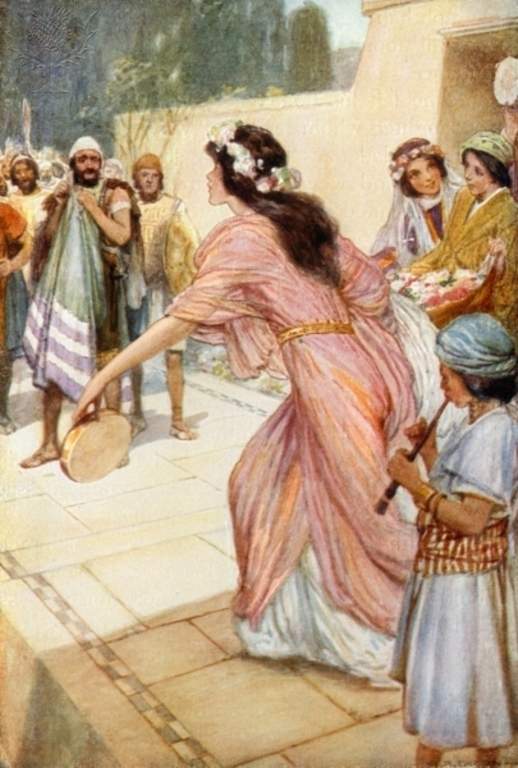
Jephthah, the Eighth Judge
The people of Israel worshipped false gods again and again. They made God angry. As a punishment, God gave them over to the Philistines and the Ammonites. These nations oppressed Israel, and the people cried out to God. He heard them and sent Jephthah the Gileadite. Jephthah was a great warrior, but he was also the son of a prostitute. When he grew up, his brothers threw him out of his father's house, and he fled to the land of Tob. There, Jephthah hung around worthless men.
The Ammonites attacked Israel, and the elders of Gilead went to Jephthah and implored him to lead them. He asked them how they could want him now after throwing him out. Jephthah cautioned them that if he were to come back and beat their enemy, then he would be head over all of Gilead. The elders swore an oath to this, and Jephthah returned with them.
Then, Jephthah sent a message to the king of the Ammonites. He asked why they were attacking him. They sent a message saying that the Israelites had come from Egypt and taken their land. Jephthah sent back a message telling the king of the Ammonites about how the Israelites came into possession of the lands they had and that God had given the lands to them. The Ammonite king did not listen to the message.
One day, Jephthah made a vow to God that if he won against the Ammonites, he would make a burnt offering out of whatever first came through his front door when he returned home. Jephthah and his army defeated the Ammonites, and he returned home. Upon his return, his only child, a daughter, came out the front door to greet him. Jephthah was anguished by what he had said. His daughter, however, told him that he must do as he had sworn to God. She asked that she be allowed to weep for two months, which she did. When she returned home, Jephthah kept his tragic promise and made a sacrifice for her.
The tribe of Ephraim was upset because Jephthah did not call on them when he attacked the Ammonites. They told him that they would burn his house. Jephthah replied that they did not come when he called upon them. He said that when they did not come, he took matters into his own hands, and God gave victory to him. They fought with each other, and 42,000 Ephraimites died. Jephthah judged Israel for six years before he died and was buried in Gilead.
Ibzan, the Ninth Judge
Ibzan came from Bethlehem. He had thirty sons and thirty daughters. He judged Israel for seven years. He then died and was buried in Bethlehem.
Elon, the Tenth Judge
Elon was the tenth judge. He judged Israel for ten years. He died and was buried in Aijalon.
Abdon, the Eleventh Judge
Abdon was the eleventh judge. He had forty sons and thirty grandsons. He judged Israel for eight years. He died and was buried at Pirathon.
Samson, the Twelfth Judge
The Israelites did evil again, so God gave them to the Philistines for forty years. During this time, there was a man named Manoah whose wife could not have children. An angel came to her and told her that she would have a son. She was instructed not to drink wine or strong drinks or eat unclean food. She could never cut her son's hair. The angel said that her son would save Israel from the Philistines. She told her husband they wanted to know what to do with the child. They returned to the angel, who said the child was to be raised as a Nazarite. Manoah offered the angel food, but the angel declined and told Manoah to make an offering to God, so he did. He did not know that this was an angel. When he made the offering, the angel went toward heaven in the altar's flame. Upon witnessing this, Manoah and his wife fell on their faces.
The angel did not come again. The woman had a son and named him Samson. When Samson had grown into a young man, he saw a Philistine woman in a place called Timnah, and he asked his father and mother for her. His parents asked him if there was a woman that was not a Philistine that he would want instead, but he told them that he only wanted the Philistine woman.
One day, in Timnah, a young lion attacked Samson, and he tore it apart. He told no one about this. He spoke with the Philistine woman, and she remained who he desired for his wife. Soon after, he returned to get the woman and saw the carcass of the lion he had killed. There was now a nest of bees in it, and they had made honey. He scraped out the honey and ate it. He took some to his parents, and they ate it as well. He did not tell them where he had gotten the honey.
Samson's father came down to get the woman for his son, and Samson prepared a feast. During the feast, he told the people there that he would give them a riddle, and if they could answer it, he would give them clothes. If they couldn't answer it, they would give him clothes instead. He made up a riddle about the honey and the lion. The woman's family told her to find out the answer to the riddle. Eventually, she did, and she said her family. When they told Samson that the answer was honey and a lion, the spirit of God came down on him, and he killed the thirty men that had solved the riddle. The woman was given to Samson's friend by Samson's father-in-law.
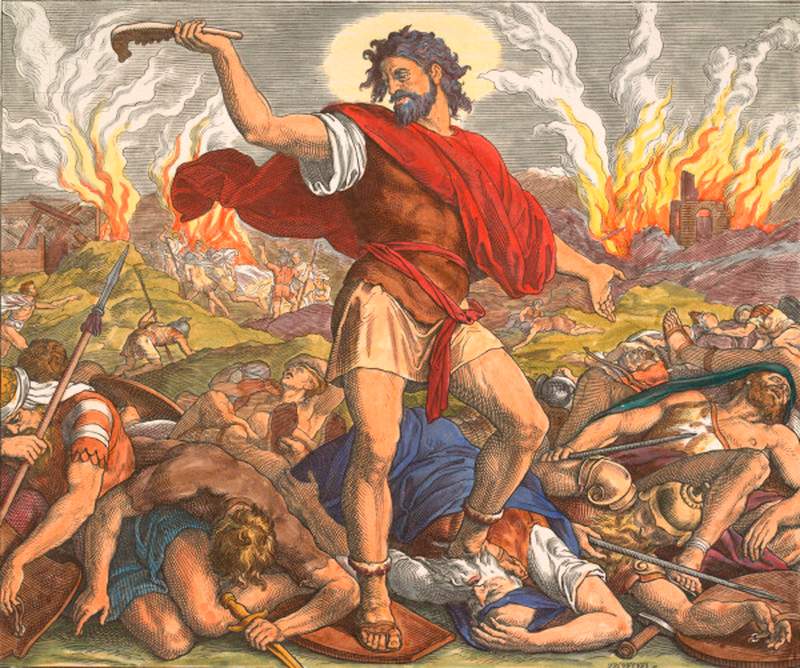
Samson and the Jawbone of a Donkey
Samson told his father-in-law that he was going to see his wife, but her father told Samson that he thought Samson hated her, so he gave her to Samson's friend. In anger, Samson then took three hundred foxes, tied them tail to tail, placed torches between each pair of tails, lit them, and sent the foxes running into the Philistines' fields and olive orchards. The Philistines came and burned the woman and her father.
Three thousand men of Judah came to bind Samson so that they could turn him over to the Philistines. He let them bind him, and they gave him to the Philistines. At this time, God came down and turned Samson's bindings into flax, and Samson broke them. Samson then picked up the jawbone of a donkey and struck down a thousand Philistines with it. After this, he called God, telling God he was thirsty. God split open a hollow place, and water came out. Samson judged Israel for twenty years.
Summary
This lesson begins with a continuation of the story of Gideon, in which he defeats Zebah and Zalmunna. The men of Ephraim were upset because Gideon did not ask for their help. Gideon went to Succoth and Penuel to get bread for his men, and the people there mocked him since he had not yet captured Zebah and Zalmunna. He promised retribution—and ultimately, he carried out that retribution.
Abimelech, one of Gideon's sons, rose to power by killing all of Gideon's other sons (all but one, Jotham). Jotham cursed Abimelech, and eventually, that curse came true when Abimelech's family turned on him, and they were all destroyed.
Israel was oppressed once again because the people returned to their evil ways. Jephthah rose to be a judge and helped free Israel. He had promised God that he would offer whatever came through his door as a burnt offering when he returned from battle (if he were victorious). Horrifyingly, his daughter became that sacrifice.
There were other judges mentioned, but it was the last judge, Samson, who killed a lion with his bare hands. He killed a thousand Philistines with the jawbone of a donkey in retaliation for the way they had wronged him.

Application and Reflection
Application
Samson made many choices. Some were good, and some were bad. He was looking for someone to love, and he made some poor decisions and ended up being used. We should all evaluate our relationships to see if they are healthy.
Reflection
When young people and adults enter into relationships, they must ensure that their relationships are healthy. If a relationship was unhealthy, would you end it before it worsened?