Respiration
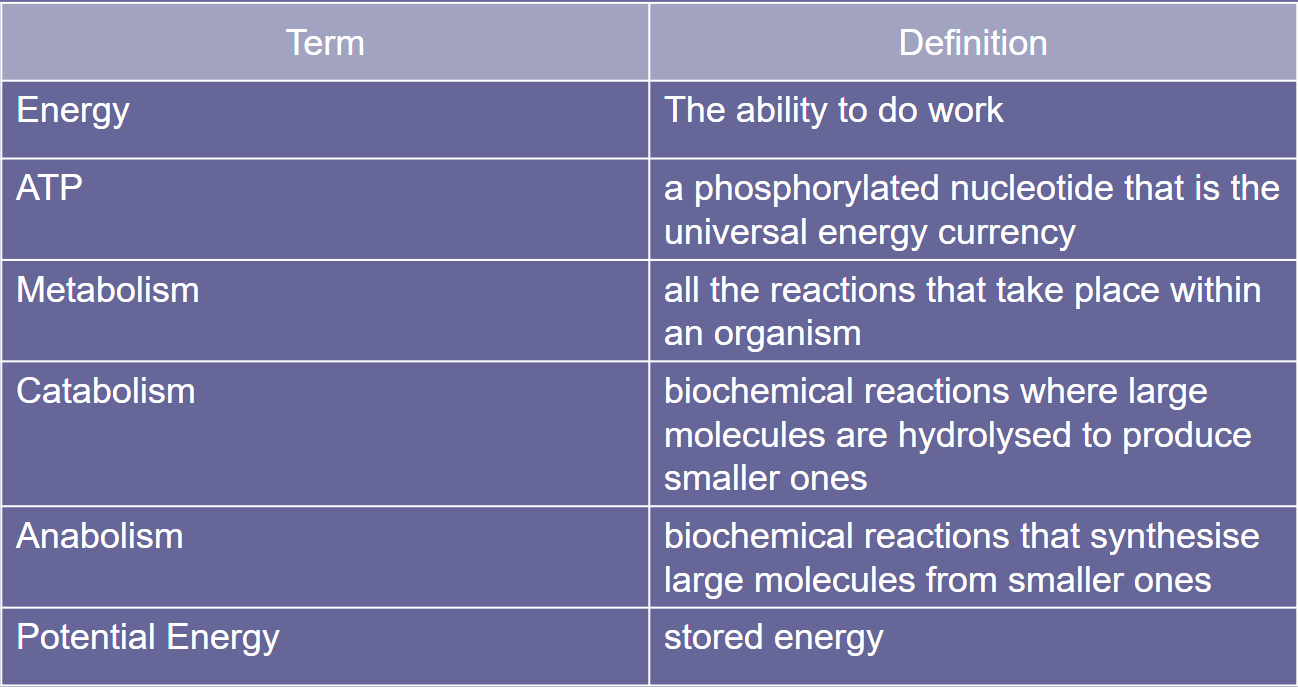
Respiration - the process whereby energy stored in complex organic molecules is used to make ATP
Respiration in synthesising ATP
ATP formation is anabolic
small molecules are built up into larger ones using an input of energy
regeneration of ATP
substrate-level phosphorylation
direct transfer of a phosphate group from a donor molecule to ADP
substrate-linked reaction
ATP is made using energy provided directly by another chemical reaction
chemiosmosis
using the movement of protons across a membrane to drive ATP synthesis
Coenzymes
needed to transfer protons, electrons, and functional groups between molecules
many of the reactions in the stages of respiration involve redox reactions
coenzymes are reduced
NAD and FAD
NAD | FAD |
used in all stages of respiration | only used in Krebs cycle |
accepts one hydrogen | accepts two hydrogens |
NADH is oxidised at the start of ETC | FADH2 is oxidised further along the ETC |
NADH leads to the synthesis of 3x ATP | FADH2 leads to the synthesis of 2x ATP |
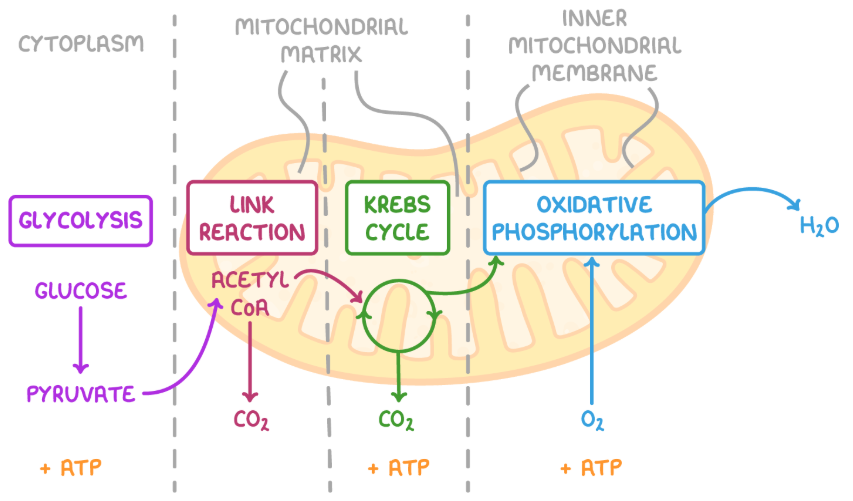
Aerobic cellular respiration - 4 distinct stages
Stage | Location | Main process | Main products |
| cytoplasm | breakdown of glucose into pyruvate molecules | per glucose molecule: 2 ATP, 2 reduced NAD, 2 pyruvate |
| mitochondrial matrix | conversion of pyruvate into acetyl CoA | per pyruvate molecule: 1 acetyl CoA, 1 reduced NAD, 1 CO2 |
| mitochondrial matrix | series of reactions starting with acetyl CoA | per acetyl CoA: 1 ATP, 3 reduced NAD, 1 reduced FAD, 2 CO2 |
| inner mitochondrial membrane | transfer of electrons through proteins, creating a proton gradient that allows ATP synthesis | approx. 30 ATP, water |