wk9 emotional social communicative brain I
Key Regions
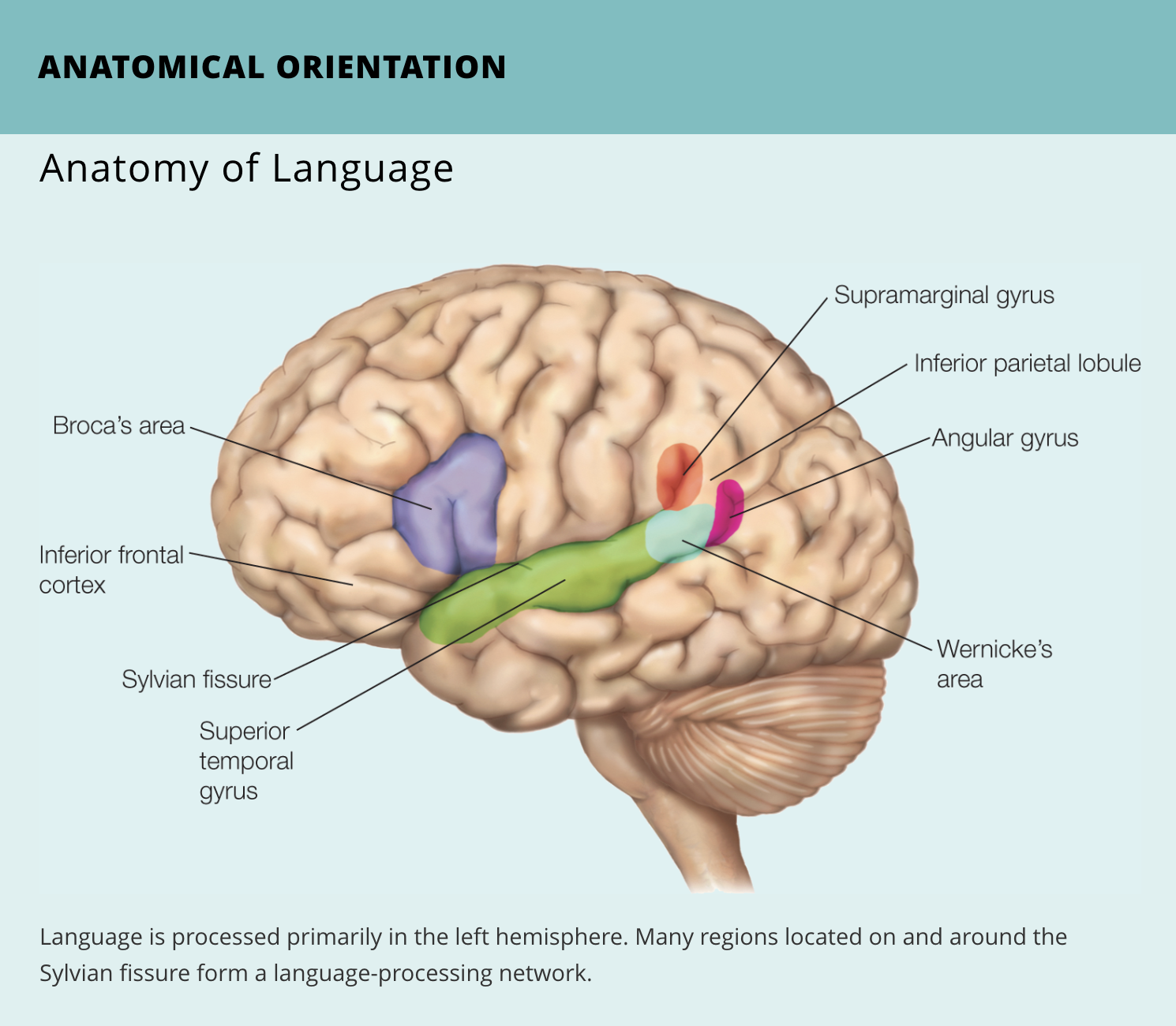
Broca's Area: Responsible for language production.
Identified through research on patient "La Borneo."
Located in left inferior frontal lobe.
BA 45/44
Wernicke's Area: Responsible for language comprehension.
Identified through studies showing comprehension impaired despite preserved production.
Located in the posterior superior temporal gyrus.
BA 22
Types of Aphasia
Broca's Aphasia (Motor Aphasia): Difficulty in production of language, comprehension relatively intact.
Wernicke's Aphasia (Sensory Aphasia): Difficulty in comprehension of language, production relatively intact.
Conduction Aphasia: Affects the connection between Broca's and Wernicke's areas via the arcuate fasciculus (fibre bundle). Conduction Aphasia means that individuals may struggle to repeat phrases or words, despite having intact comprehension and speech production.
Agrammatic Aphasia: Characterised by difficulty in forming grammatically correct sentences, often resulting in the omission of function words and specific grammatical markers.
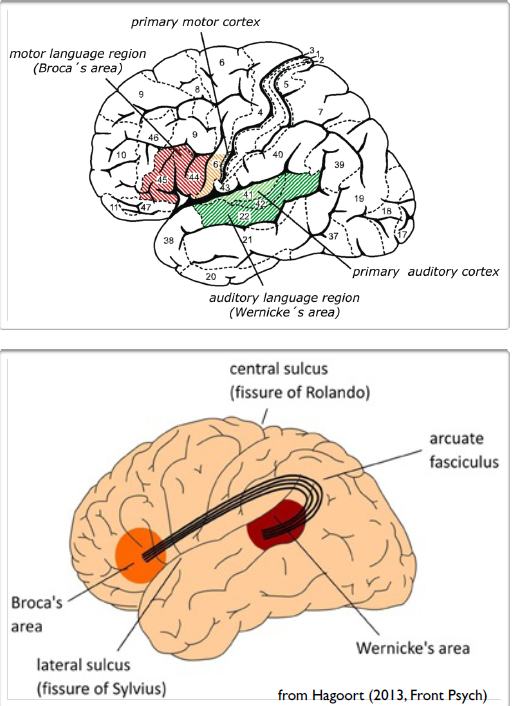
Modern Understanding of Language Processing
Speech and language processing occurs through neural networks rather than strict regions
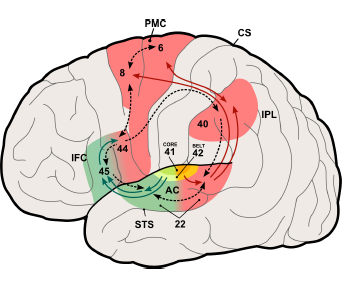
Language Pathways
Anterior Ventral Stream (Green): Connects auditory cortex to anterior temporal and inferior frontal areas.
recognises auditory objects (species, phonemes, syllables, words)
mapping of spectro-temporal (acoustic) patterns to meaning (concepts) - linking sound to meaning
Posterior Dorsal Stream (Red): Connects auditory cortex to posterior temporal and parietal areas.
sensitive to call location, stimuli moving auditory space
Involved in auditory-motor mapping (sound to articulation/action
Important for language production and language learning (associating sounds with articulatory patterns)
Repeating pseudowords activates dorsal stream regions and fibre tracts
essential for understanding word order and syntax
Hierarchical Organization
Further from auditory cortex, response shifts from acoustic sensitivity to intelligibility and meaning (Increasing independence from acoustic form with increasing distance from auditory cortex)
Investigated using intelligibility responses and distortion studies (e.g., vocoding, sine wave speech).
When speech input is distorted in different ways (voice coding or embedding), regions surrounding audio cortex show sensitivity to the type of distortion, regions further ‘downstream’ do not and rather respond to intelligibility
Functions of Dorsal Stream
Auditory-Motor Mapping: Important for language production and learning.
Sequence Processing: Essential for understanding word order and syntax.
Lesions in dorsal tracts lead to difficulties with atypical word orders.
Syntax means the arrangement of words and phrases to create well-formed sentences in a language.
Additional/Textbook
Semantic dementia occurs from a neurodegenerative disease primarily affecting the anterior temporal lobe
Semantic dementia can lead to word-finding difficulties and conceptual deficits
Anterior Temporal Lobe as a semantic hub has the assumed function of ‘binding’ distributed features into coherent concepts
Language is processed in at least two pathways: antero-ventral and postero-dorsal
- Each stream consists of multiple anatomical sub-pathwaysCurrent understanding of the functional role of the two streams (simplified
version):
• ventral stream: mapping from sound to meaning, recognition of auditory objects
• dorsal stream: mapping from sound to action, processing of sequence information
Language processing is lateralised to the left-hemisphere regions surrounding the Sylvian fissure
Dysarthria is the loss of control of the articulatory muscles
Spoken language has two properties: meaning and phonological form
Written language includes orthographic form (vision-based)
Mental lexicon is a mental storage of information about words (meaning and how they combine to make sentences)
Lexical access is the process by which we retrieve the meanings and phonological forms of words
Lexical selection is the ability to choose the correct words from the mental lexicon to convey intended meanings in specific contexts.
Lexical integration is the process through which selected words are combined with grammatical structures to form coherent phrases and sentences.
Morpheme: The smallest meaningful unit of language stored
Phoneme: The smallest unit of sound in speech that can distinguish one word from another.
Semantic paraphasias occur when a person substitutes a word with another word that is semantically related (cow instead of horse), often resulting in sentences that may still be understandable but may not accurately convey the intended meaning.
segmentation problem: A difficulty that arises in speech perception where individual words are not clearly delineated from one another, making it challenging for listeners to accurately identify and comprehend spoken language.
sound comprehension involves the superior temporal cortex; damage to this area may cause pure word deafness
Distinguishing speech from non-speech sounds occurs in the superior temporal sulcus surrounding the early auditory cortex
Distinguishing words from non-words involves the middle temporal gyrus, inferior temporal gyrus, angular gyrus and temporal pole: can occur 50-80 milliseconds after word onset
Written-word processing takes place in the occipitotemporal cortex in the left hemisphere; damage to this area can cause pure alexia (a condition where patients cannot read words, though other aspects of language are normal)
syntactic parsing is the process in which the brain assigns a syntactic structure to words in sentences
lexical selection can be influenced by sentence context
lexical access and selection involve a network that includes the middle temporal gyrus, superior temporal gyrus and ventral inferior and bilateral dorsal inferior frontal gyri of the left hemisphere
the middle temporal gyrus and superior temporal gyrus are important for speech sounds to word meanings
In ERP’s, the N400 is a negative-polarity brain wave related to semantic processes in language and the P600 is a positive component elicited after a syntactic and some semantic violations
A syntactic is phenomenon that occurs when a sentence structure is disrupted, leading to difficulties in comprehension and processability.
syntactic processing occurs in a network in the inferior frontal and superior temporal brain regions during language processing
semantic processes are critical for understanding and producing language, as they facilitate the integration of contextual information and the retrieval of word meanings
Semantic incongruities can lead to variations in the N400 response, reflecting how individuals interpret unexpected or contextually incongruent information during language comprehension.
animacy violation means an unexpected use of animate or inanimate subjects within a sentence, which can disrupt semantic processing and trigger distinct neural responses, particularly in the N400 component.
N400 effect is something you can see if you have violated predictions and something is unfamiliar, or something doesn’t fit into the semantic content
N400 component is something you can observe for all meaningful words, all nouns, adjectives and verbs
Language Processing Predictions
Language processing in the brain primarily uses a forward model (predictive model).
The brain constantly anticipates upcoming linguistic input based on prior context and knowledge.
When these predictions are violated (e.g., unexpected words, semantic incongruities), specific neural responses occur.
The N400 effect is an example of such a response, observed when predictions are violated, or when something is unfamiliar or doesn't fit the semantic content.