Internal energy and energy transfers
Internal energy
Internal energy is the total kinetic energy and potential energy of all the particles (atoms and molecules) that make up a system.
When you heat a system, you transfer energy to its particles. This energy is stored as internal energy. This causes one of two things:
Temperature increase: Particles move faster (increase in kinetic energy).
Change of state: Bonds between atoms and forces between particles(increase in potential energy).
Heating increases the energy the particles have. This increases the internal energy which:
Raises the temperature of the system.
Produces a change of state.
Temperature changes in a system and specific heat capacity
If the temperature of the system increases, the increase in temperature depends on the mass of the substance heated, the type of material and the energy input to the system.
Specific heat capacity is the amount of energy needed to raise the temperature of 1Kg substance by 1 degree celsius
Change in thermal energy=mass*specific heat capacity*temperature change.
Mass=Kg
Specific heat capacity=J/Kg C
Changes of state and specific latent heat
The amount of energy needed to change the state of 1kg of a substance without a change in temperature.
Specific latent heat of fusion: The energy required to change 1kg of a substance from a solid to a liquid with no change in temperature.
Specific latent heat of vaporisation: The energy required to change 1 kg of a substance from a liquid to a vapour with no change in temperature.
Energy for a change of state= mass * specific latent heat
Energy for a change of state=J
mass=Kg
specific latent heat=J/Kg
Heating graph
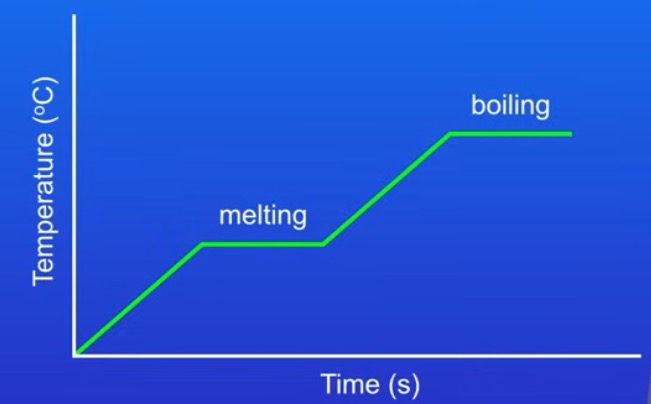
The increase in temperature results to the energy weakening or breaking the forces of attraction between the particles.(Straight line)
During the state of change, the internal energy store is being increased but the temperature stops increasing and stays constant
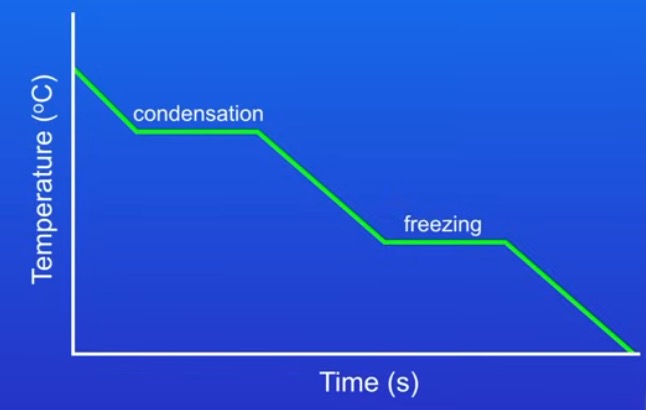
Cooling graphs