Aldosterone Antagonists
Because the end goal of the renin-angiotensin aldosterone system, or RAAS, is the production of aldosterone, it’s logical that aldosterone antagonists are effective in treating hypertension. They are also effective in treating manifestations of heart failure following a myocardial infarction.
Prototype and Other Medications
The prototype medication for aldosterone antagonists is eplerenone. Another medication in this category, that will be discussed in the section on medications for heart failure, is spironolactone.
Expected Pharmacologic Action
Aldosterone antagonists exert their antihypertensive effect, by blocking aldosterone receptors, which effectively blocks the effects of aldosterone. This results in urinary excretion of sodium and water, and retention of potassium.
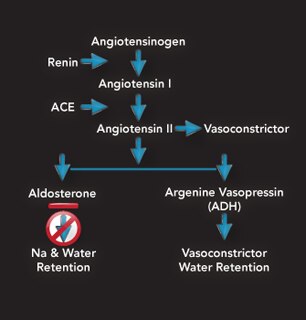
A flow chart of the pharmacological action of aldosterone antagonists:
When a client’s blood pressure decreases, the kidneys release the renin enzyme into the bloodstream.
Renin splits angiotensinogen (a molecule secreted from the liver) into smaller parts, leading to the formation of angiotensin I.
Angiotensin I is inactive at this point and travels in the bloodstream to a client’s lungs, where it is further split into smaller parts by angiotensin-converting enzyme. One of the small pieces is angiotensin II.
Angiotensin II is an active hormone that is powerful in causing vasoconstriction of small arteries (increase a client’s blood pressure); stimulating the adrenal glands to release aldosterone; and the pituitary gland to release antidiuretic hormone (ADH or also called vasopressin).
Aldosterone and ADH cause sodium and water to be retained, increasing the blood volume and blood pressure. Potassium is excreted in the urine.
Vasopressin causes more vasoconstriction and water retention, leading to further increase in blood pressure.
Aldosterone antagonists block aldosterone binding with receptors in kidneys, leading to sodium and water excretion and retention of potassium. Thus, decreasing blood volume and blood pressure.
Adverse Drug Reactions
The primary side-effect of aldosterone antagonists is hyperkalemia, due to their potassium-sparing effects.
Interventions
Since hyperkalemia is a common adverse drug reaction of aldosterone antagonists, make sure to monitor for signs of hyperkalemia, such as palpitations, muscle twitching, weakness, or paresthesia in the extremities. In clients at risk for hyperkalemia, periodically monitor clients’ potassium levels, blood urea nitrogen, (BUN), and creatinine. Make sure clients are not using a potassium-containing salt substitute or taking potassium-sparing diuretics or other medications that can raise potassium levels.
Safety Alert
Other signs of hyperkalemia that you must watch for when caring for clients taking an aldosterone antagonist are slow, irregular heart rate, muscle cramps, progressive weakness, hyperactive bowel sounds and diarrhea. If clients begin exhibiting any of these signs of hyperkalemia, check their serum potassium level in the medical record. If a recent value is not available, notify the provider and request a prescription for a serum potassium level to be drawn.
Administration
Aldosterone antagonists are available for oral use only. The provider can give them alone or combined with other antihypertensive medications. The maximum therapeutic effect of eplerenone may take up to four weeks to develop.
Client Instructions
When instructing clients on aldosterone antagonist therapy, tell them to avoid taking potassium supplements, potassium-containing salt substitutes or medications which raise potassium levels unless prescribed by the provider. Advise them to report to their provider palpitations, muscle twitching, weakness, or paresthesias in the extremities, which could indicate hyperkalemia.
Contraindications and Precautions
The use of aldosterone antagonists is contraindicated in clients whose serum potassium levels are above normal, as well as clients who have type 2 diabetes mellitus with microalbuminuria, an increased serum creatinine, decreased creatinine clearance, or in women who are lactating. The provider needs to use aldosterone antagonists with caution in children, as well as clients who have a history of liver failure or disease or are concurrently taking a prescribed medication that could raise potassium levels. Concurrent administration with potent CYP3A inhibitors such as ketoconazole, clarithromycin, and ritonavir are contraindicated. CYP3A are enzymes found in the liver that break down certain medications causing an increased concentration of medications. NSAIDs may decrease antihypertensive effects of eplerenone.
Interactions
Medications that raise potassium levels, such as ACE inhibitors and potassium-sparing diuretics, increase risk for hyperkalemia. Aldosterone antagonists may also cause lithium toxicity in clients who are taking lithium for a mood disorder. NSAIDs may ↓ antihypertensive effects of eplerenone.