chapter 6: rocky and sandy shores
6.1 introduction
shores are studied because they are accessible, taxonomically relatively simple, and provide ecological goods and services to society
shorelines around the world are experiencing increasing pressure from human developments that threaten their physical and ecological integrity despite our increasing dependence on the services they provide to human society
box 6.1: early human dependence on the shore
traces of shell middens (discarded shells left over by prehistoric people that used to eat shelled animals from the shore)
some middens are so large, they are termed megamiddens, like the ones found on the coast of Africa
6.2 what is the shore?
not all shores experience significant tides, yet they support a typical intertidal fauna and flora. The functional extent of the shore extends well above and well below normally recognised limits
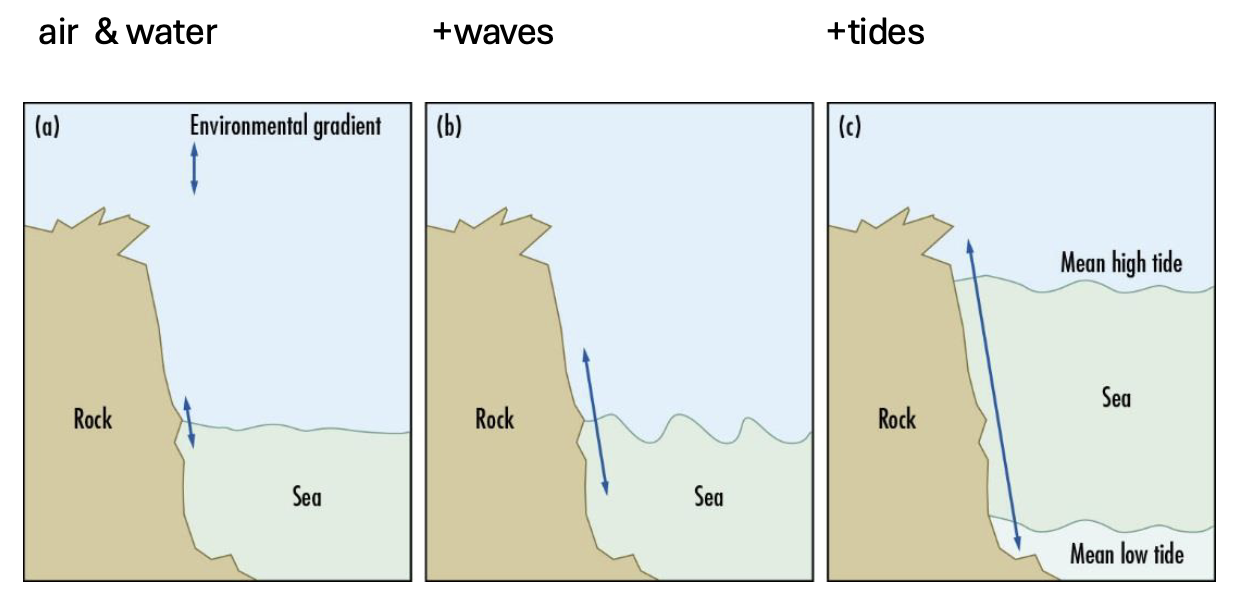
tides do not create the wet-dry gradient, but amplify it
6.3 environmental gradients and the shore
zonation → a phenomenon where different species have different physiological and ecological tolerances and hence occupy different section of environmental gradients
four main physical gradients on shores:
wetness/dryness
exposure to wave action
substratum particle size
salinity
6.3.1 wetness/dryness
the environment gets progressively drier with distance from the water surface, and this gradient is amplified by waves and tides
generally species have different requirements/tolerances and are able to live further or closer to the water surface according to these tolerances
but this does not mean that high shore organisms cannot tolerate immersion in sea water
most shore species are marine in origin and need regular access to the sea
6.3.2 exposure to wave action
fetch → the longer the distance the wind blow, the higher the waves
swells → the residual effects of large wind generated waves produced by storms far offshore
wave action is a major determinant of community structure and composition, as well as individual shape, form, and behaviour
morphodynamic state is preferred to the term wave exposure to describe sandy beaches and mudflats
box 6.2: wave formation
waves are generated by friction form winds in teh air/water interface
the fetch, wind speed, direction, and duration, and the depth of water all affect the period and height of waves
waves can continue to be propagated even without influence of wind, which is known as swells
6.3.3 particle size
the size of particles that make up the shore have a huge effect in determining the kinds of organisms that can survive there
large particles provide a stable surface for attachment, and epifauna and flora dominate such shores
finer particle sands are often too unstable to permit surface attachment and the fauna lives within the beach (infauna and meiofauna)
6.3.4 salinity
salinity gradient is generated by the meeting of freshwater with saltwater, aka an estuary
teh degree of physical mixing between freshwater and seawater can range from very little to complete mixing
the distribution of the flora and fauna along this gradient will depend on where they give the best response
6.3.5 interaction between gradients and zonation patterns
increasing wave action will amplify the wetness-dryness gradient, and thereby uplift biological zones with increasing wave exposure
wave action and water movement will sort particles according to their mobility and in the process drive the overall beach environment towards a more reflective or dissipative morphodynamic state
zonation patterns → the overall patters of distribution and abundance
remarkably similar general patterns of zonation recur throughout the world which offers interesting possibilities to undertake comparative studies
box 6.3: macrofauna and meiofauna
meiofauna → organisms smaller than 1 mm
they occur in large numbers on beaches because of how small they are
due to that body size, they have high respiration rates
6.4 causes of zonation
zonation patterns on shores cannot be explained by tidal rise and fall. The concept of a critical tidal level that dictates entirely teh patterns observed on shores still persists in some marine ecology textbooks. This is an outdated concept and should be treated accordingly
juvenile stages of most species tend to be teh most vulnerable to stress
the environemtnal condition experienced by teh juvenile usually determines where teh adults are gonna finally be
upper distributional limits of species are generally (but not always) set by their tolerance to physical factors
competition and predation have been shown to be important determinants of lower distributional limits of species on many rocky shores
zonation patterns, as well as their underlying causes, are much harder to detect on sandy beaches and mudflats
interference competition → where individuals overgrow or crush one another
space is not such a sever constraint on sandy shores as the fauna are mobile and can relocate to avoid competition
6.5 the organization of shore communities
shore communities are organised by a combination of top-down (consumer driven) and bottom-up (resource driven) processes
6.5.1 the role of field experiments
teh outcome of experimental manipulation of shore communities are only persuasive if executed correctly and unambiguously and take account of potentially confounding variables
6.5.2 keystone predator or prey?
a keystone species may simply be another brick in the wall in different circumstances. In other words, teh identity of keystone species can be highly context specific
population recruitment processes operating far out at sea may profoundly affect teh outcome of interactions on the shore, especially for those species that have offshore dispersed larvae
what determines recruitment strength?
if larger scale process are taken into account, it could be argued that bottom-up processes organize the shore, and not top-down
6.5.2 primary and secondary space
top down effects on shores are most obvious between consumers and those prey species that are primary space limited
the structure created by beds of primary space occupiers, such as mussel and oysters, permits a high local biodiversity of associated fauna to develop due to increased habitat complexity and organic enrichment from the production of faeces and pseudofaeces
6.5.4 bottom-up processes
the outcome of competitive interactions between mobile species may be less dramamtic than for sessile taxa becasue mobile taxa can move to avoid competition by searching for alternative sources
it would seem that bottom-up processes dominate, with predators limited by their prey, rather than vice versa
most prey individuals in mudflats and beaches are unavailable (i.e buried too deep in the mud) to predators like shorebirds and fish, and their numbers are riven by the supply of organic matter and other food resources
6.5.5 disturbance and bioturbation
physical disturbance to the strucuture of the sediment and lateration of the physico-chemical environment by the organisms themselves or by external events such as storms or ice scours
species licing in the sediment move through it, ingest and egest particles, and draw oxygen rich water down from the surface to the depths; this can also create a favourable environment for other species
6.6 the shore network
shores are highly open systems, recieving and exchanging resources and propagules with each other and with offshore systems
often major shifts in community strucutres and composition on the shore can only be satisfactorily explained by considering near shore coast hydrodynamic processes
6.7 the future of rocky and sandy shores
anthropogenic effects:
increase of human populations along coastlines will increase the light pollution and potential shading from industrial structures
accelerated sea level rise, due to climate change, will have large scale impacts on sandy beaches and mud flats over the next 50-100 years
may increase erosion
increase turbidity (not good for primary production)
lower biomass of infauaa due to reduced retaining of organic matter on beaches
sea level rise not only reduces intertidal area, but profoundly alters sediment distributions
the frewuency of catastrophic wave action is likely to increase dramatically with rises in sea level