Lecture 25 - Succession
Definitions
Succession - change in communities following disturbance or creation of new substrate
Primary succession - on new substrates, such as lava flows, sand bars, or surfaces exposed by glacier retreat
Secondary succession- following disturbance (what you see everywhere)
Ecosystem - a community (however the researcher wants to define it) plus any abiotic variables affecting the community that the researcher chooses to consider. From the succession lecture, ecosystem factors included soil, nutrients, water availability, etc. In this lecture, productivity is an ecosystem property.
Succession occurs on sandbars. We can call this primary succession, although some people would call it secondary succession if the sediments are topsoil rather than sand or some form of rock
Examples of typical plants in secondary succession in Louisiana hardwood forests
Golden rod → Red maple → American beech
The general path of succession in any system -
Pioneer species = r-selected → Climax species = K-selected
The climax in ecology refers to the final stage of ecological succession, where a stable and self-sustaining community of plants and animals is established in an ecosystem. It represents the peak of biological diversity and productivity in the ecosystem. The climax community is characterized by a balance between the various species present and their interactions, resulting in a relatively constant composition and structure over time.
‘Climax’ is an old concept in ecology, but fuzzy to define better to say ‘late successional,’ which does not imply a stable climax
Species richness increases during the early stages of succession, then reaches a plateau.
The timing of increasing species richness differs among plant growth forms.
Mechanisms for succession
Facilitation- Pioneer species modify the environment in a way that makes it less suitable for them, but more suitable for later species.
Ex. Lichens facilitate succession for later species by accumulating nutrients and physically breaking down rocks
Tolerance- Climax species are present all along but take time to become dominant. Their dominance is not due to changes caused by pioneer species.
Ex. Tolerance may best explain old-field succession. The late succession plants are present all along, but grow more slowly than the pioneer species.
Inhibition- Early successional species modify the environment to make it unsuitable for other species
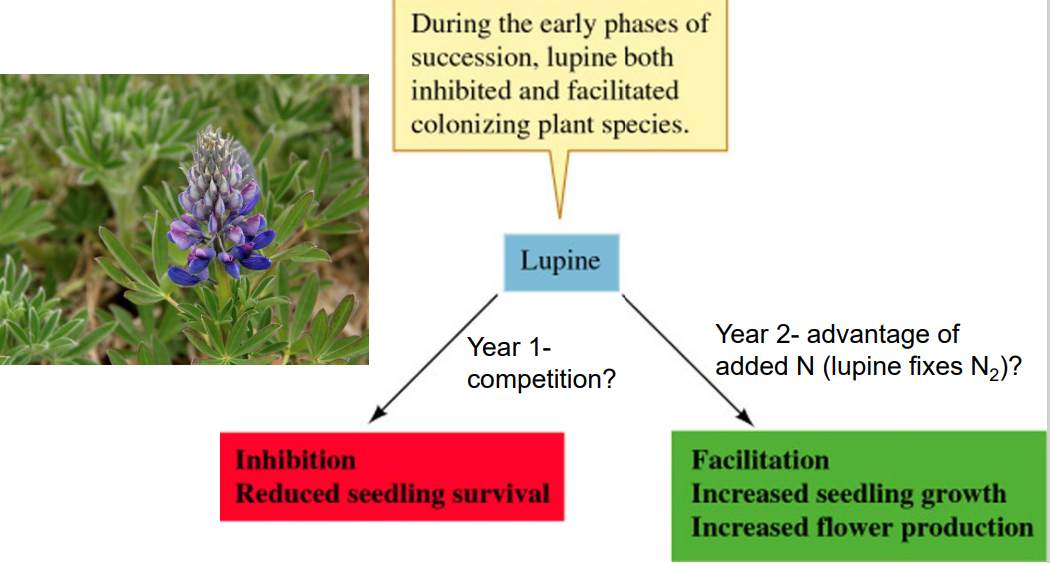
Ex. Inhibition and facilitation by lupine in primary succession at Mt. St. Helens, Washington
Lecture questions
What would be the first plants to establish during secondary succession? = r-selected plants
Which is true about secondary succession? = plant diversity initially increases, fixed nitrogen accumulates, biomass increases
Geography this lecture
Grand Canyon, Arizona
Iceland
Hawaii
Louisiana
Glacier Bay, Alaska
North Carolina
Michigan
Mt. St. Helens, Washington