Permit study guide (:
SECTION 8: SAFE DRIVING
Be aware of your surroundings-
ahead of you (green), next to you (blue), blind spots (yellow), and behind you (red).
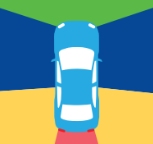
Always give yourself time to react and give yourself at least 10 seconds to scan the road ahead of your vehicle.
Tailgating = When the person in front of you blocks your view so it makes it hard for you to keep track of what is going on from the road ahead. Use 3 second rule (safe following distance) to avoid collision. When a vehicle merges to closely in front of you, take your foot off the accelerator to give yourself space. (Creating space : a tailgater is behind you and maintain your course and speed and when good to do so, merge right to change into another lane to allow that tailgater to pass. OR when following motorcyclists on metal surfaces such as bridge gratings, railroad tracks and gravel.
What’s on your side = don’t stay in another driver’s blind spot, don’t drive directly alongside other drivers, make space for drivers on freeways, make space between you and a parked vehicle, look both ways even at intersections where traffic has a red light/stop sign.
Blind spots = areas around the vehicle where a driver cannot see when looking straight ahead or using the mirrors. (the sides, slightly behind the driver)
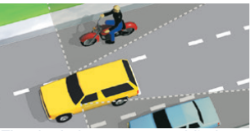 - Check when: changing lanes, turning an intersection, merge with traffic, backing up, leaving a parking space, parallel park, pulling out from the curb, and opening your car door.
What’s behind you = help you avoid rear end collisions and you can check for traffic by using your side mirrors, rearview mirror, and turning your head
changing lanes, checking blind spots, reducing your speed, turn into side road/driveway, stop to pull into parking space, pull up to or away from the curb and backing up
Understand the road conditions-
Darkness = When driving in the dark turn your high beam headlights and make sure you can stop in the distance lit by your headlights. Don’t have your headlights on where it is illegal and make sure to dim your headlights to avoid blinding other drivers. When driving in raining turn your low beam headlights, don’t just use your parking lights
If high beam headlights are too bright from others: don’t look directly to the oncoming headlights, look toward the right edge of your lane, make sure to watch the oncoming vehicle from the corner of your eye, and don’t react by having your lights on (just makes it harder for both of you).
Smaller vehicles and people are harder to see, highway construction can take place at night so reduce your speed, when leaving a brightly lit place make sure to drive slow to adjust to the darkness, and when you see a vehicle with one light go to the right as much as possible it may be a smaller vehicle or one with a missing headlight.
Sun glare = keep windshields clean (in and out), wear sunglasses, maintain space between you and other vehicles, make sure car visor works and is free of anything that would restrict use, beware of pedestrians, and try to avoid driving during sunset or sunrise.
Skids = When one or more of your tries lose traction with the road and the vehicle starts to slip. Won’t be able to control your vehicle during skids. Different types of skids=
Slippery surface skids- may be caused by snow or ice and results more likely when driving fast or going down hill. To avoid this on slippery surfaces try to slow down on tight curves/turns/intersections, avoid fast turns and quick stops, shift to low gear when going downhill, and avoid paths with ice patches, wet leaves, oil, and standing water.
Locked wheel skids- usually caused when braking too hard while you were driving too fast and your vehicle will skid no matter which way your steering wheel is turned. If it doesn’t equip any of these below, then quickly pump your brakes until you are at a safe speed. To dry your wheels, press the brakes and accelerator lightly at the same time and only do so until your wheels are dry.
Four wheel antilock system (ABS) - apply firm pressure on the brake pedal
Rear wheel ABS (common in light trucks) - ease up on the brake pedal while maintaining enough pressure to allow the front wheels to roll again so you can steer and stop braking and turn the steering wheel into the direction of the skids.
Front wheel ABS - Remove foot from brake pedals to unlock the wheels, steer in the direction you want to go and straighten the front wheels as the vehicle begins to straighten out.
Steps when you start to skid- slowly remove you foot from accelerator, do not use your brakes, turn your steering wheel in the direction of the skid, and try to get a wheel on dry pavement.
Slippery roads = Drive slower than you would on dry road and adjust to different conditions. When a road is more slippery than others, they’ll usually have warning signs. Slow down at the first sign of rain, drizzle, or snow on the road. Turn your windshield wipers, defroster, and low-beam headlights.
Wet roads- reduce speed to 5-10 mph
Packed snow- reduce speed by half
Ice- reduce speed to no more than 5 mph
Shade from trees or buildings may make icy spots harder to see and they freeze first than dry out last, Bridges and overpasses tend to freeze before the rest of the road having icy spots, and when it rains.
Heavy snowstorm/rainstorm- may not see more than 100 feet in front of your vehicle, don’t drive faster than 30 mph, you might have to stop to wipe mud or snow off your windshields, headlights, and taillights. If driving in snowy areas, try to bring snow chains for your tires, it helps give your tires more traction.
Hydroplaning = It occurs when driving in rainy/wet conditions and is when the vehicle rides on water because the tires lose all contact with the road. Any slight change could throw your vehicle into a skid. To avoid this:
drive slowly, steer around standing water, slow down if you hear any sloshing sounds from your tires or when changing lanes or direction.
If you start hydroplaning- slow down gradually, don’t use brakes, sudden braking may cause you to lose control
Stuck in snow or mud = shift to low gear and keep front wheels straight, gently step on accelerator and don’t spin wheels, drive slowly forward as far as possible, shift reverse and back up as far as possible (don’t spin wheels), shift low gear again and drive forward, repeat forward-backward motion until vehicle rolls free. If in deep mud/snow, put boards or tree branches under the tires and only take this action when the vehicle is stopped.
Flooded roads = Dangers of water may include being swept off the road, floating debris/unseen hazards, road collapsing, vehicle malfunction, and electrocution if there are fallen power lines. May not be able to see how deep the water is so in most cases don’t cross but if you need to drive and drive slowly and may sure to test brakes work correctly after.
High winds = this is hazard while driving mainly for larger vehicles.
Reduce speed, you can control your vehicle more if hit by strong winds
Maintain a firm grip on your steering wheel if not you can possibly lose control when hit by strong winds
Be alert and make sure to keep an eye on any debris on the road to give yourself time to react to road hazards
Don’t use cruise control, maintain maximum control of the accelerator
Be proactive, safer just to pull over and let the storm pass
Fog or heavy smoke = Drive slowly, use low-beam headlights, don’t just drive with parking or fog lights, make sure you have enough space to stop within what’s ahead of you, increase your following distance, use defroster and windshield wipers as necessary, avoid crossing lanes/passing traffic unless really necessary, listen to traffic that isn’t visible.
!Consider pulling off road if fog is too thick, activate your emergency flashers and wait for conditions to improve!
Law enforcement traffic breaks = An officer turns their emergency lights and slowly weaves across lanes. They use traffic breaks to slow/stop traffic to remove hazards from the roads or during heavy fog/unusual traffic conditions, prevent collisions during unusual conditions. You should:
turn emergency flashers to warn others, slowly decrease speed to match officers speed, don’t brake suddenly unless to avoid a collision, keep a safe distance between officer, don’t drive past officer, don’t speed up until officer turns emergency lights off and traffic conditions allow you to return to normal speed.
Protect yourself and your passengers-
Seat belts = You may get a ticket for not wearing your seatbelt. Wearing it will increase your chances of survival. They keep you in a better position to control the vehicle and minimizes serious injuries. Make sure to wear seatbelt correctly.
Child restraint system and safety seats = Those who are under 2 years old, under 40 pounds and under 3ft and 4 inches need a rear-facing child passenger restraint system. Children who are 8 years or older or at least 4ft and 9 inches may use a properly secured safety belt that meets federal standards. And those who are under 8 years old or less than 4ft and 9 inches need a child passenger restraint system in a rear seat. In some cases, these children may ride in the front if:
there is no rear seat or they are side-facing jump seats or are rear-facing seats
the child passenger restraint system cannot be installed properly
all the rear seats are occupied by children 7 years old or younger
medical reasons prevent the child from riding in the back seat
Air bags = These keep you more safe than a seatbelt alone. Drivers and passengers should sit at least 10 inches from the airbag cover. Children seated next to a side air bag may be at risk of serious or fatal injury.
Unattended children and pets = It is illegal to leave a child under the age of six unless under supervision of a person who is at least 12. The temp inside a parked vehicle can rise rapidly when sitting in the sun even if a window is slightly opened. It often leads to dehydration, heat stroke, and death.
Manage your speed-
Basic Speed Law: You shouldn’t drive faster than is safe for the current road conditions.
Unless otherwise posted, max speed limit in CA highways is 65 mph and it’s 55 mph on a two-lane undivided highway & for vehicles towing trailers
Regardless of the posted speed limit, your speed should depend on:
# of vehicles on the road
speed of other vehicles
road surface: smooth/rough/graveled/wet/dry/wide/narrow
bicyclists/pedestrians on the road
weather: rain/fog/snow/wind/dust
traffic congestion: small changes in driving behaviors reduces this or avoiding weaving in/out of freeway lanes
Choose between Hazards-
Give more space to the most dangerous situation when facing hazards on both sides.
Know how to handle emergencies-
Tire blowouts = Don’t suddenly brake or abruptly remove your foot from the accelerator because you can lose control instead hold steering wheel with both hands, maintain vehicle speed, gradually release the accelerator, correct steering and stabilize vehicle to regain control, steer in the direction you want to go, and once it’s stabilized continue to slow down and pull off the road when it’s safe.
Driving off the pavement = grip the steering wheel firmly, remove foot from accelerator, brake gently, check for traffic behind you, and carefully steer back onto pavement. Do not pull/turn steering wheel with too much force as it may cause you to drive into oncoming traffic.
Overheating conditions = Extreme heat: watch temp gauge, avoid driving high speeds for long periods, and turn air conditioner off. Extreme cold: watch temp gauge (engine might not have correct level of antifreeze), use defroster or slightly open windows to keep them from fogging.
If your vehicle becomes disables on the freeway = safely pull over to right shoulder, exit right side so you are away from traffic if you have to get out, Dial 511 on cellphone/call box, get back into vehicle, put seatbelt and stay there until help arrives, put emergency flashers to make other drivers aware especially at night. Points where you may get out of vehicle: not enough space on the shoulder, a guardrail, or an area for you to stay away from freeway lanes. FSP won’t tow vehicle to private repair service/residence, recommend tow service companies/repair/body shops, tow motorcycles, and help vehicles involved in a collision unless directed to by CHP.
Disables vehicles on railroad tracks = immediately exit vehicle, run away from tracks diagonally in the direction the train comes from and dial 911 if your vehicle stops/stalls in the railroad tracks. Exit vehicle, dial # on the railroad crossing posts/metal control box near tracks, provide the crossing number and tell them a vehicle’s on the tracks then dial 911 if you don’t see train approaching and no warning lights flashing.
Do not drive distracted-
Looking at phone/navigation system/children & pets
changing music or volume
applying makeup/shaving
Cell phones and texting-
Driving and using a handheld phone is unsafe & illegal. You should only use a cell phone in hands-free mode when necessary. Don’t answer calls, do not send any type of messaging while driving, you phone shouldn’t block your view of the road, use the single swipe/touch feature on the mounted cell phone.
Minors and cell phones-
It is illegal for a minor to answer any calls/messages while driving. They may only use their cell phone to make a call for emergency assistance.
Be familiar with new technology-
Technology in vehicles are advancing and we will see more self-driven assistant cars and they may respond to road situations differently than a human driver would.
Be aware of carbon monoxide-
It is a deadly odorless gas released from a vehicle’s exhaust pipe. Don’t start car inside the garage with the door closed. Symptoms of this poisoning may be tiredness, yawning, dizziness, nausea, headache, ringing in the ears.
SECTION 9: ALCOHOL AND DRUGS
Intro = As you age, your tolerance to alcohol decreases, which increases the risk of alcohol-related driving problems. Medications and illegal drugs have no difference, they still have an affect on your ability to drive. Law enforcement have the right to ask for a blood/urine test if they are sus abt DUI. revoke/suspend license for a year if refused.
Illegal to drive after- drinking excessive amounts of alcohol in any form, any medications that affect your ability to drive (prescriptions or over-the-counter medications), combination of drugs/alcohol that affect your ability to drive safe
!13-20 years old and under the influence on a bicycle, your license may be suspended or delayed for a year once eligible to drive!
Use/possession of alcohol or cannabis products in a vehicle = Must be sealed and unopened. If opened, keep in trunk or where passengers aren’t sitting. Illegal to keep opened containers of alcohol in glove box, doesn’t apply when passenger to bus, taxi, or camper/motorhome.
Blood alcohol concentration (BAC) limits = BAC measures how much alcohol is present in your bloodstream.
Illegal to drive if = BAC of 0.08% if over 21 years old, 0.01% if under 21 years old, 0.01%+ any age when on DUI probation, 0.04%+ when vehicle requires a commercial driver’s license, OR 0.04%+ if driving a passenger for hire.
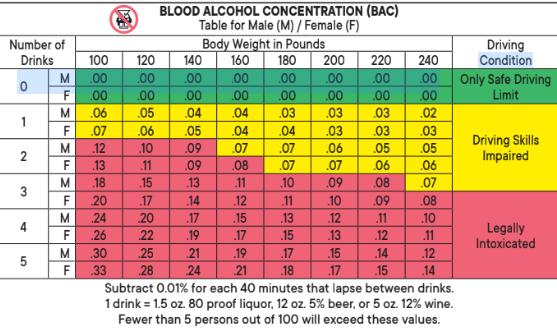 Chart of BAC estimates based on how many drinks consumed, gender, and body weight.
! Still illegal to drink alcohol or take drugs when operating boat, jet ski, aquaplane, or any similar vessels.
DUI arrests = DMV can suspend your driving privilege, officers can take your DL and give you a temporary one for 30 days, and can request a DMV administrative hearing within 10 days from the date of your arrest.
DUI convictions = If convicted, they may take your license for one year and you must complete a DUI program, file a California Insurance Proof Certificate, pay any applicable license reissue or restriction fees, and install an IID (ignition interlock device) on your vehicle.
Additional penalties' are sentenced to 6 months in jail, pay a fine, impound your vehicle and may have to pay a storage fee, or face civil lawsuits.
!DUI’s stay on your driving record for 10 years and if you get another during that time frame you may face additional penalties.
Drivers under 21 =
Possessing Alcohol: you may carry alcohol beverages in the car if you are 21 years old or older with you. Same as use/possession of alcohol. Exception = if working with an off-site liquor sales license, may carry closed containers.
Consuming Alcohol: Based of the consumption of alcohol while driving can result in various consequences such as getting asked to do certain tests (chemical, breath, and PAS tests), revoke or suspend driving privilege and complete a licensed DUI program, may get arrested.
SECTION 10: FINANCIAL RESPONSIBILITY, INSURANCE REQUIREMENTS, AND COLLISIONS
Insurance requirements = (1) $15,000 for single death/injury, (2)$30,000 for death/injury of more than 1 person, or (3)$5,000 for property damage.
18+ cover themselves
make sure insurance is licensed
Low-cost insurance = be eligible for California Low Cost Automobile Insurance Program, if you cannot afford liability insurance.
Causes of Collisions = Driver distractions, unsafe speed, improper turns, not following the right-of-way rules or stop signals/signs, driving on the wrong side of the road, and a vehicle traveling at a faster or slower pace as the flow of traffic.
emergency flashers on in another vehicle ahead means you should slow down and pass carefully bc there may be a collision ahead
avoid passing by a collision and if you do so, help by not blocking the road
What to Do if you are in a collision =
Stop! do not leave, it is considered a hit and run and is severe if convicted
Call 911 if hurt or someone else is hurt
move vehicle away from traffic and call 911
Show considerable documents to anyone who is involved in the collision (drivers license, insurance, vehicle registration, and current address)
Report the collision to law enforcement within 24 hours of the collision if someone is injured or killed
If hit a parked car, find owner, and if not then leave a note with your information and report the collision
If you kill/injure an animal, call Humane society or law enforcement, do not move animal
reporting a collision = Report within 10 days if it caused more than $1,000 in damage in property or someone was injured/killed even if minor. Every driver must file a report of traffic accident occurring in California with DMV whether you caused the collision or not even if it happens in private property. Failure to do so can make your driving privileges suspended.
driving without insurance = If no proper insurance coverage while in a collision, your driving privilege may be suspended for 4 years. During the last 3 years of suspension you may receive your drivers license if you provide a California Insurance Proof of Certificate.
Collisions on your driver’s record = When in a collision, you must file a report and the DMV will add it to your driver’s record and it won’t matter whether you caused the collision or not.
SECTION 11: VEHICLE REGISTRATION REQUIREMENTS
Buying/selling a vehicle
Buying- have 10 days to transfer ownership to your name
Selling- notify the DMV within 5 days by completing a Notice of Transfer and Release of Liability
Out-of-state vehicles = 20 days to register your vehicle after becoming a resident or getting a job in California.
SECTION 12: DRIVER SAFETY
Reexamination = conditions prevent safe driving therefore need help for that
Medical information
Requires tests
Limited term drivers license
no action toward driving privilege
appointment for reexamination
can revoke or suspend license
Drivers License Restrictions
Place specific mechanical devices (hand controls)
Limitations to driving (no night/freeway driving)
Eyeglasses/corrective contact lenses
additional devices (outside mirrors)
!NOT BASED ON AGE, BASED ON CONDITIONS!
SECTION 13: SENIORS
Unsafe drivers = gets lost, makes close calls/collisions, creates dents or scrapes on car or objects.
Senior drivers = Don’t drive at night and when traffic is light, no difficult intersections, no freeway driving, short distances, additional right-side mirror