MCB 150 - chapter 15.5
15.5 Explain some of the ways that damage to DNA is repaired
When an incorrect deoxyribonucleotide is added, its 3’ OH does not align properly in the polymerase active site, causing the enzyme to pause. The mismatched deoxyribonucleotide moves to another part of the enzyme where it does fit, the exonuclease active site. This site catalyzes the removal of the incorrect deoxyribonucleotide. DNA polymerase restarts synthesis. The ability of DNA polymerase to recognize and remove an incorrect deoxyribonucleotide is called proofreading.
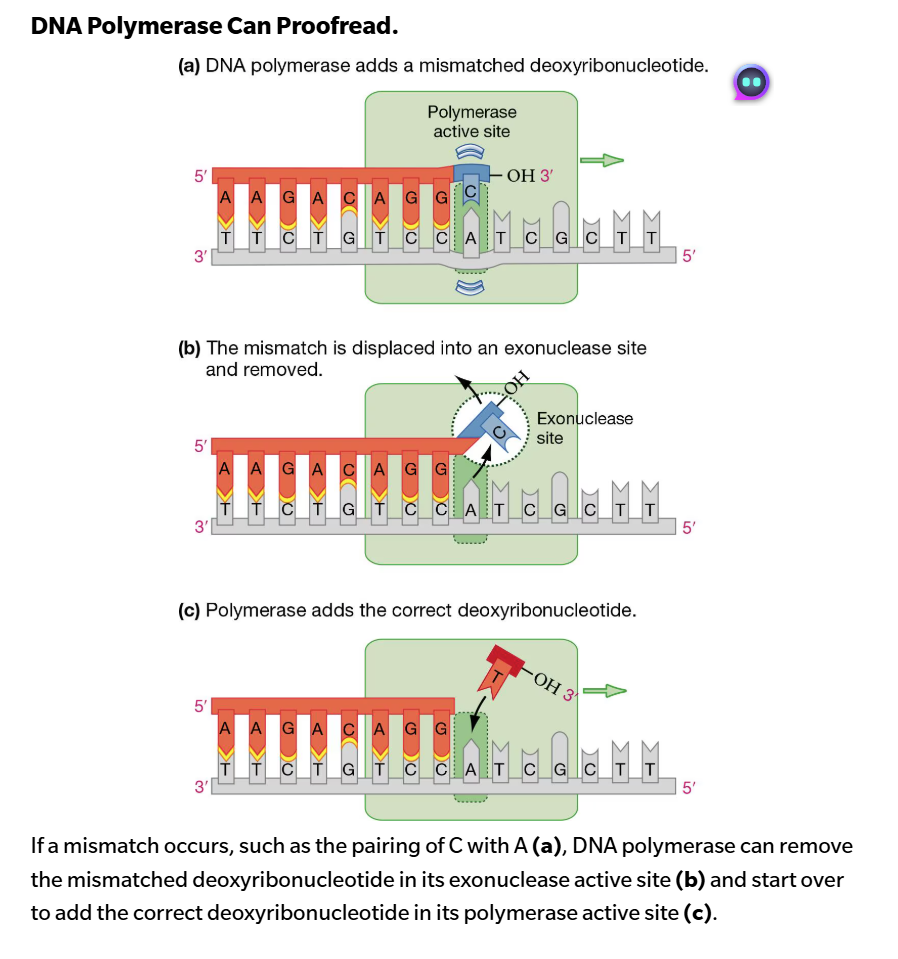
Eukaryotic DNA polymerases have the same type of proofreading ability.
Once DNA synthesis moves beyond a mismatch, proofreading is no longer possible. A battery of proteins can correct the problem by mismatch repair, a form of error correction that cleans up errors introduced during DNA synthesis.
How do mismatch repair proteins determine which strand has the incorrect case and needs repair? In E. coli, chemical marks on the parental strand allow these proteins to distinguish between the parental and daughter strands. Eukaryotes also must distinguish older from newly synthesized DNA, but they use a different system.
Mutations in many genes of the mismatch repair system are observed frequently in cancers, and they play a major role in cancer development and progression.
Damage to DNA can come from sunlight, x-rays, and chemicals. There are many DNA damage repair systems in organisms, one being the nucleotide excision repair, which is a system that works on DNA damage caused by ultraviolet light and many different chemicals.
UV light in sunlight and in tanning booths can cause a covalent bond to form between adjacent pyrimidine bases within the same DNA strand. This creates a kink in the sugar phosphate backbone. If the damage is no dealt with, the cell will die.
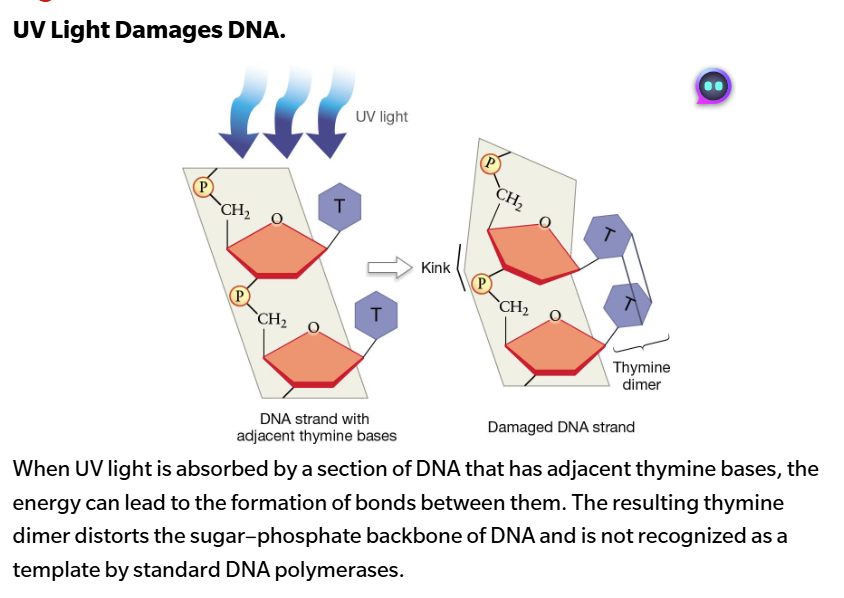
nucleotide excision repair removes these and replaces the damaged DNA strand with correct newly synthesized DNA.
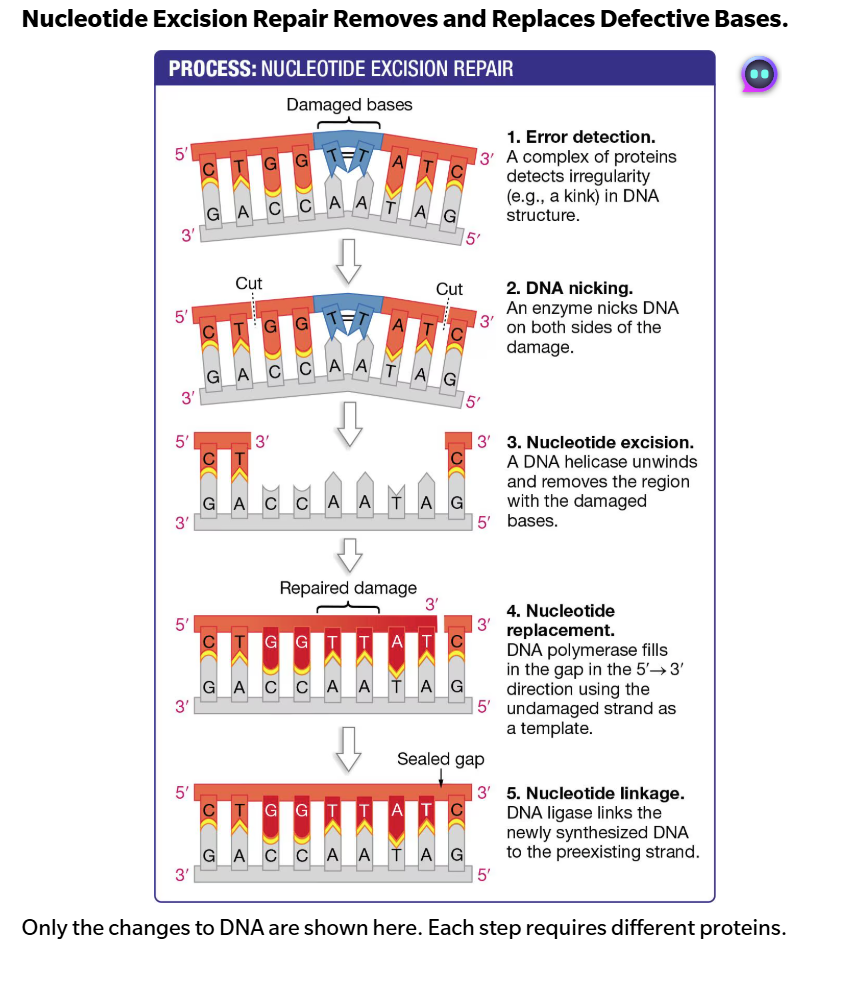
A protein complex recognizes this irregularity in the DNA helix, then an enzyme makes nicks on both sides of the defect, and a DNA helicase removes the strand of DNA that contains the damage, leaving behind a gap. The intact DNA provides a template, and DNA ligase links the newly synthesized DNA to the original strand.
Replication, transcription, and translation all depend on accurate complementary base pairing, very reliable but none are perfect
DNA replication is the most reliable –– why? Needs to be the most reliable. What if you make a bad RNA during transcription? Just make another one. What if you make a bad protein during translation because you made a bad protein? Just make another one and try again. Mistake in DNA replication? Only have one opportunity to make it and that is it.
Mistakes in replication lead to alterations in the nucleotide sequence in the DNA. Mutation becomes part of that organisms genome forever.
These alterations are passed on to daughter cells when the cell divides
Heritable changes in the DNA are called MUTATIONS
Sometimes these changes are productive. mutations doesn’t always have to bad. it can also go unnoticed.
In single-cell organisms (like E. coli) all daughter cells have the mutation
In multi-cell organisms, mutations can be somatic or germline. Depends on which type of cell gets mutated.
Somatic (non-sex cell or not sperm or egg cells): passed to daughter cells in area. Not a threat to the species but to the individual.
Germline (sex cell): passed to new organism. All cells in the zygote carry that mutation.
Why are mistakes in transcription or translation not as critical? We can and do make mistakes in translation and transcription. Not critical mostly because of redundancy.
Many copies of RNA and then protein produced
RNAs & proteins are not heritable over multiple generations
Important terminology: gene–, gene+
For example, lacI+ is wild type (normal, unmutated)
lacI– is mutated form of the gene
if we are talking about the name of a gene (some exceptions) the name of the gene is going to be italicized and lowercase. If we put a superscript by the name of that gene, it is telling you whether there’s a mutant version of that gene or the wild type.
Wild type - unmutated with +
mutant - mutation in that gene with -
If we don’t say there is a mutation in that gene, most of the time there is no mutation.
DNA sequences can be changed by many factors:
How can we make heritable changes in DNA?
Uncorrected mistakes in replication
Chemical mutagens (can be exposed to a chemical that alters the chemistry of the DNA)
High-intensity radiation (x-rays, UV, etc.)
Among these, uncorrected mistakes in replication account for the most mutations. Why are there more mistakes in DNA replication if it is the most reliable? We are comparing DNA replication to chemical mutagens and radiation, not translation and transcription.
This is when millions to billions of new bonds are formed
How often do errors occur in DNA replication? depends on the organism.
Frequency of mutations that end up in E. coli is about 0.04 mutations/cell division
Can also be represented as 4 mutations/100 cell divisions
Average in humans is 1 mistake per billion nucleotides (we have more repair mechanisms than in bacteria) If we are doing human DNA replication, and our diploid genome is 6 billion base pairs, that means we are changing our genome, on average, 6 times every time we go through DNA replication. Majority of these we don’t notice, but still counts as a mutation.
But in vitro (in a controlled environment, take the DNA polymerase by itself. they strip out everything other than polymerization), E. coli DNA polymerases make ~400 mistakes/ cell division -- 10,000X the observed number! what does this mean? cell recognizes how flawed its polymerase is and is doing a lot of fixing before it becomes a problem. The cells method of fixing these problems before they become permanent is that they go back and fix it and then at the end it goes back and checks it again.
So how does E. coli (or any other organism) reduce the frequency of the errors it makes by 10^4 ? How do they correct all those mistakes that our DNA polymerases are letting slide?
Molecular “backspace keys” and “spell checkers”
Proofreading (a DNA polymerase’s “backspace key”): an example of 3′–5′ exonuclease activity. Exonucleases have directionality. if you work from the 3’ end and take off a single base, you are a 3’-5’ exonuclease. The DNA polymerase physically breaks the phosphodiester bond that it just formed (bc it was the wrong base)
If this exonuclease activity is gone, error frequency is 100 times higher
accounts for half of 10^4 reduction in error frequency
If proofreading doesn’t catch the mistake:
Mismatch repair system in E. coli scans recently synthesized DNA, looking for mismatches and hemi methylated DNA
New DNA gets methylated at adenine residues within the sequence 5′–GATC–3′ shortly after replication
Mistake is in new strand
Mismatch repair enzymes fix problem in unmethylated(new) strand
Once DNA gets methylated, no way of distinguishing parent from daughter strand
Methyl directed mismatch repair is a way to scan recently synthesized DNA looking for mispaired bases. But, it needs to know which side to fix, but in a double stranded DNA where the C is with a T, which one is correct? Need a way to tell the difference between daughter and parental DNA. In E. coli, there is a sequence in the 5’-3’ direction of GATC and the A in that sequence is going to get methylated.
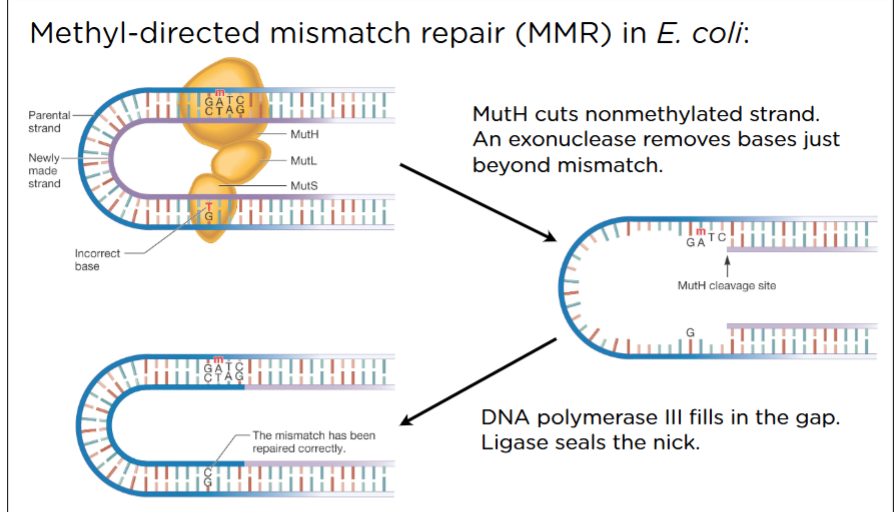
If mismatch repair enzymes are missing, error frequency is 100 times higher
One type of colon cancer can be traced to a mutation in the human mismatch repair system
Proofreading and Mismatch Repair each decrease error frequency by 100X
100 x 100 = 10,000, which is the observed difference
What about mutations that arise from sources other than errors in DNA replication?
Other specialized systems of repair enzymes recognize damage and do their best to fix it