Cognitive Neuropsychology and Language Notes
Cognitive Neuropsychology
Definition: The study of the relationship between brain regions and behavior.
Historical Context:
Initially linked to observations from damaged brains.
Now includes various methods like imaging and lesion studies.
Key Concepts in Cognitive Neuropsychology:
1. Localisation of Function
Assumption: Brain function is “localized”/”modular” with different structures performing distinct roles.
Modularity: Different areas specialize in functions like language and memory but do not map perfectly.
Many functions rely on distributed brain systems,
Language, memory etc., use much of the brain.
Brain regions are specialized to perform roles, but these may not map neatly onto ideas of “brain functions”.
2. History and Development
Franz Joseph Gall & Johan Spurzheim: Early founders of localization theories advocating that different brain regions control different faculties.
As a youth, Gall was annoyed by students with
a good memory but poor original thinking
Developed a theory of brain function: Localisation of function. Here, different parts of the brain responsible
for variations in individual differences.
Phrenology: Study of skull shape as an indication of mental faculties.
Studied individuals with skills in maths, music, sense of colour, combativeness, - discovered “bumps” in some areas.
Samuel George Morton: Contributed to phrenology, though criticized for scientific racism.
3. Cognitive Recovery
Flourens' Experiments: Initial behaviors post-lesions suggested lack of function; however, recovery occurred, countering strict localization assumptions.
Observations indicated that certain brain lesions led to consistent outcomes; e.g., brain stem lesions resulted in permanent breathing difficulties.
Neuropsychology and Language:
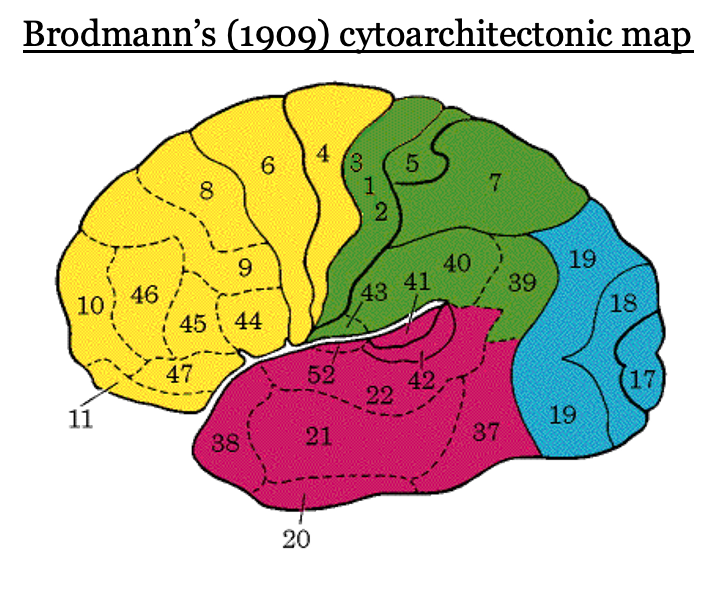
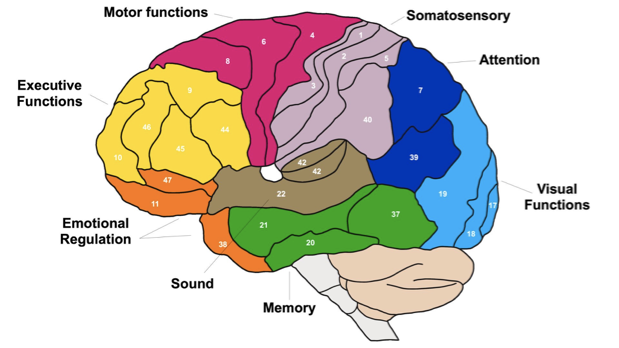
1. Brodmann Areas
Mapping of brain areas correlating to psychological functions based on cytoarchitectonics (cell organization).
Numbers correspond to areas relevant for specific functions (e.g., Broca’s area in Area 44, Wernicke’s area in Area 22).
Despite some of the problems linked with localisation of function, it is still the case that many researchers still associate specific parts of the brain with specific aspects of behaviour/cognition.
Used natural “creases” (fissures/gyrus) in the brain to inform initial decisions. These typically follow a standard pattern from person to person.
Baptiste Bouilaud
Proposed that certain functions were localised & lateralized
Physicians noted that damage to left hemisphere resulted in impaired movement on an individuals right.
2. Broca's Area & Aphasia
Paul Broca: Noted that damage in areas of the left frontal lobe led to speech impairments:
Broca’s Aphasia: Results from damage to Broca’s area; characterized by impaired speech production but relatively preserved comprehension.
3. Wernicke's Area & Aphasia
Carl Wernicke: Investigated the region for understanding language processing.
Wernicke’s patients spoke fluently but with no sense, could hear but could not understand what was said to them
Wernicke’s Aphasia: Syndrome that results from damage to Wernicke’s’s area. Results in fluent speech without meaning; the patient can hear but not comprehend language.
Wernicke’s’s area: the region of the temporal lobe.
Model of Language Processing: Auditory information travels from Wernicke's area to Broca’s area through the arcuate fasciculus, coordinating speech production. So if the temporal lobes are damaged, individuals can still produce speech but are unable to be fluent (i.e., make sense).
4. Conduction Aphasia
A disorder characterized by impairment in repeating words or phrases, retaining comprehension but losing the ability to produce coherent speech upon repetition.
Conclusion
The field of cognitive neuropsychology sheds light on the complexities of brain functions in relation to behavior and language, illustrating both localized and shared brain functions across psychological processes.
Understanding these systems is crucial for addressing brain injuries and cognitive disorders through rehabilitative strategies and therapies.