March 3rd
Historical Factors Associated with Sexual Morality
Overview
Discussion on the cleanliness, social acceptability, and morality of certain sexual acts.
Questions posed include:
Are some sexual acts considered universally immoral, and what historical context contributed to these views?
Examples of sexual acts in question:
Is it immoral to have sex before marriage? What kind of sex?
Is oral sex immoral?
Is anal sex immoral?
Is sex during menstruation immoral?
Is masturbation immoral?
Is sexual intercourse with a cousin immoral?
Review of Historical Beliefs
Greek Beliefs
Examination of how Greek beliefs influenced Western concepts of morality and sexuality.
Key themes:
Morality and Sex
Perspectives on women and their sexuality.
Concept of pederasty and its social implications.
Plato’s Dualism and its significant influence on Christian thought.
Plato’s Allegory of the Charioteer as an analogy for sexual behaviour, emphasizing the conflict between rationality and desire.
Review of Abrahamic Religions
Christianity’s Perspective
Overview of when, how, and why Christianity began to label certain sexual acts as immoral.
Comparison of Judaism and how it distinguishes itself from other religions regarding sexual ethics.
Gnosticism and Manichæism
Gnostics: Their beliefs on the body being impure, evil emerging from the body's desires.
Closer to the Greeks (Plato)
All matter is impure (e.g., anything with the flesh)
We are born good/evil
Manachians
Evil comes from the body, and our weakness/desires lead us astray
Strive to abstain from sex…because it is good, proper and moral.
St. Augustine:
Emphasized the need to abstain from sex; believes sex is primarily for procreation.
Associated women with original sin, viewing them as subservient.
Thomas Aquinas
Discussed concepts of acts against nature and how these beliefs shaped social and legal norms around sexuality.
Examined whether the Reformation brought forth a more liberal stance toward sexual morality.
Impacts of Religion on Sexual Cognition and Behaviour
Exploration of how various religious teachings influence sexual thoughts, behaviours, and social norms.
Masturbation
Historical Perspectives
Regarded as a natural and healthy substitute for other sexual experiences in some circles.
Christian Influence:
St. Augustine: Advocated for sexual intimacy only within marriage, focused on procreation; believed foreplay was unacceptable.
Thomas Aquinas considered masturbation a sin and an act against nature.
Biblical References
Coitus Interruptus: Example from Genesis 38:7-10 describes Onanism and its moral implications.
And Er, Judah’s firstborn, was wicked in the sight of the Lord; and the Lord slew him. And Judah said unto Onan, Go in unto thy brother’s wife, and marry her, and raise up the seed to thy brother.
And Onan knew that the seed should not be his; and it came to pass, when he went in unto his brother’s wife, that he spilled it on the ground, lest that he should give seed to his brother.
And the thing which he did displeased the Lord; wherefore he slew him also.
Masturbation (18th - 19th Century)
1700s
Masturbation caused baldness, wrinkles, bleeding lungs, sudden death, epilepsy, insanity, blindness and loss of memory.
Dr. Benjamin Rush believed it also caused tuberculosis and ‘nervousness disease’.
Masturbation in the 1800s
Masturbation was so widespread that devices were created to curb the practice.
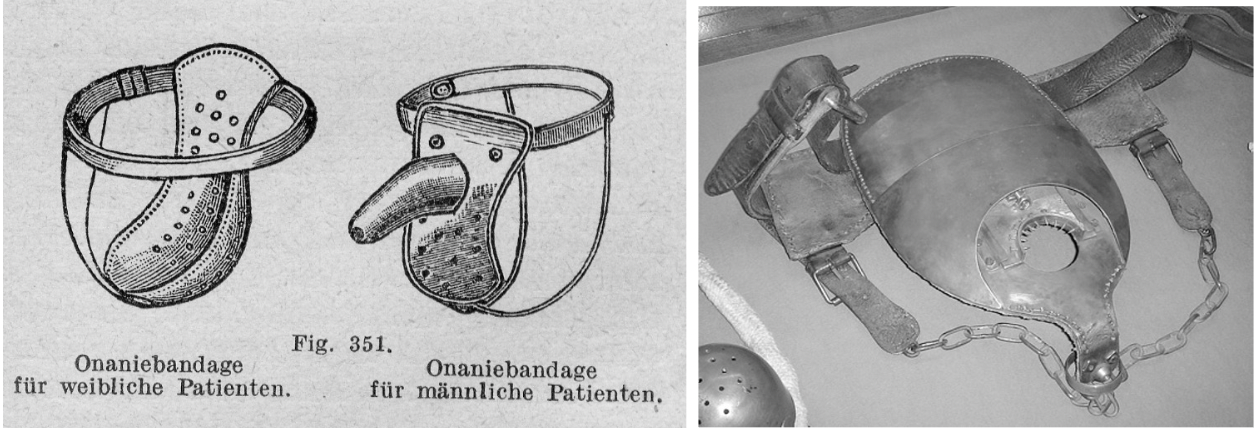
Victorian Era (1837-1901)
Self-pleasure was seen as a considered a serious health detriment.
Sturgis Solution (1900): Introduced suppressive ideas about sexual urges through dietary restrictions (eating bland foods).
Sylvester Grahm introduced the idea that eating bland foods would inhibit sexual arousal.
Mid 20th Century Views
Richard von Krafft-Ebing (1886): Condemned masturbation as psychogenic damage.
Dr. Alfred Kinsey published significant studies in the 1940s and 50s, highlighting actual behaviours and societal views.
Dr. Kinsey’s books in the 1940s and 50s provided insight into actual reported behaviours.
Autoeroticism and Self-Generated Pleasure
Benefits of self-exploration for understanding personal and partner intimacy (Zamboni & Crawford, 2002).
Recognized as a treatment for premature ejaculation and orgasmic disorders in women (Heiman & LoPiccolo, 1988).
Provides an avenue for older adults to fulfill sexual needs and express intimacy (Kontula & Haavio-Mannila, 2002; Ginsberg et al., 2005).
Masturbation Statistics
Data indicating masturbation habits:
Recent Masturbation: Men: 51.7%; Women: 17.8%.
Never Masturbated: Men: 5.4%; Women: 28.2%.
Factors Influencing Masturbation Practices
Influences on habits include socioeconomic status, education level, religiosity, race/ethnicity, and the duration of partnership.
Native American Perspectives on Sexuality
Principles of Sexuality
Over 500 unique spiritual traditions, making broad generalizations inaccurate.
Sexuality in Indigenous cultures is recognized as non-shameful; encouraged sexual curiosity during childhood and adolescence.
Historically, women often took the initiative in sexual matters; many communities practiced polygamy with minimal prostitution.
Kinship Systems
Comparison with European missionaries:
Matrilineal descent systems in Native cultures, notably among Iroquois, granting women substantial political power.
Different kinship rules allowed cross-cousin marriage, contrasting with European norms.
Gender Systems in Indigenous Cultures
Two-Spirited Individuals
Concept of beings who possess both male and female spirits is commonly respected in various Indigenous cultures.
Traditional Chinese Views on Sexuality
The interplay of sexual behaviour with Yin and Yang:
Yin: Associated with passivity, particularly in women, viewed as limitless.
Yang: Linked to activity and depletion in males, with sexual activity seen as promoting unity.
Sex is complementary in creating unity.
Feudal Japan (Until 19th Century)
Notable cultural attitudes included:
Acceptable homosexuality and significant occurrences of pederasty among monks and warriors.
Geishas provided entertainment and sexual companionship to men.
Similar to Ancient Greek culture.
Homosexuality common and acceptable.
Hinduism and Sexuality (Circa 2,500 BCE)
Four major life goals in Hinduism include:
Sensory gratification,
Material well-being,
Religious duty,
Rebirth/salvation.
Pleasure desirable
Sexuality in General
Sex a religious obligation
Erotic picture books instruct on techniques
Specifics of Sexuality
Love is important, and couples truly in love have more pleasure.
Kama Sutra
A significant text providing guidelines on love, relationships, and varied pleasures in life.
the nature of love
finiding a life partner
maintiatin one’s love life, and other aspects pertaining to pleasure-oriented faculties of human life.
The Psychological Effects of Religion on Sexual Behaviour
Sexual Partners and Experiences
Studies show patterns differing among religious affiliations:
Catholics tend to report fewer sexual partners compared to Protestants.
Non-religious individuals report higher rates of sexual activity and masturbation than their religious counterparts.
Religious Influence on Adolescent Behaviour
Religious upbringing leads to decreased engagement in risky sexual behaviours (Rostosky et al. 2004).
Early initiation of sexual activity correlates with a higher number of sexual partners and risks for STDs and unplanned pregnancy.
Intrinsic Religiosity (Allport, 1950)
Associated with
A lower likelihood of casual sex,
Fewer desired sexual encounters,
Reduced the likelihood of sexual relationships within a year.
Spirituality (Hymen & Handal, 2006)
Positive correlations include:
Comfort with the body,
Intimate relationships and expressions of sexuality.
Increased sexual activity and varied sexual experiences.
Fundamentalism
Associated with conservative views on gender roles and sexual orientation.
Minimal variation noted in sexual behaviors across different religions.
Paranormal Beliefs (Bainbridge, 2004)
Individuals in traditional religions more likely to believe in paranormal phenomena.
Women are more inclined than men to endorse these beliefs, sometimes leading to a higher propensity for seeking short-term sexual relationships.
Contraception
Preventing Pregnancy Pathways
An increase in estrogen leads to a reduction in FSH (Follicle Stimulating Hormone).
An increase in progesterone also works to inhibit ovulation and increase the effectiveness of contraception.
Oral Contraceptives (The Pill)
Mechanism of action:
Estrogen's role in preventing ovulation is through the suppression of FSH production by the pituitary gland.
Progestin enhances contraceptive effectiveness by:
Inhibiting ovulation,
Thickening cervical mucus,
Reducing endometrial thickening,
Slowing Fallopian tube activity.
Drug Interactions with The Pill
Approximately 30 medications can interfere with the efficacy of oral contraceptives.
Antibiotics may diminish the effectiveness of hormonal birth control.
May increase metabolism of some drugs (anti-anxiety drugs, corticosteroids and some asthma drugs), making them more potent.
Variants of Oral Contraceptives
Various formulations exist, affecting estrogen and progestin ratios, including:
Triphasic Pill and progestin-only options.
Works by changing cervical mucus, inhibiting sperm passage.
Emergency Contraceptives
Plan B
Contains levonorgestrel, a form of progestin.
Must be taken between 12 hours to 5 days post-intercourse; its purpose is to prevent, not terminate, pregnancy.
Effectiveness ranges from 75% to 89%.
Does it encourage irresponsibility?
Ethical Question
Discussion on whether emergency contraceptives encourage irresponsible sexual behaviour.
Psychological Aspects of Oral Contraceptives
Attractiveness Preferences
Recent studies show inconsistent results on the impact of the pill on preferences in male attractiveness.
No pill, the female spent more time looking at the genitals in the photo.
Pill users focused on contextual details such as clothing and background.
Cognitive Changes
Increased Estrogen (typical of the follicular phase) associated with regonition of emotions (in particular: disgust) (Kamboj et al., 2015).
Sexually dimorphic cognitive tasks that favour women (e.g., facial emotional recognition) are performed best during periods of high estrogen levels and vice versa. (Sanders, 2002).
BUT… is estrogen increasing sensitivity toward all emotions?
More recognition errors in the follicular phase than in the luteal phase (when progestins dominate).
Estrogen may be suppressing positive emotions to focus on more negative immediate ones.
Mood Considerations
Mixed findings on oral contraceptive effects on women's mood, with some studies suggesting a decrease in depression and others noting increased variability in mood across the menstrual cycle.
Inconsistent findings
Depression one of the most common reasons for discontinuing OCs.
Decreased depression
May even prevent against depression.
No differences
Jealousy and Relationship Dynamics
Jealousy has adaptive value for monitoring potential threats to a partner's resources.
Reports indicate that partnered women using oral contraceptives experience increased jealousy levels compared to naturally cycling women.