Circular flow of income
The circular flow of income illustrates how money moves through an economy, highlighting the interactions between households and firms.
Households provide factors of production (CELL) to firms, who in exchange give factor incomes (wages) to the households.
Households spend their factor incomes (wages) on goods on services from firms. In turn, firms use this revenue to pay for the factors of production and invest in their operations, thus perpetuating the cycle.
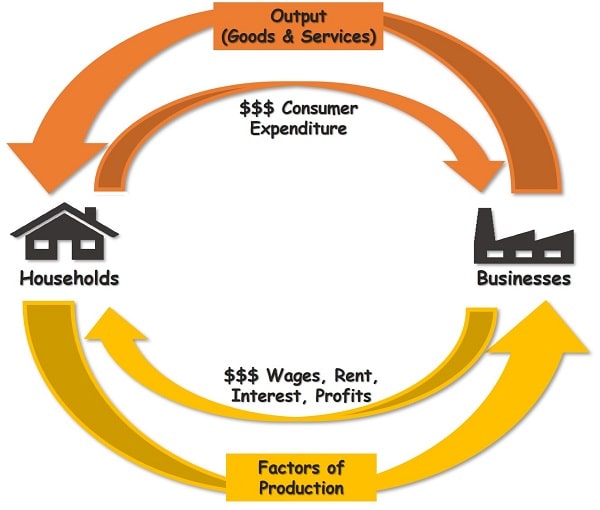
Under the surface, this simple circular flow model suggests how income = expenditure = output. This creates 3 methods for determining national output.
The expenditure method - working out the total of all factor incomes spent on goods and services.
The output method - working out the total things produced by all producers of goods and services
The income method - working out the total amount of factor incomes earned
This is measured in Real GDP = the total value of all goods and services within a country adjusted to inflation
However the simple circular flow is incomplete.
The money circulating doesnt always make it to the households or firms but instead leave the circular flow.
These are called leakages. They include (SIT) Savings, Imports, Taxation
Money can also enter the circular flow.
These are called injections. They include (GIX) government spening, investment, exports
eg. gov spending on housing, education, healthcare. investment from banks into new companies, exports of agriculture to other countries
By comparing leakages and injections you can determine whether an economy will shrink or grow
In theory:
If injections > leakages the economy will grow - EXPANDING Real GDP - because there is more money circulating within the economy which can be spent on goods + services etc
If injections < leakages the economy will shrink - CONTRACTION in Real GDP - because there is less money circulating within the economy leading to less expenditure etc
IT IS THESE LEAKAGES AND INJECTIONS WHICH CAUSE FLUCTUATIONS IN REAL GDP
