Impulse / Momentum
Main concepts this unit - conservation of Impulse/Momentum, Energy conservation, Force Time and other graphs, and Kinematics sometimes
Equations
J = change in p (Impulse = change in momentum)
J = Ft (Impulse = force * collision time)
P = mv
When looking at force time graphs : J = FMAXt or ½ Ft (f average = ½ FMAX)
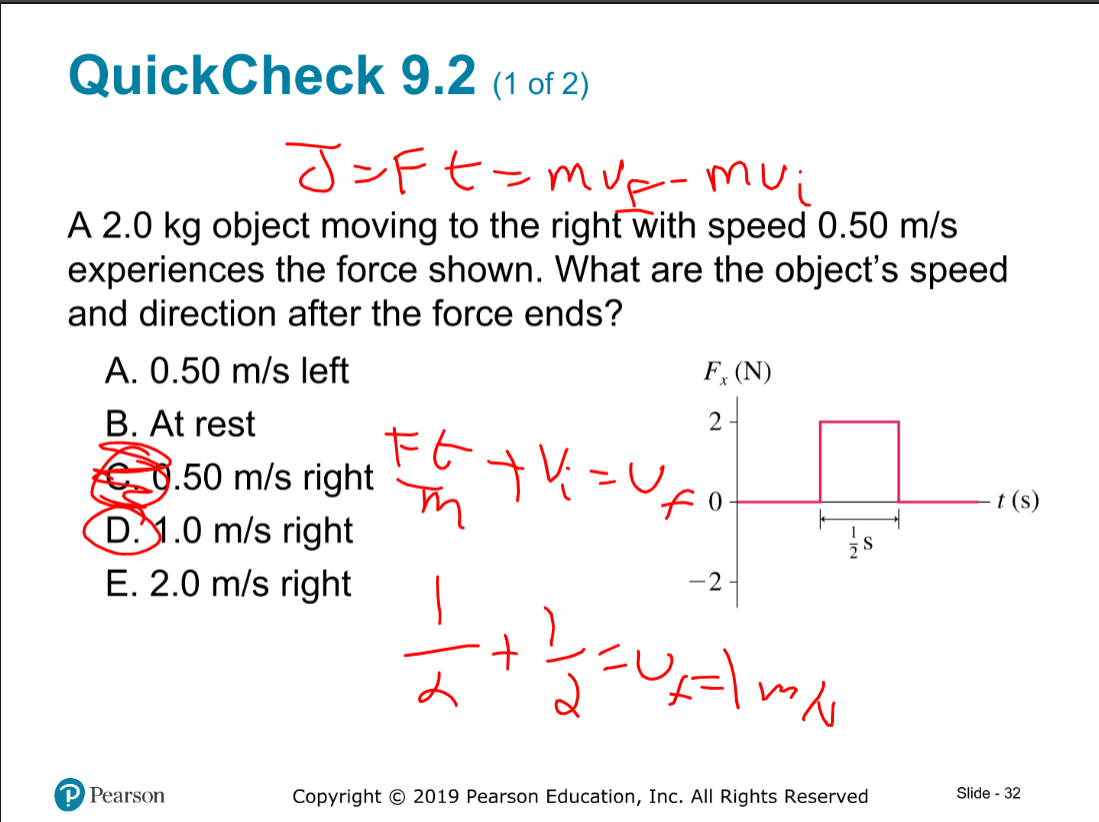
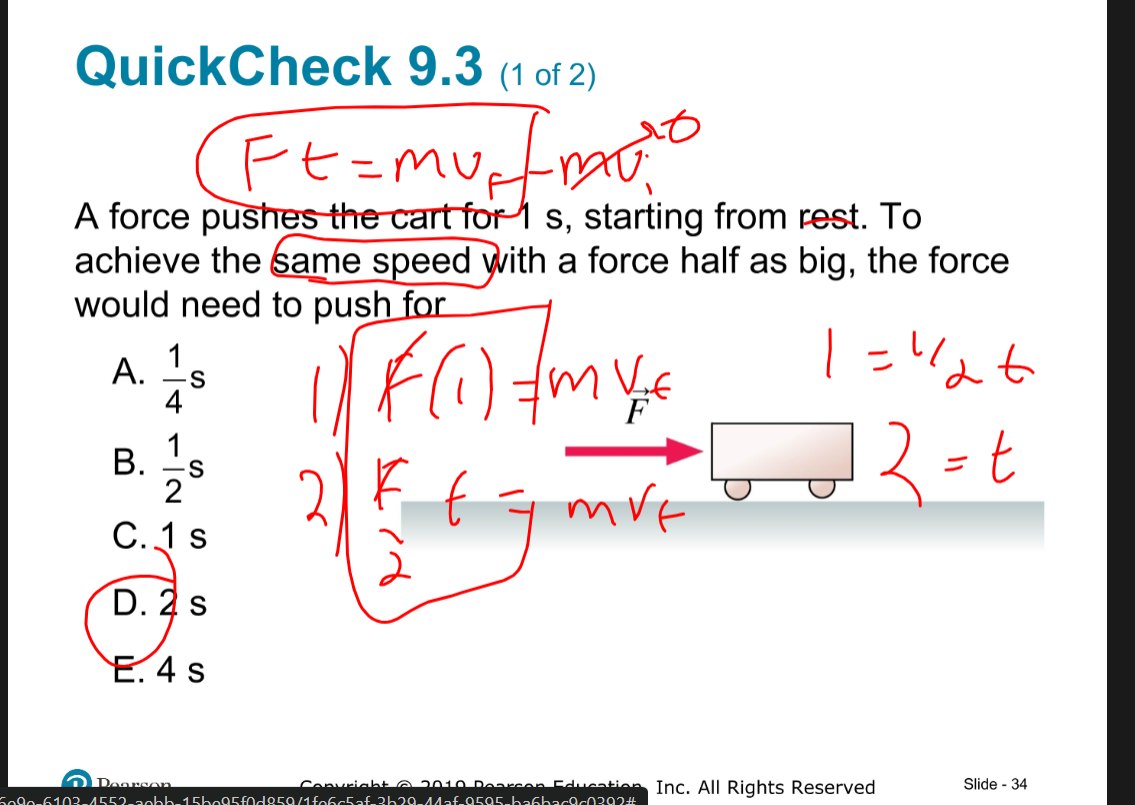
Impulse - change in momentum, area under force time graph
If 2 objects have the same force applied for the same time the momentum will be equal
Direction of Vf tells you direction of impulse, make sure they are the same when solving, when trying to figure out the direction, make sure you check for the negative sign since the equation if pf - pi, negative negative will make a positive
Impulse is proportional to collision time and force
Solving for acceleration with a momentum time graph - divide the slope by mass
When solving momentum problems with the x and y direction make sure you calculate each direction separate, then draw the vectors and connect start to finish (to find direction / sign) and use pythag to find the final momentum. if finding final velocity divide the final momentum by total mass
If 2 objects have the same impulse, the one with the greater velocity will always have more kinetic energy
Conservation of momentum - when theres nothing external force we know theres no impulse so we can set inital and final momentums equal
eleastic collision - interacting objects “bounce” of eachother after collision
inelastic collision - interacting objects “stick” together or move together after collision
Graph Relationships
slope of position time = velocity
slope of velocity time = acceleration
area under acceleration time = time
area under velocity time = displacement
slope of momentum time = net force
area under net force time = impulse
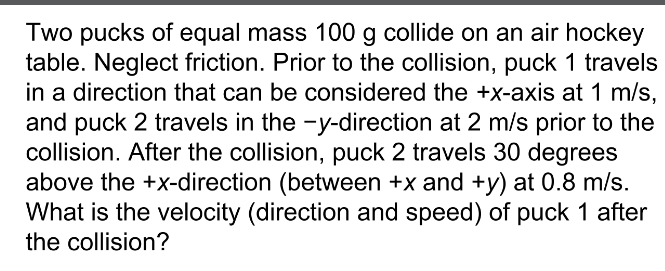
Steps to solve ^^:
solve the momentums for what’s given
split the momentums into x and y direction using the conservation of momentum equations (dont forget the trig)
Use pythag to find the overall momentum
divide the momentum by mass to get velocity
use inverse tan to get the angle / direction
Equation for solving problems where object 2 is at rest
V1xf = ((m1-m2) / (m1 + m2)) * V1xi
V2xf = (2m1 / (m1 + m2)) * v1xi (same mass situation)
Quiz Reflection
To see if a collision if partially inelastic use conservation of energy
Inelastic collisions - mechanical energy is not conserved
Perfectly inelastic stick and move together
FRQ Reflections
Area under Force Time Curve = Impulse
Remember what direction the force will hit an object (check the sign)
Area under Velocity Time Graph = Displacement
Slope of velocity time graph (change in velocity over change in time) = acceleration
to find max elevation use energy approach, k → k + Ug
Remember to cancel units when deriving (especially mass)
Not all collisions conserve energy and you wont know unless you solve so try not to use energy approach during collisions (if energy not conserved then its inelastic)
Finding the length between a string and object use this equation L - L cos 0
Always remember to split kinematics into the x and y direction, you will commonly use y direction to find time
To figure out if its elastic collision, compare the energy before and after to see if its conserved
When drawing momentum vectors after a collision make sure it matches the magnitude and direction of the initial momentum (if its 0 cancel it out)
Double check if the question asks for expressions (bc then you will lose points for not using proper units / not expressing it correctly)
Keep g as g don’t make it 10
Always try to use the energy approach first execpt for during the collision then use impulse / momentum
You can use energy in problems with collisions you cant use it during the collision tho (you dont know if the energy is conserved)