1.8.2 Gibbs free energy, entropy change
ΔS - entropy change, J K-1 mol-1
S is a measure of disorder / the energy of the system
increased ΔS = increased disorder
disorder increased for gases
disorder increased if number of moles increases
disorder increased if temperature increases, as particles gain (kinetic) energy and move further apart
at 0 Kelvin, crystal is perfectly ordered, so entropy is 0 J K-1 mol-1
ΔS = ΣSproducts - ΣSreactants
Gibbs free energy change, kJ mol-1
ΔG = ΔH - TΔS
same form as y = mx + c, so straight line graph of ΔG against ΔS
feasible = a reaction that is energetically possible and likely to occur spontaneously
feasible reactions go spontaneously in the direction of increasing disorder, so have a positive ΔS
ΔG ≤ 0 for a feasible reaction
ΔG = ΔH - TΔS
ΔG more likely to be negative if ΔH is negative and ΔS is positive
changing temperature or reaction type changes feasibility
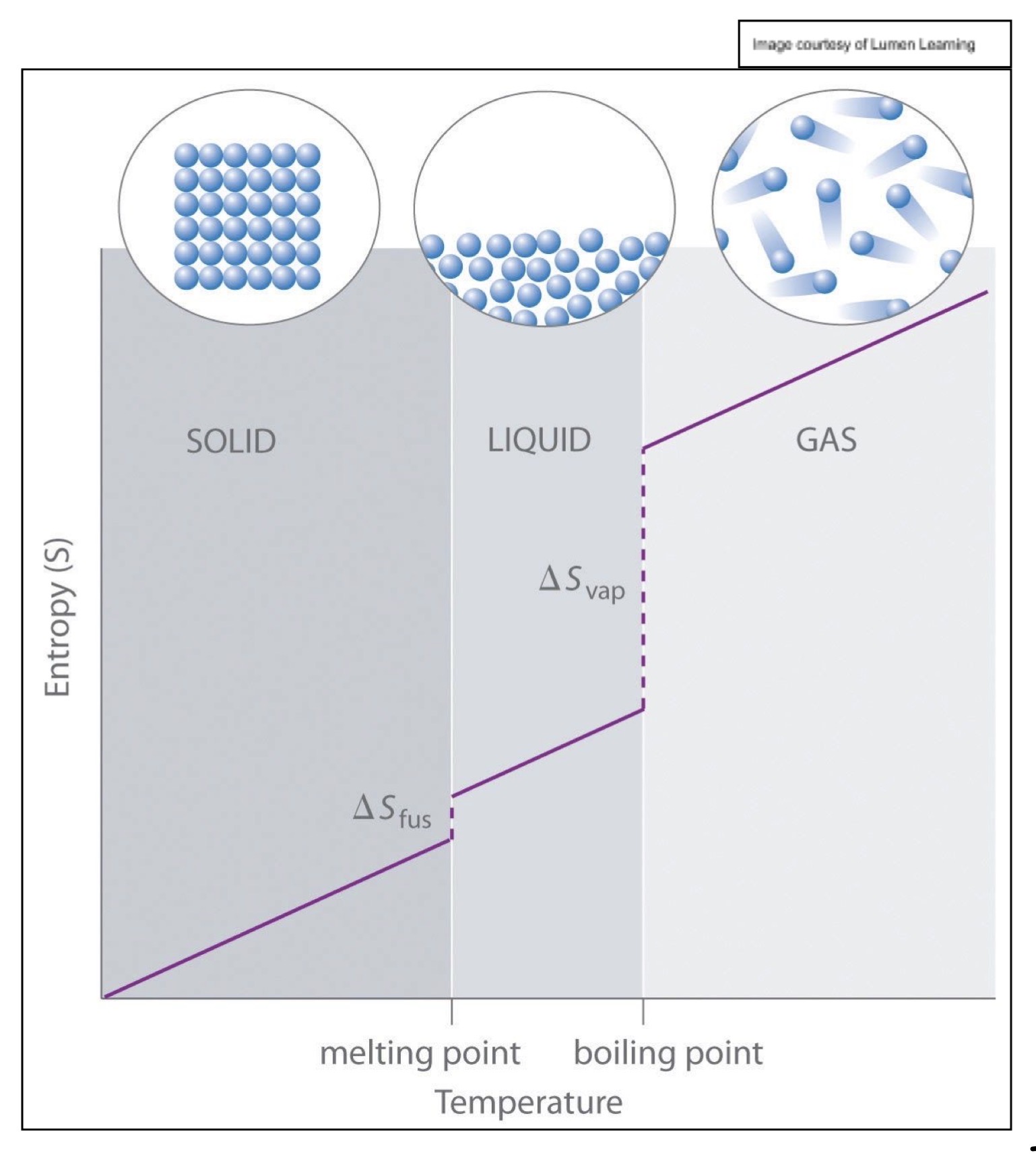
at the melting point
there’s a sudden increase in S
molecules lose their fixed arrangement and absorb heat energy
increased kinetic energy, increased disorder
ΔG = 0
the solid and liquid states coexist
the rate of melting = the rate of freezing
ΔS of vaporisation > ΔS of fusion, because a gas is more disordered than a liquid or solid
vaporisation = liquid to gas
fusion - solid to liquid