CH 3.1 What is Social Stratification
Intro:
Social stratification: hierarchical ranking of individuals/groups → some have advantages.
Inequality: exists within (gender, class, age, ethnicity) and between societies.
Social differentiation: division of roles/statuses; basis for stratification.
Stratification: ranking of people → some seen as superior or more powerful.
Open societies: roles/status can change (e.g., education, effort); modern industrial societies; dynamic stratification.
Closed societies: roles/status fixed by birth; traditional societies; e.g., gender/class restrictions.
Forms of stratification: social class, age, ethnicity, gender.
Intersectionality: multiple factors combine → e.g., young, working-class, female, minority ethnic = lower status/power.
Achieved and Ascribed Status
Ascribed status: A social position given at birth or beyond a person’s control, e.g., age, sex, ethnicity, or royal family membership.
Common in traditional closed societies; life chances mostly determined at birth.
Age: changes over time; adults higher status than children; rites of passage mark adulthood.
Traditional societies → elders respected, cared for.
Modern societies → older people may lose status; ageism (discrimination based on age, usually against elderly).
Achieved status: A social position earned through effort, skills, or choices, e.g., doctor, athlete, or university graduate.
Examples: occupations (teacher, engineer), changing religion, social mobility.
1. Poverty
Definition: A situation where people lack enough money or resources to meet basic needs such as food, shelter, and healthcare.
Types of poverty:
Absolute poverty: When people cannot afford the basic necessities needed for survival, such as food, clean water, shelter, and clothing.
→ Example: Families living on less than $2 a day and lacking enough to eat.
Global standard: <$1.90/day (World Bank, 2017); updated to $2.15/day in 2022
2017: ~700 million people in extreme poverty (down from >1 billion in 1990)
Factors increasing poverty: COVID-19, climate change
Relative poverty: When people have much less than most others in their society, making it hard to participate fully in normal life.
→ Example: A family can afford food and shelter but cannot afford a computer or go on holidays like others in their country.
Common in modern industrial societies
High-risk groups:
Lone parents & children
Unemployed/long-term unemployed
Low-paid workers
Chronically ill/disabled
Welfare-dependent individuals
Refugees, asylum seekers, recent immigrants
Also: women, children, elderly, ethnic minorities
Global Poverty & Risks:
Regions with most extreme poverty: South Asia and Sub-Saharan Africa
South Asia: economic growth lifting many out of poverty
Africa: slower growth, lower starting point → many remain in poverty
Risks faced by the poorest:
Urban slums: temporary homes, few services, no security; risk of demolition
Rural areas: limited access to healthcare, education, other services
Political instability & civil wars: poor most affected; wealthy can escape
Climate change: floods, landslides, pollution, rising sea levels; poor cannot afford to relocate
Causes & Cycle of Poverty
Main causes of poverty:
Born into a poor family
Lack of opportunities for education/qualifications
Unemployment or no income
Low-paid work
Insufficient welfare benefits
Intergenerational poverty: being born into poverty increases adult likelihood of poverty
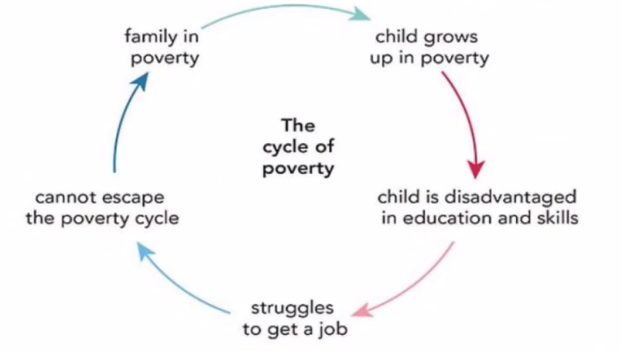
Cycle of poverty: The pattern where poverty is passed on by more than 3 generations, making it hard for families to escape poverty.
Poor parents → children with limited education → low-paid jobs → continue poverty
Lack of resources: poor often lack social and cultural capital (as well as money) → perpetuates poverty
Contrast: children of wealthy parents likely to remain wealthy
Poverty Trap & Culture of Poverty
Poverty trap: A situation where poor people cannot escape poverty because any income they earn is absorbed by basic needs, debt, or taxes, preventing them from improving their situation.
→ Example: Earning a low wage that only covers food and rent, so there’s no money to invest in education or a better job.
Expensive to be poor:
Cannot travel to cheaper supermarkets → pay more locally
Cannot buy in bulk → higher long-term costs
Cannot insulate homes → higher fuel costs
Buy old/second-hand goods → frequent replacement
Cannot afford facilities for opportunities (e.g., childminder)
Unable to borrow from banks → may borrow at high interest rates
Culture of poverty: The idea that poor people develop habits, attitudes, and values (like lack of motivation or reliance on welfare) that keep them in poverty, passing it on to the next generation.
→ Example: Children growing up in families where education is not valued, making it harder to get well-paid jobs.
Characteristics:
Low literacy/education
Inability to plan for future
Immediate gratification vs deferred gratification (linked to educational underachievement)
Fatalism → The belief that people cannot change their social situation and that life outcomes are determined by fate or circumstances.
Feeling excluded from society
Controversy:
Some research: poor share same values as wider society
Risk of victim blaming → not the poor’s fault
Used politically to justify inaction on poverty
2. Wealth
Definition: The resources and assets a person or household owns, allowing them to live comfortably above the average standard of living and have economic power and security.
Forms of wealth:
Stocks/shares → generate dividends
Land
Houses/buildings
Art, jewellery, valuables → often increase in value
Inheritance: wealth often inherited, not earned
Wealth and social class:
Key indicator of status
Very wealthy may not need to work → wealth creates more wealth
Wealthy can be secretive; use tax advisers to reduce tax visibility
Global wealth gap:
Developing countries: stark contrast between rich and poor
Example: Mukesh Ambani – $103bn fortune; owns 27-storey Mumbai house; millions live in slums
Transnational capitalist class (Leslie Sklair): global bourgeoisie
Owners/controllers of transnational corporations
Politicians & bureaucrats (UN, global organisations)
Professionals
Consumerist elites (media, etc.)
Wealth in developed countries:
Higher standard of living than majority of world population
Lifestyle: consumerism, high energy/resource use
Consumerism: A social system where buying and using goods and services is a central part of life and measures status and success.
Most have:
Bank/building society savings
Consumer goods (TVs, computers, cars)
Housing (main form of wealth; not easily liquid)
Pensions (cannot access before retirement)
Shares (majority held by very wealthy)
3. Power
Definition: The ability to achieve goals or influence others even when there is opposition; without power, a person cannot achieve their goals.
Sources of power:
Occupation: police, judges, managers, government officials
Status: gender, age, social class, ethnicity
Men → power over women
Adults → power over children/elderly
Middle class → power over working class
Dominant ethnic group → power over minorities
Uses of power:
Direct: force, threats, legal consequences (job loss, imprisonment, violence)
Indirect: manipulate situations, withhold information
Social exclusion: systematic exclusion from rights, opportunities, resources; prevents full societal participation; politically ignored
Challenging power: more effective collectively
Trade unions → improve pay/conditions, strikes
Protest groups → force change (e.g., Black Lives Matter, 2020)
NGOs → advocate for powerless groups
4. Social Mobility
Definition: movement between social classes
Types:
Upward mobility: move up hierarchy (e.g., working → middle class)
Downward mobility: move down hierarchy (e.g., middle → working class)
Intergenerational: children change class from parents (e.g., working-class child → middle-class job)
Intragenerational: individual changes class in lifetime (e.g., worker → manager)
Open vs Closed societies:
Occurs in open societies; impossible in closed societies
Meritocracy → social position based on talent/effort → high mobility expected
Factors enabling mobility:
Education & qualifications
Promotion/career advancement
Marriage into different class
Changes in wealth (inheritance, lottery)
Patterns:
Upward mobility more common than downward
Most mobility is short-range (e.g., top of working → bottom of middle class)
Sociological perspectives:
Marxist: mobility = safety valve; prevents anger/class conflict; creates illusion of fairness
Functionalist: middle-class positions naturally filled by middle-class origins; assumes inherited intelligence → controversial
Critics: system prevents talent realisation → waste of human resources
5. Meritocracy
Definition: individuals achieve status based on talent, ability, effort
Claimed features in modern open societies:
Equal opportunities in education and employment
Outcome inequalities exist, but opportunities are theoretically equal
Supporters’ view: outcome inequalities are justified → people get what they deserve
Problems with meritocracy:
Unfair: rewards those already advantaged (talent, ability); punishes those without
Not truly equal: wealth/privilege passed to children (e.g., private schooling vs state schools)
Broader context:
Modern industrial societies → social class central
Closed societies → stratification via slavery or caste systems
6. Modern Slavery
Definition: contemporary forms of slavery where people are exploited and have no freedom
Historical context: early closed societies → citizens vs slaves; legal slavery abolished in 19th century
Forms of modern slavery:
Debt bondage: poor borrow money → work to repay debt; low pay + interest → almost impossible to escape
Human trafficking: forced work; victims often imprisoned or controlled
Forced marriage: victim must marry; performs demanding domestic tasks; treated as servant
Victims: often children and females due to power imbalance + minority status or discrimination
Global statistics (2022, Anti-Slavery International):
~40 million people in slavery worldwide
25% children
71% female
Modern slavery often only exposed after serious incidents (e.g., unsafe working conditions, deaths)
7. Caste System
Definition: A closed social hierarchy where people are born into a fixed social group and cannot change their status.
Impacts:
Determines jobs
Controls marriage (must marry within caste)
Rules on ritual, purity, and contact with lower castes
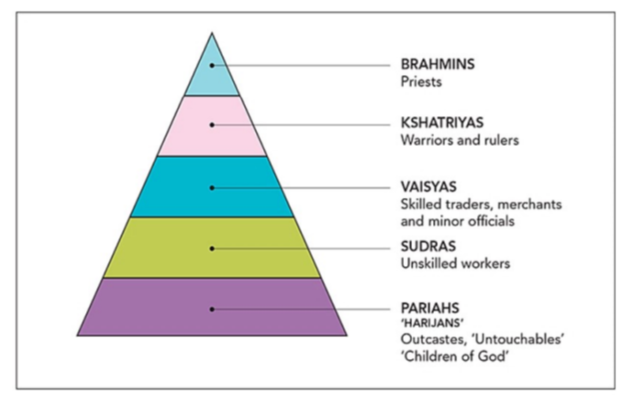
India’s caste system: officially abolished 1950, but social hierarchy persists
Five broad categories:
Brahmins – priests
Kshatriyas – warriors, rulers
Vaisyas – skilled traders, merchants, minor officials
Sudras – unskilled workers
Pariahs/Harijans – outcastes, “Untouchables”
Comparison to other systems:
Slavery & caste → largely closed systems
Social class → more open, allows some mobility, but limited by gender, ethnicity, class
Intersectionality: combination of social class, gender, age, ethnicity → produces patterns of inequality
Differences in life chances affected by age, gender, ethnicity and social class
1. Age and Life Chances
Definition: age affects opportunities in education, employment, health, housing, life expectancy
I. Education
Children/young people: school attendance central; gender, ethnicity, class more relevant than age
Older adults in developing countries: many illiterate → limited life chances
Adult literacy projects run by NGOs improve skills/knowledge
COVID-19 disrupted education globally (school closures, online lessons, TV broadcasts) → negative effect on life chances
II. Employment
Children: limited paid work to protect education
Poorer countries: children may work on farms, markets, home care
Child labour = long hours, low pay, no school → abuse of rights (2020: ~160 million children)
Worst cases linked to modern slavery
Older adults: face ageism (denied promotion, job change)
Welfare states → A system where the government provides support and services like healthcare, education, and benefits to reduce inequality and help people meet basic needs.
→ Example: Free healthcare and unemployment benefits in the UK.
III. Health
Children: improved hygiene, sanitation, nutrition, vaccination → lower risk of diseases
Malaria still major in Africa: 241 million cases, 627k deaths (2020), 80% under 5
Poor nutrition → lower educational achievement
Older adults: vulnerable to age-related diseases (e.g., dementia, slower healing)
COVID-19 highlighted vulnerability
Specialized health services exist; debate over allocation of resources
IV. Housing
Children usually live with family → influenced more by class, ethnicity
Older adults: may live alone or in specialized housing/care homes for independence and support
V. Life Expectancy
Global average: 1800 → 30 yrs; today → 72 yrs
Past: high infant/child mortality → lower average
Infant mortality reduced by:
Vaccinations
Better nutrition, hygiene, living standards
Antenatal/postnatal care (diet, scans, genetic tests)
Longer life expectancy → smaller families, more resources per child
Older adults now live longer post-retirement; centenarians increased (UN: >0.5 million in 2020)
2. Gender and Life Chances
Patriarchal definition: A society or system where men hold most power and authority in politics, work, and family, giving them higher status than women.
I. Education
Historically: boys educated; girls expected to marry → limited qualifications
Developing countries: girls still less likely to attend/complete school
2/3 of illiterate people are female
Example: Chad 74/100 girls vs boys in primary school; Pakistan 84/100; Taliban restricts girls’ education in Afghanistan
Where equality exists: girls perform equally or better, more progress to university
II. Employment
Traditional role: women → home/family, men → income
Women’s work often low-paid, undervalued (cleaning, care, teaching)
Modern trends: many women combine paid work + family responsibilities
Gendered life chances in employment:
Lower pay → financial dependence
Greater risk of poverty (esp. sole earners)
Career interruptions (pregnancy, childcare)
Segregation:
Horizontal: women in “female” jobs (low status/pay), men in higher-status sectors (IT, law, finance)
When men and women work in different types of jobs, often reflecting traditional gender roles.
Vertical: women lower in hierarchy within same sector (“glass ceiling”)
When men and women work in the same field but occupy different levels, with men in higher, more powerful positions and women in lower ones.
Reasons for increased female participation:
Desire for independence, changes in socialization, economic demand, equality legislation, birth control, female role models
Gender division of labour: The different roles and tasks assigned to men and women in work and family life.
III. Health
Men and women differ in health risks:
Women → dementia more common, pregnancy/childbirth risks (303,000 deaths in 2015, higher for poor/uneducated/15-19 yr olds)
Women → domestic violence, FGM
Men → occupational hazards (e.g., mining, factory work), risky behaviour (alcohol, tobacco)
IV. Housing
Usually shared with family → more affected by ethnicity and social class than gender
V. Life Expectancy
Women live ~5 yrs longer than men
Reasons:
Men more exposed to high-risk situations (accidents)
Higher consumption of alcohol, tobacco, drugs
Occupational hazards
Biological factors
3. Ethnicity and Life Chances
Definition: Minority ethnic groups’ opportunities affected by racism (beliefs + behaviour) and racial discrimination (actual disadvantage)
Prejudice: Negative beliefs or attitudes about a person or group without good reason or experience.
Racism: Beliefs or actions that discriminate against people based on their race or ethnicity, treating them as inferior.
Types of racism:
Institutional: When laws, rules, or organisations treat certain racial or ethnic groups unfairly, often without individuals necessarily being racist.
Example: Minority groups getting fewer job promotions or harsher prison sentences.
Cultural: When cultural norms, values, or traditions assume one race is superior, influencing attitudes and behaviour.
Example: Believing Western culture is “better” than other cultures.
I. Education
Teachers usually from majority → may stereotype minority students (lazy/deviant)
Students may internalise negative views → lower achievement
Ethnocentric curriculum disadvantages minority learners
Limits life chances via reduced qualifications
II. Employment
Minority ethnic workers often: low-paid, low-skilled, temporary jobs
Face discrimination in hiring (CV bias, post-interview decisions)
Fewer opportunities for training or promotion
Vertical segregation & glass ceiling effects similar to women
III. Health
Inequalities overlap with social class, but often worse than majority in same class
Some conditions more common (e.g., sickle cell anaemia in African Caribbean population)
Lifestyle factors: smoking, high-fat diet → obesity, heart disease
Stress and discrimination → higher rates of physical & mental health problems
Reluctance to seek outside medical help
IV. Housing
Discrimination in local authority and private housing → informal segregation
Minority communities often concentrated in specific areas (e.g., Chinatown, Little Tokyo)
Housing disadvantages: poor quality, risk of eviction, overcrowding
Low-paid/unstable jobs worsen housing situation
V. Life Expectancy
Lower average life expectancy linked to health inequalities
4. Social Class
Definition: Social class = grouping by occupation, wealth, income, education, status, lifestyle; harder to define than other stratification dimensions
Indicators: wealth, income, housing, occupation, education, status, lifestyle
I. Education
Middle-class children often go to better schools (area, private vs state) → higher life chances, less downward mobility
Working-class children do less well on average due to fewer resources, lower parental support, cultural factors
II. Employment
Occupation used as main indicator
Upper class: very wealthy, may not work; includes aristocracy (inherited) + super-rich (earned)
Middle class: diverse, from small business owners to professionals/managers; generally secure, clean jobs with promotion opportunities
Working class: skilled, semi-skilled, unskilled; often manual, lower pay, more hazardous, fewer benefits
Employment affects life chances via income, safety, promotion opportunities, and work conditions
III. Health
Working-class people more likely to suffer poor health: stress, poor diet, unsafe environment, hazardous work
Fewer local health services; less able to pay for treatment (where not free)
Poor housing + lifestyle factors (smoking, lack of exercise) worsen health outcomes
IV. Housing
Middle-class: better-quality, less damp/overcrowded, safer areas, better air quality
Working-class: poorer quality housing, higher exposure to crime/pollution
V. Life Expectancy
Working-class = lower life expectancy than middle-class
Example (UK, 2017): Males: 74 (most deprived) vs 83.1 (least deprived); Females: 78.9 vs 86.1
Reasons: dangerous jobs, unhealthy environments, less healthcare access, poorer lifestyle choices
Intersectionality of Age, Ethnicity, Gender, and Social Class
Definition: Intersectionality = how multiple aspects of identity (age, gender, ethnicity, social class) combine to shape life chances and experiences of inequality.
Key idea: Factors cannot be considered in isolation; each individual has all four characteristics, producing many possible combinations.
Social class often has the largest impact, but other factors can modify it:
E.g., a working-class male from a majority ethnic group may have advantages due to gender and ethnicity, despite class disadvantages.
Use in sociology: Helps explain why some people face compounded disadvantages while others may experience some advantages.
Sociological Theories of Social Inequality
Here’s a super-condensed, exam-ready version of the sociological theories of inequality:
1. Labelling Theory (Interactionism) – Micro-level
Focuses on small-scale interactions, not society-wide structures.
Key ideas:
Stereotypes → negative assumptions about groups.
Master status → label becomes main identity.
Self-fulfilling prophecy → labelled people act to confirm expectations.
Shows how powerless groups (working-class, women, minority ethnic, some age groups) are disadvantaged.
Applied to education and crime.
2. Marxism – Macro-level
Inequality and poverty are inevitable under capitalism.
Key ideas:
Exploitation → workers paid less than value of work.
When one group takes advantage of another for their own benefit, often without fair reward.
Ideological control → workers manipulated to accept system as fair.
Poverty trap → When people cannot escape poverty because any income they earn is used for basic needs, leaving no chance to improve their situation.
Reserve army of labour → A Marxist idea that refers to unemployed or underemployed workers who can be used by employers when needed, keeping wages low and workers easily replaceable.
Focus: class inequality, globally and locally.
3. Feminism
Focuses on gender inequality.
Key ideas:
Division of labour → women traditionally do unpaid domestic work, men earn.
Dual/triple shift →When someone (usually women) works a paid job and also does unpaid domestic work, sometimes including emotional/family labour.
Horizontal/vertical segregation
Horizontal: When men and women work in different types of jobs.
Vertical: When men and women work in the same field but at different levels, with men in higher positions.
4. Functionalism
Sees inequality as necessary and positive.
Key ideas:
Social mobility → The ability to move up or down the social hierarchy in society, often through education, work, or wealth.
Meritocracy → A system where people succeed based on their abilities, effort, and talent, rather than their social class, wealth, or background.
Legislative change → Changes to laws made by the government to improve society, reduce inequality, or protect rights.
Poverty ensures necessary low-paid jobs are done; reminds society of values.