Week 3A
Neurotransmission Summary
Neurotransmission: Process to which ligands will binds to receptors in the brain
Why we should study this process:
Every process in the brain relies on neurotransmitters binding to receptors → allows us to understand the functioning of the nervous system
With errors in the process their is mood disorders a
New therapeutical drugs could be develops to better disorders
Insight on drug use
Symptoms of poisonous animals
Synaptic Transmission Steps
Action potential travels down to axon terminal
Depolarization in the terminal causes the voltage gated calicum channels
Causes a cascade leading to fusion of vesicles and neurotransmitters
Vesicles fuses with the membrane to release transmitters in the cleft (exocytosis)
Transmitters cross the cleft and bind to their corresponding receptors leading to an IPSP or EPSP
after binding the transmitters is inactive through degradation or removal through transporter
Transporters pump the transmitters back to the axon terminal
Transmitter may activate auto-receptors (in the axon terminal) which decreases the release of more neurotransmitters
Types of Ligands
Degradation of neurotransmitter: rapid break down and inactivation of transmitter by an enzyme
the enzymes that causes the breakdown of neurotransmitters are located in different locations of the synapse
Examples:
Presynaptic Breakdown: Monocamine Oxidase
Postsynaptic Breakdwon: COMT (catchol-O-methyltransferase)
Will break down catecholamines (dopamine,norepinephrine,epinephrine)
Reuptake recycling of transmitter back into the presynaptic neuron
Reuptake: transporter takes the transmitter back into the presynaptic neuron → Think of this as recycling transmitters
Serotonin, dopamine, norepinephrine transporters
will be located on the membrane of the the presynaptic neurons and will indicate the type of neuron that could be made by a neuron since it will only take that specific neuron it made
Transports: Help with presynaptic receptors during reuptake
Autoreceptors: binds to the overflow of transmitter to serve as negative feedback loop in the neuron whcih signals for less transmitters to be made and released
Endogenous v. Exogenous Ligands
Endogenous Ligands: Molecule that is produced in the brain (ex. serotonin)
Exogenous Ligands: Not normally found in the brain of the body
For drugs and caffeine
Agonists: Will bind and act the same as the endogenous ligands to it on
Causes the same natural effect
Antagonists: Will bind and prevent the ligand from being activated. impedes the effects of the agonists
Iontropic and Metabotropic Receptors
Two Major Types of Receptors
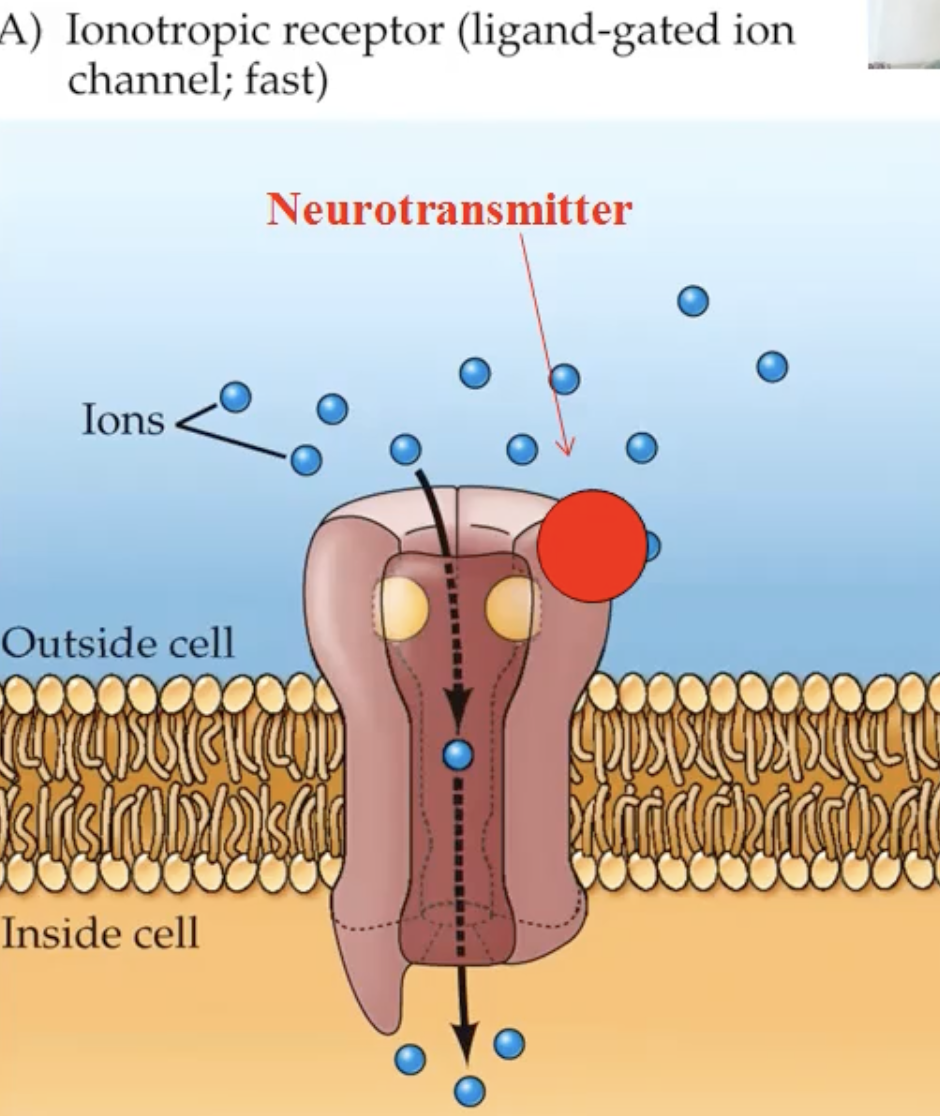
ionic receptors: open when they are bound to a transmitter (ligand-gated ion)
They are fast acting
Short lived membrane voltage
effects are no amplified
metabolic receptors: recognizes the transmitter and initiates a cascade that activates the g protein
transmitter binds to the receptor which activates the g protein to open a channel, trigger a signaling cascade,
Has slow effects on the membrane voltage
effects are amplified through the signaling cascades
Second Mssenger: a molecule that has dowsnteam effects l
Versatility of Neurotransmitters:
one neruon can realse one or two types of neurotransmitters but will responds to many types
their dendrites will hvae different types of receptors
The same types of transmitter can bind to different types of receptors (ionic or metabolic) which alters the speed of responses
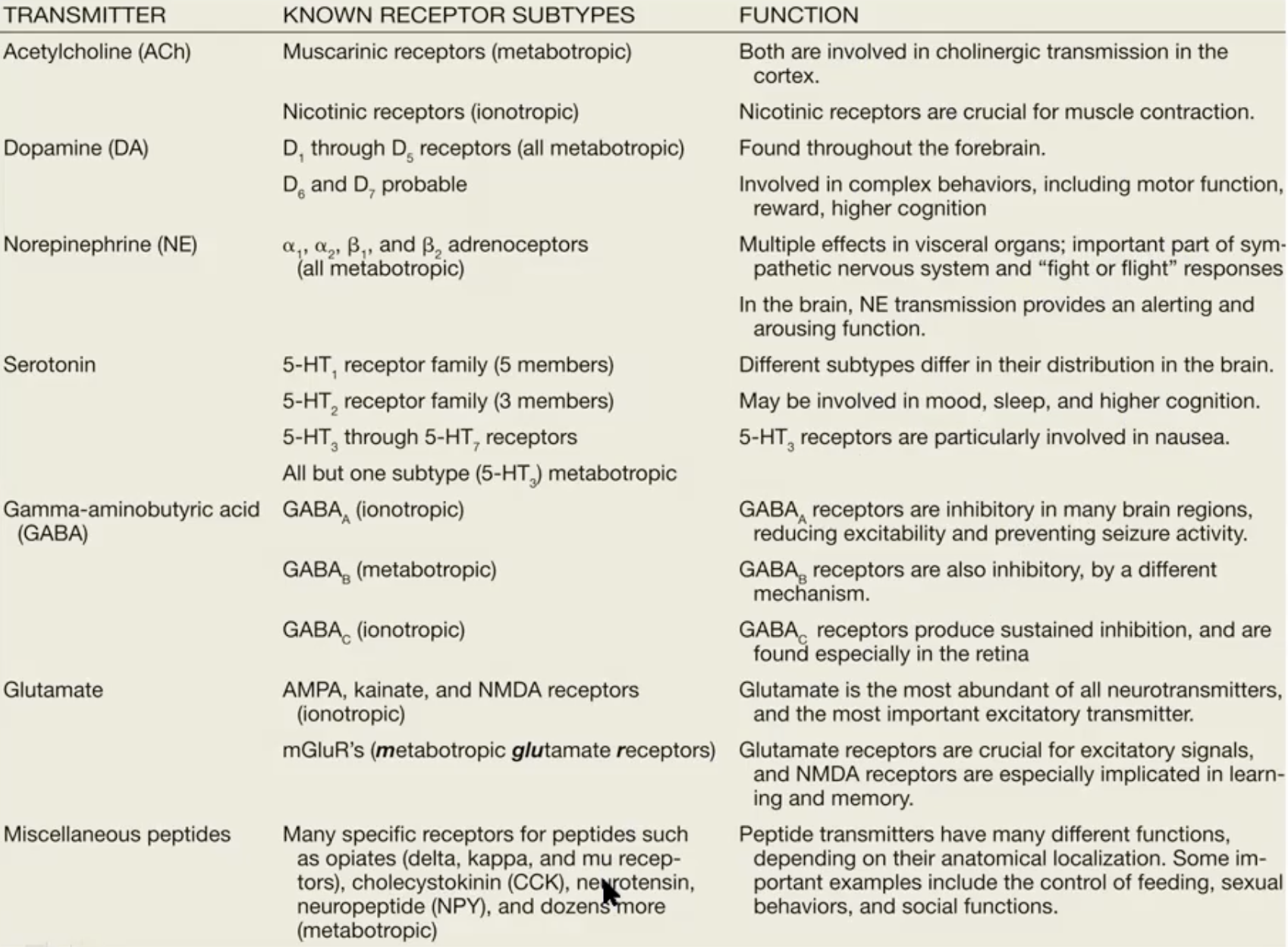
Types of Neurotransmitters
Amino acide: glutamate,gaba
Ionic and metabolic
Most of the fast signaling is due to these
Amine: dopamine,serotonin,norepinephrine, acetylcholine
Lipids-endocannabinoid receptors
Peptide: opioad peptides etc.
Gas: nitric oxide and carbon monozide
ATP
Glutamate and Gaba 7
Glutamate
main excitatory neurotransmitters
responsible for a lot of fast mental function
memory
vision
hearing
Can be ionotropic: ligand gated cation channels that are permeable to sodium and potassium
lots of sodium is rushing in as potassium exits
produce fast epsps
ampa,nmda,kainate
metabotropic: g protein receptors that activate cation channel
produce slow epsps
opens the cation channels through a biochemical cascade
mGluR1-8
GABA
main inhibitory transmitter
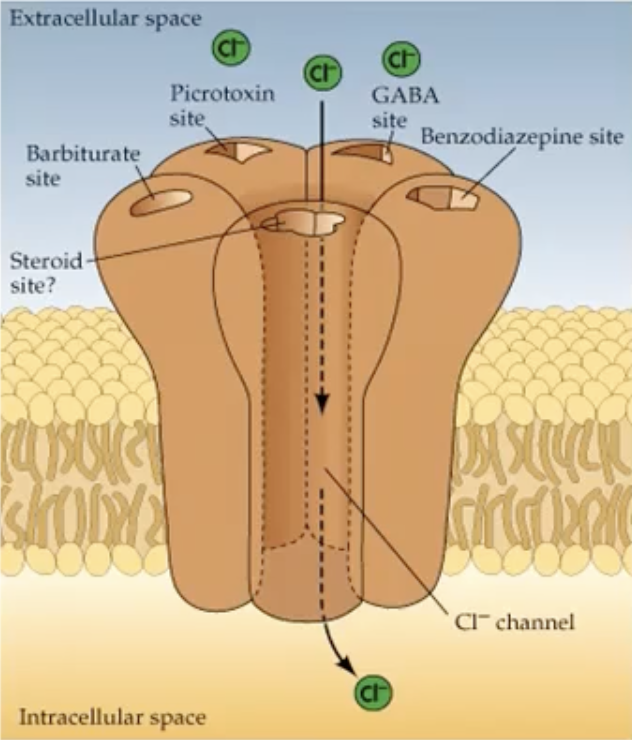
Ionotropic: ligand gated chloride channels which produce fast ipsps
gaba-a
gaba-c
made up of 5 subunits
leads to hyperpolarization of the cell
different drugs can alter the functionality of the receptors by altering how long the GABA will stay bound to the channel
Metabotropic: g protein coupled receptors that activate potassium channels
potassium exits, which decreases the potential inside and creates inhibition
gaba-b
drugs can bind to the receptors to impair or increase the activity of a receptor!
Catecholamines 7
Group of Neurotransmitters that are related in chemical composition
Dopamine
Norepinephrine
Epinephrine
part of the same biosynthetic pathway
Dopamine: can be excititraoy of inhibitroy depending on the type of channel
only has metabotropic receptors
D2 Family Receptors: Inhibitory channels which leads to the opening of potassium channels leading to a decrease of membrane potential
D1 Family Receptors: Excitatory channels which increases cAMP which increases excitability
Pathway Differences
ventral tegmental area (VTA)
involved with motivation and reward
associated with depression and addicition
In the mesolinocortical pathway
Substantia Nigra
Association with movement production
In the mesostriatal pathway
Norepinephrine → Noradrenalin
Concentrated in one nucleus
Released from the adrenal glands and into the bloodstream ← same for epinephrine
response of the autonomic sympathetic system
Control of Arousal and Attention
Low levels: more sleep
Medium Level: more vigilinace and waking
High levels: Leads to anxiety and distractions
Acetylcholine
Acetylcholine: can be an EPSP or EPSP
Supports learning, memory, muscle contraction
Part of the cholingeric system
Two Types of Recepetors
Ionotropic: Nicotinic Cholingeric Receptor
Excitatory
Metabotropic: Muscarinic Cholingeric Receptor
Excitatory or Inhibitory
Curare and Bungarotoxin ← act like antagonists
Muscarine and Nicotine ← act like agonists
Muscarinic Receptors: Metabotroic
EPSP or IPSP
Found in the brain and the parasympathetic section
Nicotine Receptors: Mostly Ionotropic
EPSP
produces changes in the neuromuscular junctions
Nicotinic Acetylcholine Receptors
In the peripheral nervous system
Motor Neurons: Release Acetylcholine
Leads to muscle contraction
Agonist
Nicotine
Antagonist
Curare → leads to body paralysis
When the receptor is blocked then there will be no contraction
Muscarinic Acetylcholine Receptors
EPSP or IPSP
5 types of this receptor
Agonist
Muscarine
Antagonist
Atropine → slows down heart rate
Scopalamine → decreases motion sickness
Depending on the area in which nucleus the cholingeric cells is, the cell will have a different function
Cholingeric Cells are concentrated in nuclei which have axons all over the brain
Serotonin → 5-HT
Serotonin
Has 14 Receptors that are all metabotropic besides one
5-HT3 Receptor
there are different components that affect the pathway
Selective Agonists
Busiprone → treats anxiety and depression
Nonselective Agonists
LSD
Selective Serotonin Reuptake Inhibitors
Prozac is used as a antidepressant since it will inhibit reuptake
Nonselective Serotonin Reuptake Inhibitors
MDMA
Signaling
Transported into vesicles through VMAT2 (vesicular transporter)
Monoamine Oxidase will degrade it and inactivates it
Autoreceptors slow down its release
Taken back into the presynaptic neuron by a serotonin transporter
targetting certain systems of the serotonin signaling pathway leads to distinct effects
Serotonin system illustrates that there are lots of side effects when developing drugs → there is a lack of specific drugs because everything is connected
The Raphe → nuclues where serotonin cells are concentrated in
Dorsal Raphe:
Median Raph
Cannabinoids
Cannabinoids Transmitter System
Major Exogenous Lipid for recept: THC is the ligand which is the active ingredient is weed
Endocannabinoids are lipids
Retrograde tranmitters; will send transmitters from the post synaptic cell to the pre synapitic cell
Aren’t packed into vesicles
Endocannabinoid Receptors
Ex if there is too much glutamate being released, the postsynaptic cell will make an endocannabinoid to create a signaling pathway to decrease glutamate by decreasing calcium levels
Most wide spread receptor in the brain
Leads to reduced neurotransmission
GABA, glutamate, endocannabinoid cells are widespread throughout the brain
There is different concentrations of the neurotransmitter systems throughout the brain
familiarize yourself with gen concepts
whats an agonist, whats an antagonist
how are EPSPs produced
what are metabotropic and ionotropic receptors
We should know the function of the transmitters