Unit 2 Psych Review
Techniques to Learn About Structure and Function
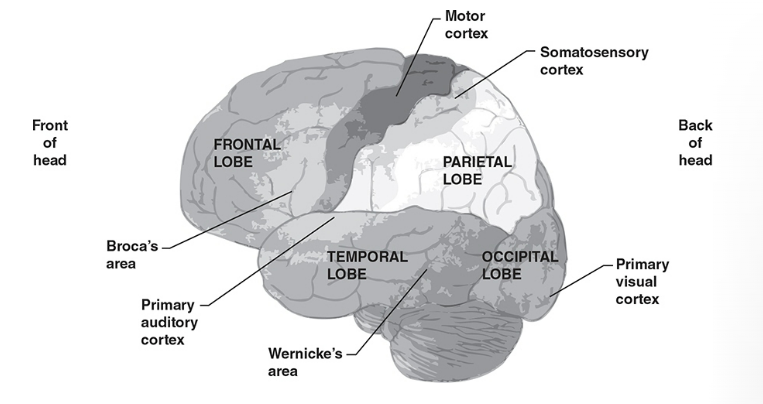
Broca’s area - part of the left frontal lobe
destruction can cause loss of the ability to speak
expressive aphasia
Wernicke’s area
destruction results in loss of the ability to comprehend written and spoken language
receptive aphasia
Lesions - the precise destruction of brain tissue, cutting of neural connections or destruction by chemical applications
Computerized Axial Tomography (CAT or CT) - computerized image using X-rays passing through various angles of the brain showing two-dimensional slices that can be arranged to show the extent of a lesion
Magnetic Resonance Imaging (MRI) - a magnetic field and pulses of radio waves cause a faint radio signal emissions that depend on the density of the tissue
Measuring Brain Function
EEG (electroencephalogram) - amplified tracing of brain activity produced when electrodes positioned over the scalp transmit signals about the brain’s electrical activity to an EEG machine
Positron Emission Tomography (PET) - produced color computer graphics that depend on metabolic activity of the brain
Functional MRI (fMRI) - brain at work at higher resolution than a PET scan
Magnetic Source Image (MSI) - produced by a magnetoencephalography (MEG) which is able to detect the slight magnetic field caused by electric potentials in the brain
Organization of Your Nervous System
CNS (Central Nervous System) - brain and spinal cord
Peripheral Nervous System (PNS) - somatic nervous systema and autonomic nervous system
outside the midline portion of your nervous system carrying sensory information to and motor information away from the CNS via spinal and cranial nerves
Somatic Nervous System (SNS) - motor neurons that stimulate skeletal (voluntary) muscle
Autonomic Nervous System (ANS) - motor neurons that stimulate smooth (involuntary) and heart muscle
antagonistic sympathetic nervous system
results in responses that help body deal with stressful events
parasympathetic nervous system
calms the body following sympathetic stimulation
Spinal Cord
The Brain
Old Mammalian Brain
New mammalian Brain
Convolutions
gyri - peaks on the surface of the cortex
sulci - valleys on the surface of the cortex
deeper ones are called fissures
Localization and Lateralization of the Brain’s Function
Association Areas - regions on cerebral cortex that do not have specific sensory or motor functions but are involved in higher mental functions
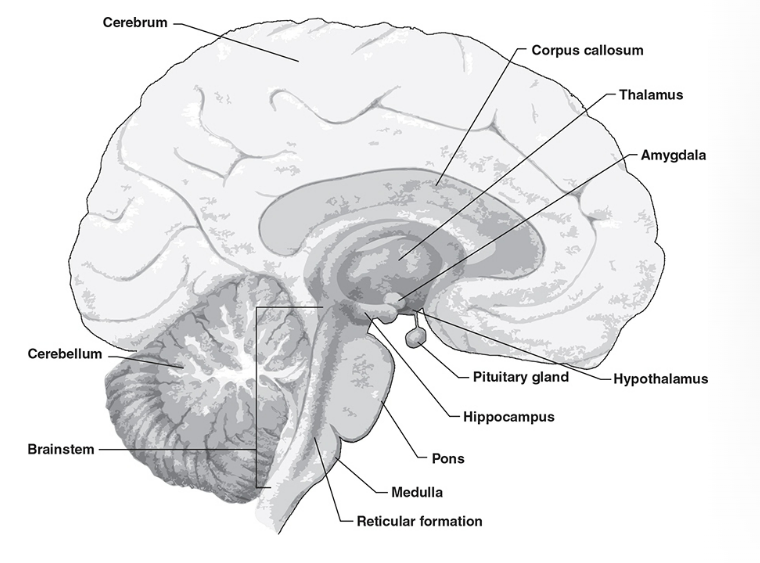
Medulla - regulates heart rhythm, blood flow, breathing rate, digestion
Pons - sends information to and from medulla, cerebellum, and cerebral cortex
Cerebellum - controls posture, equilibrium, and movement
Basal Ganglia - regulates initiation of movements, balance, eye movements, and posture, and processing of implicit memories
Thalamus - visual, auditory, taste, somatosensory information
Hypothalamus - feeding behavior, body temp, sexual behavior, rage, activation of sympathetic and parasympathetic
Hippocampus - enables formation of new long-term memories
Cerebral Cortex - higher-order processes
thinking, planning, judgement
receives and processes sensory info and directs movement
 Plasticity
Structure and Function of the Neuron
 Glial Cells - guide growth of developing neurons
helps provide nutrition for and get rid of wastes of neurons
forms sheath around neurons that speeds conduction
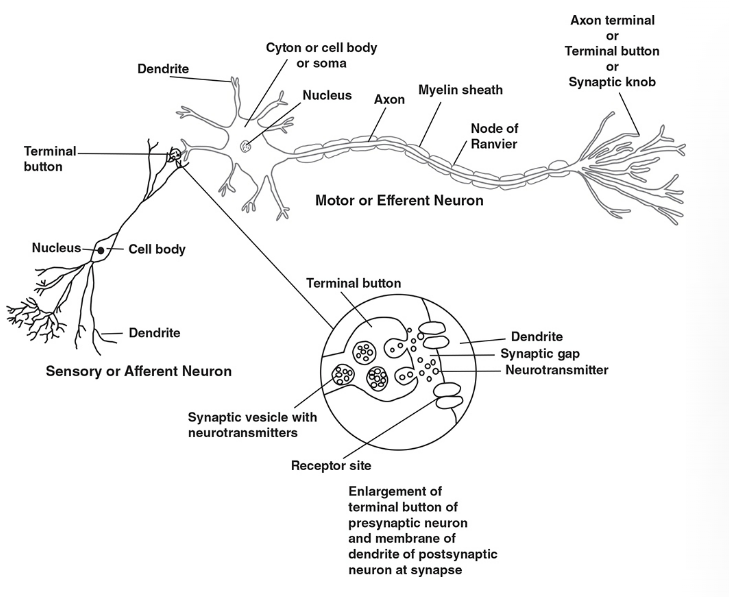
neuron - basic unit of structure and function of your nervous system
cell body - cytoplasm, nucleus which directs synthesis of such substances as neurotransmitters
dendrites - tubular branches capable of receiving information
axon - single conducting fiber that branches and ends in terminal buttons, axon terminals, or synaptic knobs usually covered by myelin sheath
dopamine - stimulates the hypothalamus to synthesize hormones and affects alertness and movement
serotonin - associated with sexual activity, concentration and attention, moods, and emotions
norepinephrine - attentiveness, sleeping, dreaming, and learning
antagonists - block a receptor site, inhibiting the effect of the neurotransmitter or agonist
Neuron Functions
urinal
excitatory
inhibitory
Reflex Action
reflex → reflex arc
interneurons - located entirely within brain and spinal cord, intervenes between sensory and motor neurons
efferent neurons - transmits impulses from your sensory or interneurons to muscle cells that contract or gland cells that secrete
effectors - muscle and gland cells
The Endocrine System
consists of glands that secrete chemical messengers called hormones into blood
Pineal Gland - produced melatonin helps regulate circadian rhythms and is associated with seasonal affective disorder
Hypothalamus - produces hormones that stimulate or inhibit secretion of hormones by the pituitary
Pituitary Gland -
Thyroid Gland - produces thyroxine → stimulates and maintains metabolic activities
Adrenal Glands
Pancreas - insulin and glucagon, regulates blood sugar that fuels all behavioral processes
Genetics and Evolutionary Psychology
nature-nurture controversy
evolutionary psychologists - natural selection
Genetics and Behavior
Behavioral geneticists
Heritability - the proportion of variation among individuals in a population that is due to genetic causes
Transmission of Hereditary Characteristics
Chromosomes - 46 of ‘em, eggs have 23 each
Turner Syndrome - only one X sex chromosome
Klinefelter’s syndrome - XXY zygote
dominant and recessive genes
Levels of Consciousness
Preconscious - level of consciousness outside awareness but can be brought into conscious awareness easily
Nonconscious - devoted to processes, inaccessible to conscious awareness
unconscious - the subconscious containing unacceptable feelings, wished, and thoughts not directly available to awareness
dual processing
unconsciousness - loss of responsiveness to environment
Sleep and Dreams
Hypothalamus - systematically regulates and changed activity levels over the course of the day
Circadian Rhythm
Hypnagogic State - relaxed and rail to respond to outside stimuli
NREM-1 - theta waves
NREM-2 - high bursts of brain activity
NREM-3 - high amplitude and very low-frequency delta waves
REM - rapid eye movement
Interpretations of Dreams
Freud
latent and manifest content of dreams
Sleep Disorders
Insomnia - inability to fall or stay asleep
Narcolepsy - awake person uncontrollably falls asleep often directly into REM sleeps
Sleep Apnea - stopping of breathing during sleep and awakening repeatedly during the night
Hypnosis
altered state of consciousness in deep relaxation and heightened suggestibility
Meditation
Drugs
Psychoactive Drugs -