Psych&100 - Brain and Behavior
The nervous system: The system that regulates the body’s responses to internal and external stimuli. Consists of:
Central nervous system
Peripheral nervous system
Neurons: Nerve cells that provide communication. Each of us has more than 100 billion neurons in
our body, most of which are found in the brain.
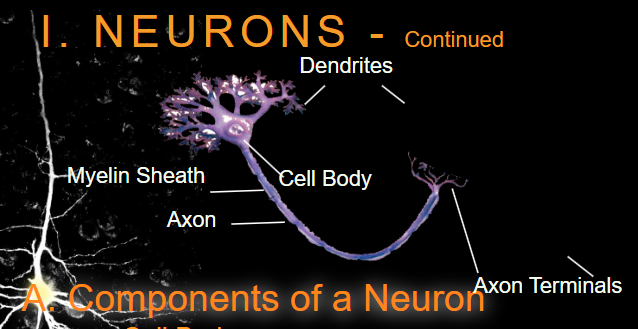 Components of a Neuron
Cell Body: Produces energy for the cell
Dendrites: Receives impulses and conducts them to the cell body
Axon: Carries messages away from the cell body
Myelin: Insulates and protects the axon.
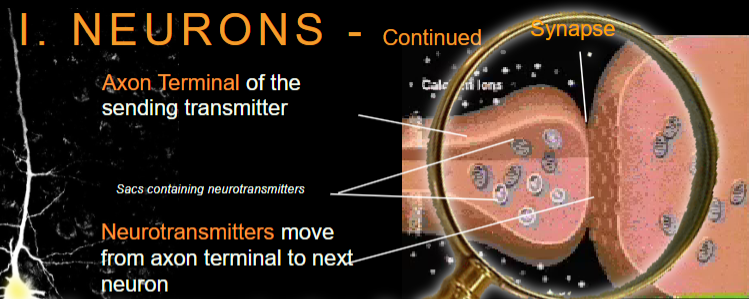
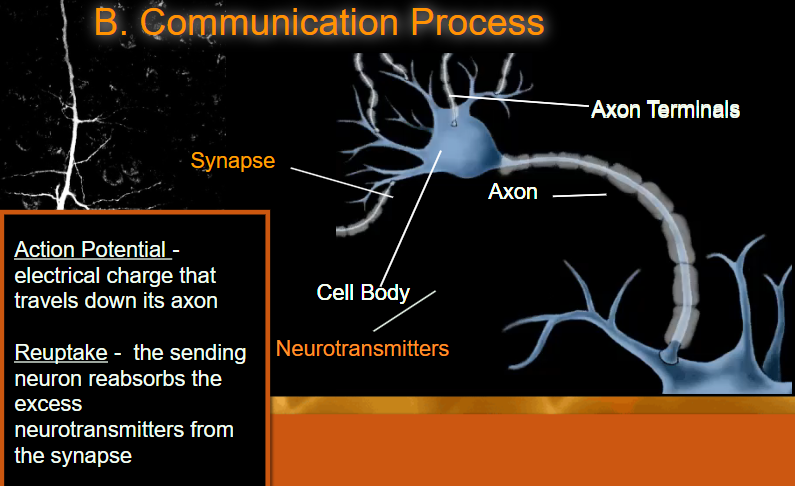
Communication Process
Synapse: The junction between the axon terminals of one neuron & the dendrites of another neuron
Neurotransmitter: A chemical messenger that carries impulses across the synaptic gap across transmitters
Fast Fact - Abuse of the drug ecstasy, inhibits the natural production of the neurotransmitters Endorphins; when off of the drug, depression is a chronic disorder
Small fiber: sensation, aging will destroy Large fiber: motor, not much of a decrease w/o condition
 The Nervous System: The system that regulates the body's responses to internal &
external stimuli. Consists of the following:
Central Nervous System:
Brain
Spinal cord - columns of nerves within the spine that transmit messages to and from the brain
Peripheral Nervous System:
Communicates between the central nervous system and all body parts.
Somatic NS: transmits senses to the central nervous system. temp – pressure
Automatic NS: regulates the body’s vital functions, Ex. heartbeat, breathing, digestion, & blood pressure
Fast Fact: The spinal cord is as thick as a thumb.
The Brain
Divided into 3 sections:
Hindbrain
Midbrain
Forebrain
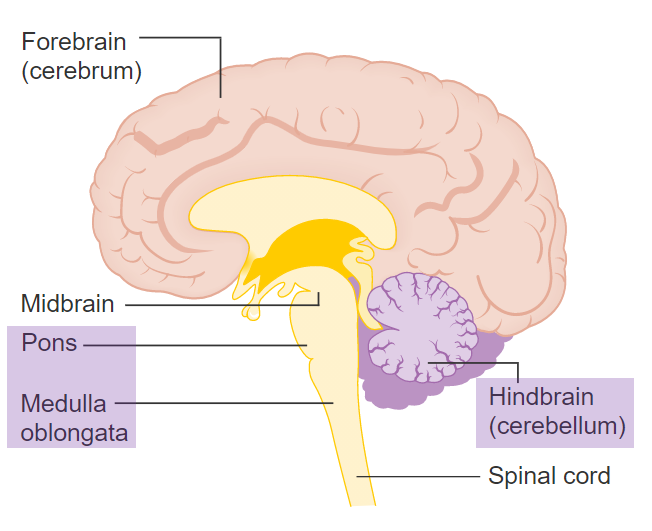
Hindbrain
Lower portions - vital functions, heart rate, respirations, and balance
Medulla: vital function
Pons: body movement, attention, sleep
Cerebellum: balance and coordination
Midbrain
Involved with vision and hearing
Reticular activating system - attention, sleep, arousal
Forebrain
Thalamus: is a relay station for sensory info.
Hypothalamus: Regulates body temp., motivation, & emotion. Also involved in hunger, thirst, & sex behavior.
Limbic System: memory, emotion, sex, aggression. - Hippocampus & Amygdala
Cerebrum: Large part of the brain - 70% of vol.
Coordination of voluntary activity in the body.
Fast Fact - The lower brain functions do not require any conscious thought or effort and are not aware of these activities. Imagine if we were aware of all this information processed by our brain.
Fast Fact - Alcohol affects the Reticular Activating System to depress our reaction time.
Cerebral Cortex: Wrinkled part of the brain - controls mental processes like thought.
4 lobes of the Cerebral Cortex
Frontal Lobe - Movement & thinking
Parietal lobe - touch sensation & spatial relationships
Occipital lobe - visual cortex
Temporal lobe - process sounds, including speech
Motor Cortex: an area behind the frontal lobes that controls movement
Sensory Cortex: receives info from skin senses and from the movement of body parts
Association Areas: involved in higher mental functions: learning, remembering, thinking, and speaking.
Broca’s Area - Producing language, Lft hemisphere
Broca’s Aphasia: understand language, hard to find words, aware of their problems
Wernicke’s area: speech comprehension
Wernicke’s Aphasia: a disorder caused by damage to Wernicke’s area
difficultly understanding speech
Speech is intelligible-nonsense words
unaware of their disability
Corpus Callosum: the structure that connects the two hemispheres of the brain.
Left hemisphere: controls language, logic, problem solving & math
Right hemisphere: deals w/imagination, feelings, art, & spatial relations.
Fast Fact - The brain is protected by the skull and three membranes, called meninges. Also, a fluid surrounds the brain and acts as a shock absorber