Waves and the Electromagnetic Spectrum
There are two types of waves:
- transverse - waves where particles oscillate perpendicular to the direction of energy transfer
- energy transfer is in the same direction as the wave motion
- transfer energy but not particles
- transverse waves can move in liquid or solid, but not as a gas
- some of them can move in a vacuum
- examples
- ripples on water
- guitar string vibrations
- S-waves
- electromagnetic waves
- longitudinal - waves where particles oscillate parallel to the direction of energy transfer
- energy transfer in the same direction as motion of the wave
- transfer energy but not particles
- can move in solids, liquids and gases
- cannot move in a vacuum
- examples
- sound waves
- P-waves
- pressure waves caused by repeated movements in a liquid or gas
Areas close together in a longitudinal wave are compressions. Areas spaced apart are rarefactions.
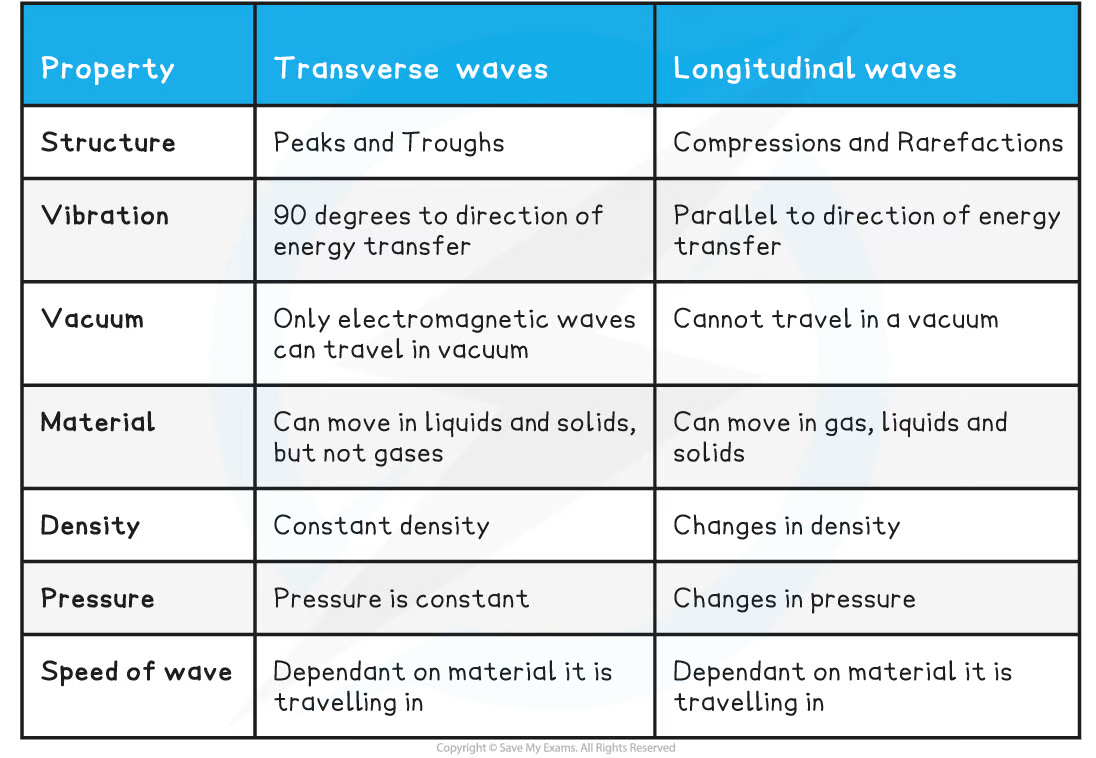
Waves transfer energy and information and are oscillations about a fixed point. In all cases, they transfer energy without transferring matter.
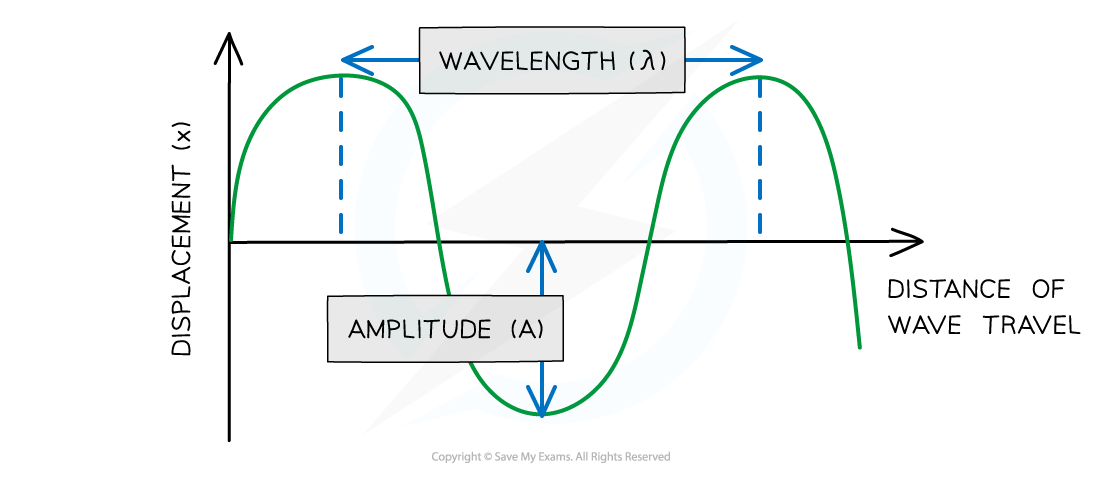
Amplitude is the distance from the undisturbed position to the peak or trough of a wave. It is the maximum or minimum displacement from the undisturbed position. Wavelength is the distance from one point on the wave to the same point on the next wave. For transverse waves, you can measure this from one peak to the next peak, whereas for longitudinal waves, you measure this from the centre of one compression to the centre of the next. Frequency is the number of waves passing a point in a second. The time period is the time taken for a single wave to pass a point. The time period and frequency are found using the equation f = 1/T. To calculate wave speed, you can use the equation v = fλ
A wavefront is a method of picturing waves from above. The arrow shows direction, sometimes being called a ray. Space between wavefronts represents a wavelength.
Electromagnetic waves are transverse waves that transfer energy from the source of the waves to an absorber. Their properties are:
- transverse
- can travel through a vacuum
- travel at the same speed in a vacuum
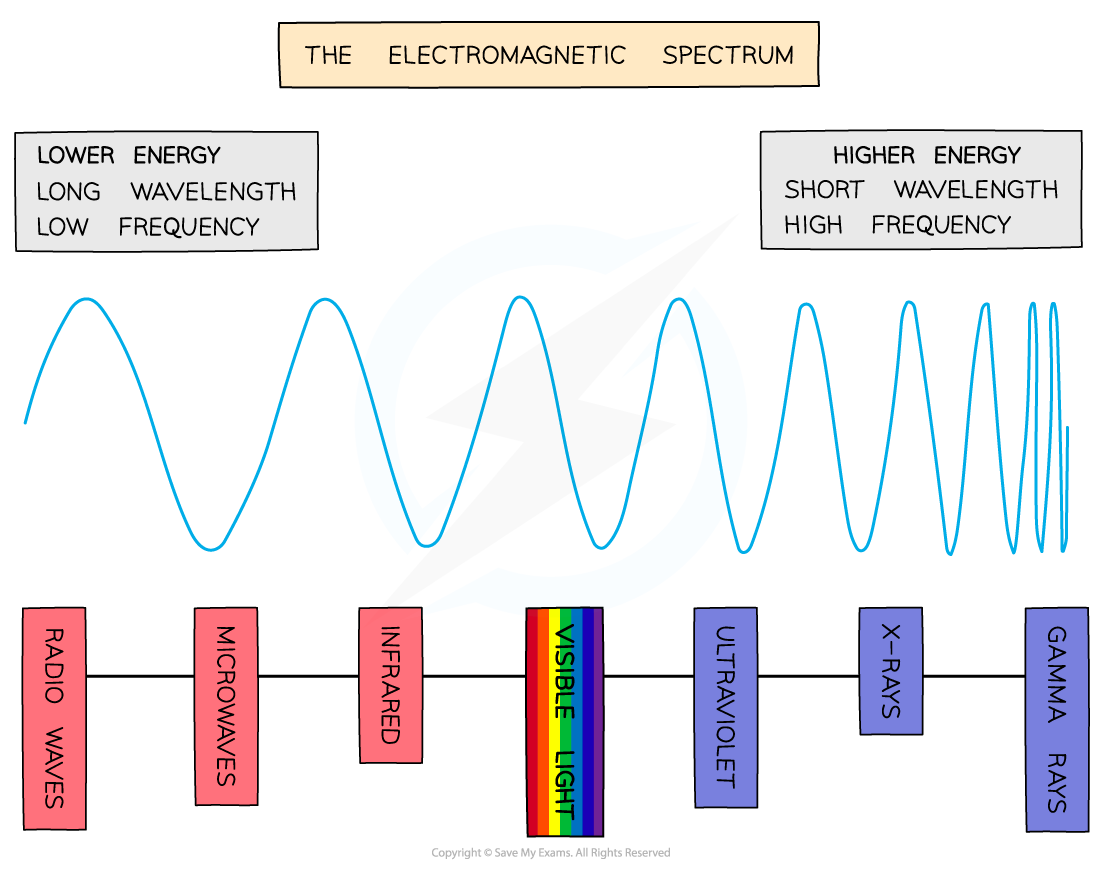
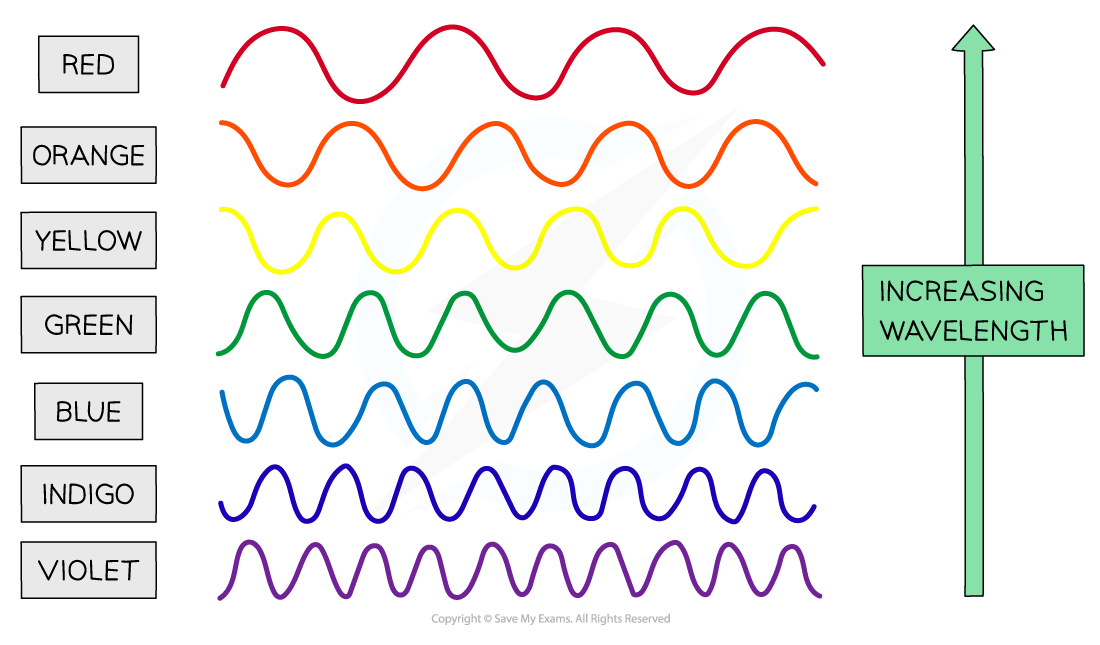
A higher frequency means that there is more radiation energy (more ionising, harmful to cells). Radiation with lower energy is better for communications and less harmful to humans. Wavelength and frequency are inversely proportional, meaning that increases in wavelength are a decrease in frequency and vice versa.
- Radio waves - used for long-range communications as they can be reflected from Earth’s atmosphere
- Microwaves - used for satellite communications as microwaves can penetrate earth’s atmosphere
- microwave dangers - possible heat damage to internal organs
- Infrared waves - used for optical fibre communication because they can undergo total internal reflection
- infrared dangers - skin burns
- Visible light - used for taking photos and videos as cameras are set up to detect visible light
- visible light dangers - bright light causes eye damage
- Ultraviolet - used for detecting security ink because if fluoresces with ultraviolet lighting
- ultraviolet dangers - eye damage, sunburn, skin cancer
- X-rays - used to photograph bones because they can penetrate soft tissues but not bone
- X-rays dangers - kills cells, mutations, cancer
- Gamma rays - used to sterilise medical tools because gamma kills bacteria
- gamma rays dangers - kills cells, mutations, cancer