BIO 112 Notes: Plants and their Roots
Growth of stems in the dark versus the light
Stems growing in the dark: ==grow upwards== and have ==less circular motion== compared to plants that grow in the light; they also have an overall straighter motion.
Plants growing in the light: have more ==circular movement== than dark-grown plants. When dark-grown plants are placed in the light, they ==move towards the light== by bending themselves in the light’s direction.
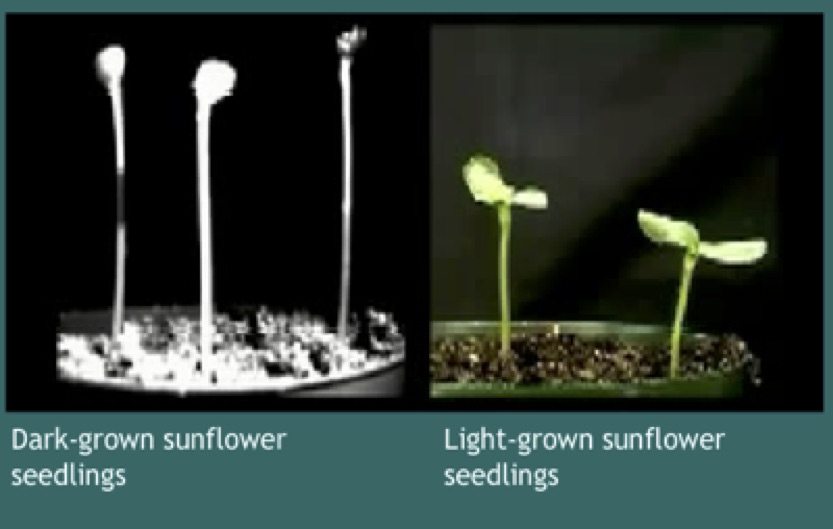
Rapid growth in dark-grown seedlings
If germination occurs in darkness, ==root growth slows== after the shoot emerges, and ==shoot elongation accelerates.==
This behavior increases the chance that the seedling will emerge from the soil into the light where it will be able to obtain energy from sunlight by photosynthesis. Once a seedling emerges into the light, the plant undergoes dramatic changes such as ==turning green and producing leaves.==
- This light-dependent developmental transformation is called ==photomorphogenesis.==
Photomorphogenesis: light-dependent developmental transformation
Shoot elongation: accelerates in dark-grown seeds
Root growth: slows in dark-grown seeds
Plants growing in the light
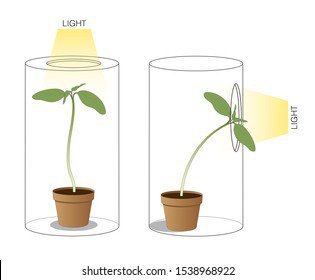
When the light ==comes from one side only==, plants ==grow sideways in the direction of the light==.
They will bend their stems and abandon the desire to stand straight, only wanting to absorb as much light as possible. They respond to light in this way because ==they need sunlight to photosynthesize== and face the sun to do that.
Photosynthesis: the process of a plant absorbing sunlight and turning it into chemical food
What happens to the leaves at night
At night, the leaves go to “sleep.” Technically, they just ==close themselves up and bend over,== almost appearing to droop like they’re tired of standing up.
- At first, the leaves stood in a horizontal position, which was best for catching the sunlight. Later, they had fallen into a more vertical position when they faced the ground.
Position of plants: in the daytime, plants stand straight up to catch sunlight; however, at night, they droop down
What controls the change in leaves from night to day?
- The ==plant’s biological clock== controls the change in leaves from night to day.
- It is also controlled by the ==leaves’ response to light==. The plant’s clock is able to calculate how might time has passed and when to move its leaves to match the changing sunlight.
Biological clock: a system in plants to tell what time of day it is
Nutation
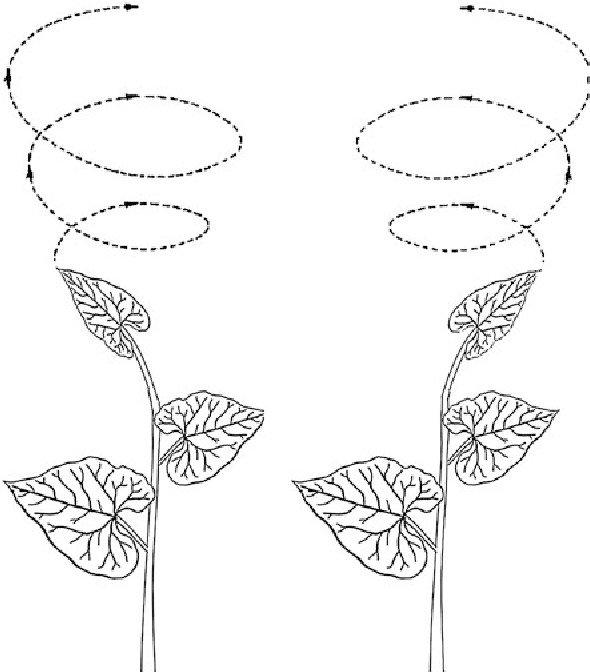
Nutation is the process by which ==stems and leaves bend themselves due to differences in growth== in different parts of the plant’s organs.
Nutation is beneficial to plants by ==helping plants latch onto objects== in their surroundings, as morning glory vines do.
Direction of roots and root hair \n
Roots grow ==downwards== because of the gravity of Earth.
- Positive gravitropism: causes plants to grow downwards. Roots usually have to avoid hitting rocks and soil clumps below by changing their downward path.
- Root hairs: formations of epidermal cells behind the root apical meristem. They assist in the uptake of water and minerals from the soil. \n