subject guide notes
C1.3.1—Transformation of light energy to chemical energy when carbon compounds are produced in photosynthesis
organisms hv developed the ability to absorb light energy from sun & convert it into chemical energy, in the form of glucose & other carbon compounds
this provides energy for all organisms
producers use photosynthesis to produce energy & carbon compounds. these are transferred to the primary consumer, then secondary consumer, then tertiary consumer
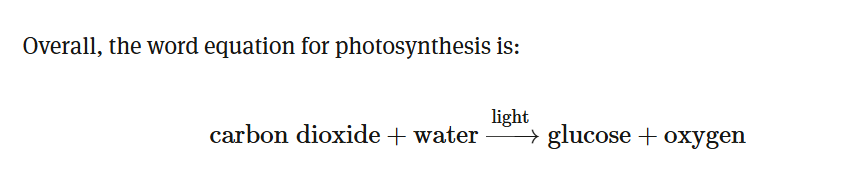
C1.3.2—Conversion of carbon dioxide to glucose in photosynthesis using hydrogen obtained by splitting water
hydrogen is needed to convert CO2 to glucose
water is common source for hydrogen
photolysis splits the water, so hydrogen can be accessed
byproduct is oxygen
C1.3.3—Oxygen as a by-product of photosynthesis in plants, algae and cyanobacteria
remember - the oxygen produced by photosynthesis comes from the splitting of water
without release of oxygen - life wouldn’t exist
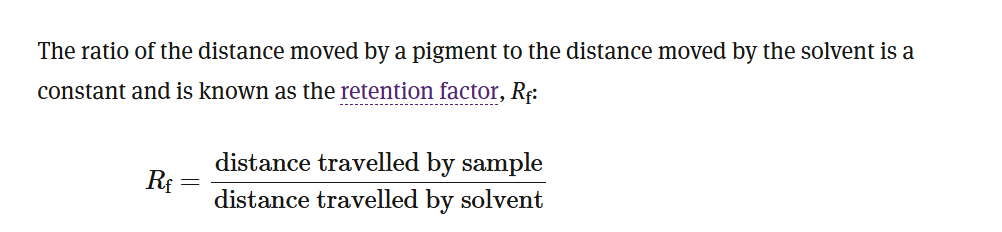
C1.3.4—Separation and identification of photosynthetic pigments by chromatography
C1.3.5—Absorption of specific wavelengths of light by photosynthetic pigments
different photosynthetic pigments, such as chlorophyll a & b & xanthophyll & carotenoids, all absorb & reflect different wavelengths of light
the wavelengths reflected give the pigments their color
photons of light & the energy they carry, excite the electrons in the chlorophyll, which’re used to power the light-dependent stage
C1.3.6—Similarities and differences of absorption and action spectra
both these graphs involve a depiction of wavelengths
absorption spectra focus more on the wavelengths that’re absorbed by each pigment
action spectra depicts which wavelengths are most efficient for photosynthesis
C1.3.7—Techniques for varying concentrations of carbon dioxide, light intensity or temperature
experimentally to investigate the effects of limiting factors on the rate of photosynthesis
rate of photosynthesis can be limited by different limiting factors, such as:
CO2 concentration
light intensity
temperature
in experiments:
CO2 concentration can be adjusted by using sodium hydrogen carbonate
light intensity can be adjusted by changing the distance of the primary light source
temperature can be changed by using an ice bath
C1.3.8—Carbon dioxide enrichment experiments as a means of predicting future rates of photosynthesis and plant growth
these experiments help us understand how plants respond to high CO2 levels
two methods:
using enclosed greenhouses - if other conditions are controlled & there’s a control greenhouse that doesn’t hv enriched CO2, then the effect of CO2 enrichment can be measured through different ways
one of these ways is the total biomass produced, which could be measured through the yield of fruits or vegetables produced
does involve natural factors that aren’t considered
free-air carbon dioxide enrichment experiments (FACE) - CO2 is released in a circular area
pipes surround the area & continuously release CO2
sensors in the area monitor CO2 levels to ensure that elevated levels are maintained
is a natural way of measuring impact of high CO2 levels
but is expensive to carry out
C1.3.9—Photosystems as arrays of pigment molecules that can generate and emit excited electrons
photosynthesis begins with photosystems
photosystems are always located on membranes
in plants they’re located on the thylakoid membranes of chloroplast
occur in cyanobacteria & the chloroplasts of photosynthetic eukaryotes
chlorophyll a molecule within the photosystem functions as a reaction centre
pigments (which include chlorophyll a, b, & accessory pigments) are arranged in such a way that maximises light absorption across multiple wavelengths & energy transfer to the reaction centre
when photons of light strike the pigment molecules, they’re excited
excited electrons transferred through pigment array until they reach the reaction centre chlorophyll molecule
here, photoactivation occurs, releasing an excited electron
two types of photosystems - photosystem I & photosystem II
photosystem I is more sensitive to wavelengths of 700nm, & photosystem II is more sensitive to wavelengths of 680nm
this doesn’t mean they can only absorb light of this wavelength - their pigments allow them to absorb a range of wavelengths. it’s just that these wavelengths are the most effective at activating the chlorophylls & exciting electrons
photosystem II is first photosystem to be activated by light
C1.3.10—Advantages of the structured array of different types of pigment molecules in a photosystem
a single molecule of chlorophyll or pigments would not be able to complete a single part of photosynthesis
wider collection of pigments = wider range of wavelengths 3can be absorbed
if light energy was absorbed by individual pigments, there wouldn’t be enough energy generated to excite the electrons
C1.3.11—Generation of oxygen by the photolysis of water in photosystem II
release of electrons from photosystem II = creates unstable molecule in oxidised state
reaction centre is now oxidised, making it more powerful
this is the reason for photolysis?
photolysis also provides a continuous supply of electrons, replacing the electrons lost by photosystem II

C1.3.12—ATP production by chemiosmosis in thylakoids
photophosphorylation uses chemiosmosis to produce ATP?
excited electrons are released to the ETC
as they move, they lose energy
this energy is used to carry out chemiosmosis
hydrogen ions (protons) are pumped from the stroma into the thylakoid lumen
thylakoid membrane impermeable to protons = high buildup or concentration of protons in the thylakoid membrane
establishes electrochemical gradient
similar to cell resp - protons move through ATP synthase
as they flow, they release enough energy to phosphorylate ADP into ATP
photophosphorylation can be cyclic or non-cyclic
cyclic is when the electrons are lost from & return to the same photosystem
non-cyclic is when electrons are lost from photosystem II BUT return to photosystem I
C1.3.13—Reduction of NADP by photosystem I
NADP (Nicotinamide Adenine Dinucleotide phosphate) is electron carrier
accepts 2 electrons from photosystem I & one hydrogen from the stroma
C1.3.14—Thylakoids as systems for performing the light-dependent reactions of photosynthesis
thylakoid membrane contains: photosystems, ETC & ATP synthase
so, photolysis, ATP production via chemiosmosis & reduction of NADP occur in the membrane
small intermembrane space within the thylakoids helps create the electrochemical gradient (cu the space is so small & narrow that the H+ build up)
intermembrane space - also where water is split by photolysis, producing oxygen
grana provide lots of SA to allow for lots of ATP synthase, ETC & photosystems
C1.3.15—Carbon fixation by Rubisco
CO2 is fixed by adding it to Ribulose bisphosphate (RuBP)
forms 2 molecules of glycerate 3-phosphate (GP)
this reaction is catalysed by Rubisco
Calvin Cycle occurs in the stroma
this is where there’s a high concentration of Rubisco
many molecules of Rubisco are needed cuz it’s a relatively slow enzyme
it can also be competitively inhibited by oxygen, making it inefficient when there’s low concentrations of CO2
C1.3.16—Synthesis of triose phosphate using reduced NADP and ATP
ATP provides energy & reduced NADP provides a hydrogen
together, these are used to convert GP to triose phosphate
C1.3.17—Regeneration of RuBP in the Calvin cycle using ATP
regeneration of one RuBP molecule requires energy from one ATP
5 molecules of triose phosphate (3-carbon molecule) are converted to 3 molecules of RuBP (5-carbon molecule)
fixing 6 molecules of CO2 = 12 triose phosphate molecules produced
C1.3.18—Synthesis of carbohydrates, amino acids and other carbon compounds using the products of the Calvin cycle and mineral nutrients
all the carbon in photosynthesizing organisms has been fixed in the Calvin Cycle
each carbon compound is produced using its own metabolic pathway
so the carbon compounds produced through the Calvin Cycle are used to form carbs, amino acids, lipids & starch
the carbon compounds are also used to form nucleotides
C1.3.19—Interdependence of the light-dependent and light-independent reactions
each reaction requires each other in order to function
light-independent requires ATP & reduced NADP from light-dependent
if light-