Unit 2 energy in Cells notes
Cellular Respiration – Notes
Purpose of Cellular Respiration
Cellular respiration is the process by which cells release energy from sugars.
The released energy is stored in ATP (adenosine triphosphate).
ATP is the main energy currency of the cell and fuels cellular activities.
ATP (Adenosine Triphosphate)
ATP is a high-energy molecule.
It consists of:
Adenine
Ribose (a sugar)
Three phosphate groups
Energy is released when the bond between phosphate groups is broken.
When one phosphate is removed:
ATP → ADP (adenosine diphosphate) + energy
Types of Cellular Respiration
Aerobic respiration
Requires oxygen
Anaerobic respiration
Occurs without oxygen
Commonly called fermentation
Aerobic Respiration: Main Stages
Aerobic respiration occurs in three stages:
Glycolysis
Occurs in the cytoplasm
Glucose is broken down into smaller molecules
Produces a small amount of ATP
Krebs Cycle
Occurs in the mitochondria
Breaks down molecules from glycolysis
Releases carbon dioxide
Produces energy-carrying molecules
Electron Transport Chain
Occurs in the inner mitochondrial membrane
Uses oxygen
Produces most of the ATP
Key Takeaways
Cells store energy as ATP
Breaking ATP releases usable energy
Aerobic respiration needs oxygen and is more efficient
Anaerobic respiration does not require oxygen
Aerobic Respiration – Glycolysis
What is Glycolysis?
Glycolysis is the process that breaks down glucose.
One 6-carbon glucose molecule is split into two 3-carbon pyruvate molecules.
It occurs in the cytosol (cytoplasm) of the cell.
It does not require oxygen, so it can happen with or without O₂.
Stages of Glycolysis
1. Energy Investment Stage
The cell uses energy to start the process.
2 ATP molecules are spent.
ATP donates phosphate groups to glucose.
This process is called phosphorylation.
Phosphorylation:
Makes glucose more reactive
Helps prepare it to split into smaller molecules
2. Energy Payoff Stage
The phosphorylated glucose is broken down into:
Two molecules of pyruvate
Energy is released and captured as:
4 ATP molecules
2 NADH molecules (high-energy electron carriers)
ATP and Energy Yield
ATP used: 2
ATP produced: 4
Net ATP gain: 2 ATP
NADH produced: 2
Why NADH Matters
NADH carries high-energy electrons.
These electrons are later used in the electron transport chain to make more ATP.
Summary (Exam-Friendly)
Location: Cytosol
Oxygen required: No
Input: Glucose, 2 ATP
Output:
2 Pyruvate
2 ATP (net)
2 NADH
Memory Tip
Think of glycolysis as:
Pay 2 ATP to unlock glucose → break it → earn back 4 ATP and bonus NADH.

Explanation (Plain but Precise)
All three stages of cellular respiration rely on energy and electron transfers.
ATP ↔ ADP handles energy transfer
Breaking ATP releases energy
Rebuilding ATP stores energy
NADH ↔ NAD⁺ handles electron transfer
NAD⁺ accepts electrons
NADH donates electrons later
NAD⁺ acts as an oxidizing agent, meaning it gains electrons. In cells, NAD⁺ commonly accepts two hydrogen atoms from an organic molecule like glucose. This produces:
NADH (which carries high-energy electrons)
A free H⁺ ion
Later, NADH gives up its electrons, reacting with an H⁺ to regenerate NAD⁺. This recycling is essential so respiration can continue.
The enzyme dehydrogenase removes hydrogen atoms from organic molecules. NAD⁺ works as a coenzyme, partnering with dehydrogenase to capture the electrons. This allows cells to break down glucose gradually, preventing energy loss as heat and enabling efficient ATP production.
Cellular Respiration – ATP & NADH Notes
Key Transformations
ATP ⇄ ADP
Stores and releases energy
NADH ⇄ NAD⁺
Transfers electrons
NAD⁺ and NADH
NAD⁺
Oxidizing agent
Accepts electrons
Picks up 2 H atoms from organic molecules
NADH
Reduced form
Carries high-energy electrons
Later donates electrons
Hydrogen Transfer Reaction
NAD⁺ + 2H → NADH + H⁺
Reverse reaction:
NADH + H⁺ → NAD⁺
Role of Dehydrogenase
Enzyme that removes hydrogen atoms from organic molecules
Enables oxidation of sugars
Works with NAD⁺ as a coenzyme
Transfers electrons safely and efficiently
Why This Matters
Allows step-by-step energy release
Prevents energy loss as heat
Feeds electrons into the electron transport chain
Essential for continued ATP production
One-Line Exam Summary
ATP transfers energy; NAD⁺/NADH transfers electrons, allowing glucose to be broken down gradually and efficiently.
Explanation (Conceptual Understanding)
After glycolysis, pyruvate still contains a lot of usable energy, but it cannot enter the Krebs cycle directly.
Pyruvate enters the mitochondria.
It loses one carbon atom as CO₂.
The remaining 2-carbon fragment attaches to coenzyme A, forming acetyl-CoA.
This step links glycolysis to the Krebs cycle.
Once inside the cycle:
Acetyl-CoA (2C) combines with oxaloacetate (4C) to form citrate (6C).
Citrate is gradually broken down:
From 6C → 5C → 4C
Each carbon loss releases CO₂.
By the end, oxaloacetate is regenerated, allowing the cycle to repeat.
Most of the energy released does not become ATP directly. Instead:
Electrons are captured by NAD⁺ and FAD
They become NADH and FADH₂
These carriers transport electrons to the electron transport chain, where large amounts of ATP are made.
Krebs Cycle – Structured Notes
Location
Occurs in the mitochondrial matrix
Preparation Step (Before the Cycle)
Pyruvate (3C) → CO₂ + 2-carbon fragment
2-carbon fragment + Coenzyme A → Acetyl-CoA
Main Steps of the Cycle
Acetyl-CoA (2C) + Oxaloacetate (4C) → Citrate (6C)
Citrate is broken down in stages:
6C → 5C → 4C
2 CO₂ molecules released per cycle
Oxaloacetate regenerated at the end
Energy Products (Per Cycle)
1 ATP
3 NADH
1 FADH₂
2 CO₂
⚠ Remember: one glucose produces two acetyl-CoA, so the cycle runs twice per glucose.
Role of NADH and FADH₂
Act as electron carriers
Store energy temporarily
Deliver electrons to the electron transport chain
Lead to massive ATP production later
Purpose of the Krebs Cycle
Complete the breakdown of carbon compounds
Capture high-energy electrons
Supply the electron transport chain
Regenerate oxaloacetate to keep the cycle running
One-Sentence Exam Summary
The Krebs cycle oxidizes acetyl-CoA, releases CO₂, and stores energy as NADH and FADH₂ for efficient ATP production in the electron transport chain.
Memory Image
Think of the Krebs cycle as a roundabout 🔄:
Acetyl-CoA enters
CO₂ exits
Electrons hop onto carriers
The road resets for the next turn
Explanation (Big Picture)
The Electron Transport Chain is where most ATP is made during aerobic respiration.
NADH and FADH₂ arrive carrying high-energy electrons from glycolysis and the Krebs cycle.
The ETC is located in the inner mitochondrial membrane.
Electrons move through a series of protein complexes, each one slightly more electronegative than the last.
As electrons move “downhill,” their energy is used to pump hydrogen ions (H⁺) across the membrane.
This creates a proton gradient.
Hydrogen ions flow back through ATP synthase, driving the production of ATP.
At the end of the chain, oxygen accepts the electrons and combines with H⁺ to form water.
Without oxygen, the chain stops.
Electron Transport Chain – Notes
Location
Inner mitochondrial membrane
The folds (cristae) increase surface area for ATP production
Inputs
NADH
FADH₂
Oxygen (O₂)
ADP + Pi
Electron Flow
Electrons pass through protein complexes
Each transfer releases energy
Energy is used to pump H⁺ ions into the intermembrane space
Chemiosmosis
High concentration of H⁺ builds up outside the inner membrane
H⁺ flows back through ATP synthase
This flow powers ATP formation
Final Electron Acceptor
Oxygen
Combines with electrons and H⁺
Forms water (H₂O)
ATP Yield
Produces 32–34 ATP
This accounts for most ATP made in aerobic respiration
Why the ETC Is So Important
Maximizes energy extraction from glucose
Prevents energy loss as heat
Links electron transport to ATP synthesis
Makes aerobic respiration highly efficient
One-Line Exam Summary
The electron transport chain uses electrons from NADH and FADH₂ to create a proton gradient that drives ATP synthesis, with oxygen acting as the final electron acceptor.
Memory Hook
Think of the ETC as a hydroelectric dam 💧:
Electrons pump protons uphill
Protons rush back down
ATP is generated
Oxygen drains the system safely

Chemiosmosis — Explained Simply
Chemiosmosis is how the Electron Transport Chain actually makes ATP.
Step 1: Electron energy pumps protons
NADH and FADH₂ give electrons to the ETC.
As electrons move through the chain, their energy is used to pump H⁺ ions:
From the mitochondrial matrix
Into the intermembrane space
Step 2: A proton gradient forms
Because of this pumping:
The matrix loses H⁺ → becomes negatively charged
The intermembrane space gains H⁺ → becomes positively charged
This creates:
A concentration difference (many H⁺ vs few H⁺)
A charge difference (positive vs negative)
Together, this is the proton gradient.
Step 3: Protons are trapped
The inner mitochondrial membrane is impermeable to H⁺
Protons cannot diffuse back freely
Energy is now stored, like pressure behind a wall
Step 4: Proton motive force
The proton gradient + charge difference =
👉 proton motive forceThis force represents stored potential energy
Step 5: ATP synthase uses the force
The inner membrane contains ATP synthase
ATP synthase has a channel for protons
When H⁺ flows back into the matrix:
ATP synthase rotates
Rotation provides energy to:
ADP + Pi → ATP
Every rotation = ATP made.
Chemiosmosis — Study Notes
Definition
Chemiosmosis is the process by which ATP is synthesized using the energy stored in a proton gradient.
Where it occurs
Inner mitochondrial membrane
Key Players
NADH, FADH₂ → electron donors
ETC → pumps protons
H⁺ ions → create gradient
ATP synthase → makes ATP
Proton Gradient
High H⁺ in intermembrane space
Low H⁺ in matrix
Creates electrical and chemical imbalance
Proton Motive Force
Combination of:
Proton concentration gradient
Electrical charge difference
Drives ATP synthesis
ATP Formation
Protons flow through ATP synthase
ATP synthase rotates
Rotation phosphorylates ADP
ATP is produced
One-Sentence Exam Answer
Chemiosmosis uses the proton motive force created by the electron transport chain to drive ATP synthesis through ATP synthase.
Final Mental Image
Think wind-up toy 🌀
ETC winds it up (pumps protons)
ATP synthase lets it unwind
Energy released = ATP

Explanation (Big Picture)
Prokaryotes do aerobic respiration, but they do it without mitochondria.
Because prokaryotic cells lack mitochondria, they can’t use an inner mitochondrial membrane for the ETC. Instead:
Their plasma membrane does the job.
The electron transport chain is embedded directly in the plasma membrane.
Protons (H⁺) are pumped from the cytoplasm to the outside of the membrane.
This creates a proton gradient across the plasma membrane.
ATP synthase uses that gradient to make ATP, just like in eukaryotes.
The chemistry is the same.
The location is different.
Why Prokaryotes Can Make More ATP
Eukaryotes must transport electrons into mitochondria, which costs energy.
Prokaryotes:
Have no mitochondria
Do not need electron shuttles
Lose no ATP during transport
Because of this efficiency:
Prokaryotes can theoretically produce 38 ATP per glucose
Eukaryotes produce about 34–36 ATP per glucose
Aerobic Respiration in Prokaryotes — Notes
Key Difference
Prokaryotes do not have mitochondria
ETC occurs in the plasma membrane
Where Each Stage Happens
Glycolysis: cytoplasm
Krebs cycle: cytoplasm
Electron Transport Chain: plasma membrane
Proton Gradient
Protons pumped out of the cytoplasm
High H⁺ outside, low H⁺ inside
Gradient stores energy
ATP Synthesis
Protons flow back through ATP synthase
ATP synthase rotates
ATP is produced via chemiosmosis
ATP Yield
Prokaryotes: ~38 ATP (theoretical)
Eukaryotes: ~34–36 ATP
Quick Comparison Table
Feature | Prokaryotes | Eukaryotes |
|---|---|---|
Mitochondria | ❌ No | ✅ Yes |
ETC location | Plasma membrane | Inner mitochondrial membrane |
Proton gradient | Across plasma membrane | Across inner mitochondrial membrane |
ATP yield | ~38 ATP | ~34–36 ATP |
Energy loss in transport | None | Some |
One-Sentence Exam Summary
Prokaryotes perform aerobic respiration using their plasma membrane for the electron transport chain, allowing more efficient ATP production than eukaryotes.
Memory Hook
Prokaryotes are minimalist engineers 🛠
Same machine, fewer walls, less energy lost.
Common symbols for “no oxygen”
✅ O₂ ✕
(Oxygen absent)
✅ –O₂
(Read as “without oxygen”)
✅ Anaerobic conditions
Often written as:
anaerobic
anoxic
✅ O₂ = 0
Used in diagrams or notes
✅ ⛔ O₂
Visual shorthand (not formal, but clear for notes)
Most exam-safe option
👉 –O₂
Example:
Anaerobic respiration (–O₂)
Sentence example
Anaerobic respiration occurs –O₂, using molecules other than oxygen as the final electron acceptor.
If you want, I can also give:
Fermentation — Explained Simply
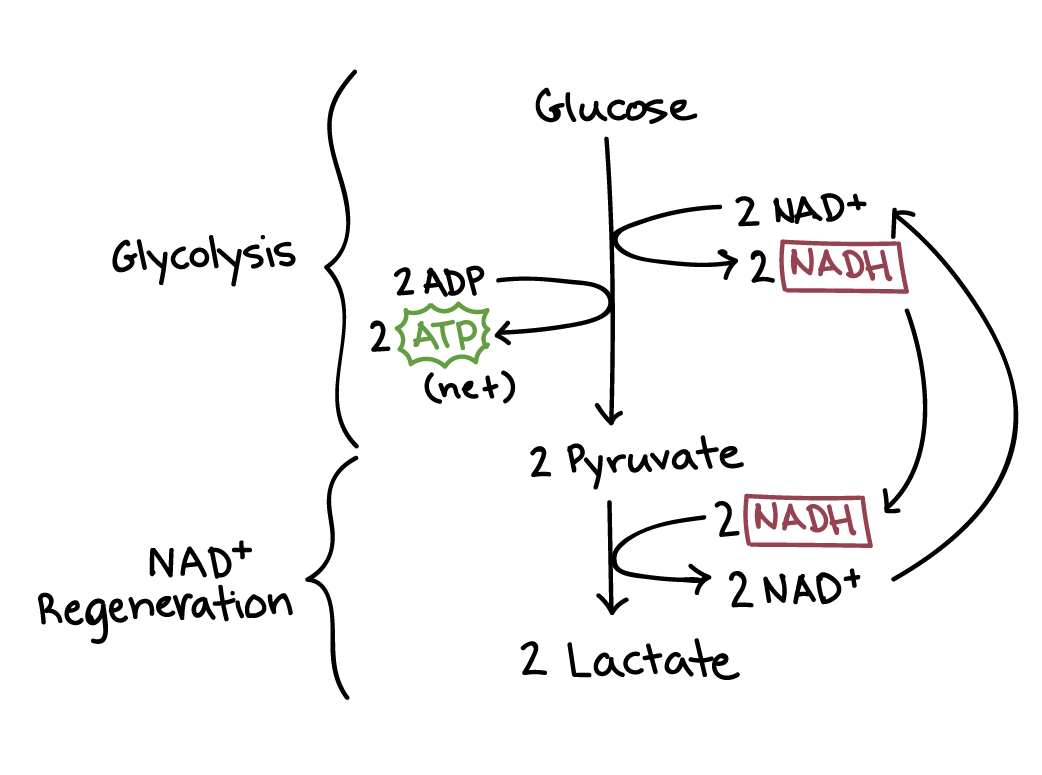
When oxygen is absent (–O₂), cells cannot complete aerobic respiration because:
The electron transport chain stops
NADH cannot unload electrons
NAD⁺ runs out
But glycolysis must continue, because it’s the only way to make ATP without oxygen.
What fermentation does:
It does not make ATP directly
Its job is to recycle NADH back into NAD⁺
This allows glycolysis to keep running
Step-by-step under anaerobic conditions
Glycolysis still occurs
Glucose → 2 pyruvate
Produces 2 ATP
Produces 2 NADH
No oxygen present
Pyruvate cannot enter the Krebs cycle
ETC cannot function
Fermentation pathway begins
Pyruvate is reduced by NADH
NADH loses electrons → becomes NAD⁺
NAD⁺ is recycled
Glycolysis can start again
ATP production continues (slowly)
Fermentation — Study Notes
Definition
Fermentation is an anaerobic pathway that allows glycolysis to continue by regenerating NAD⁺.
Key Characteristics
Occurs –O₂
Includes glycolysis + fermentation
Produces 2 ATP per glucose (from glycolysis only)
Role of NADH / NAD⁺
NADH donates electrons to pyruvate
NADH → NAD⁺
NAD⁺ reused in glycolysis
What Fermentation Does NOT Do
❌ Does not use oxygen
❌ Does not involve Krebs cycle
❌ Does not involve ETC
❌ Does not produce additional ATP
Why Fermentation Is Essential
Prevents NAD⁺ depletion
Maintains ATP production
Allows survival in anaerobic environments
One-Sentence Exam Answer
Fermentation regenerates NAD⁺ from NADH under anaerobic conditions, allowing glycolysis to continue producing ATP.
Memory Hook
Fermentation is the reset button 🔄
Not more power, just enough to stay alive.
Types of Fermentation — Explained
Fermentation happens without oxygen (–O₂) and exists to recycle NAD⁺ so glycolysis can keep making ATP. There are two main types, depending on how pyruvate is handled.
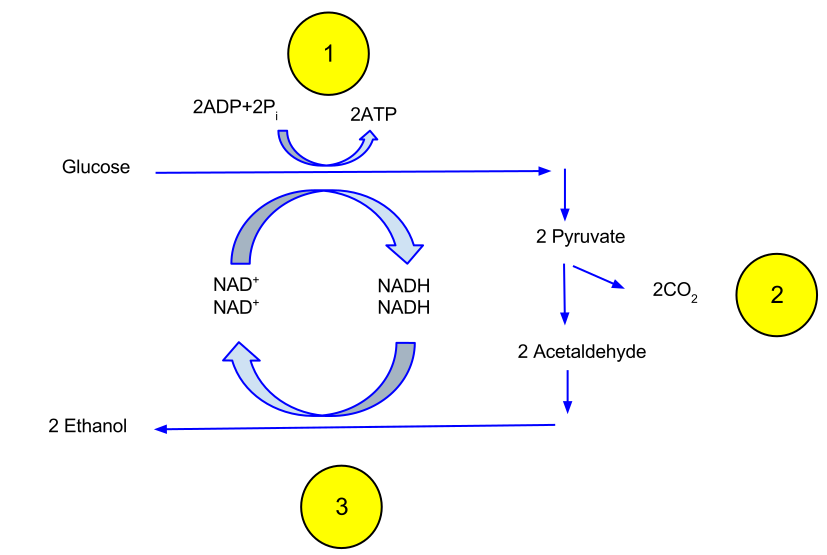
1. Alcoholic Fermentation
This occurs mainly in yeast and some plants.
What happens:
Pyruvate (3C) is converted in two steps
CO₂ is released
The final product is ethyl alcohol (ethanol)
Why it matters:
CO₂ gas forms bubbles
In bread dough, these bubbles make the dough rise
Ethanol later evaporates during baking
Energy role:
NADH → NAD⁺
Allows glycolysis to continue
2. Lactic Acid Fermentation
This occurs in bacteria and animal muscle cells.
What happens:
Pyruvate is reduced in one step
Product is lactate (lactic acid)
No CO₂ is released
Why it matters:
Used by lactobacilli to make yogurt and other fermented foods
In humans, occurs during vigorous exercise
Lactic Acid Fermentation in Humans
When you exercise intensely:
Oxygen supply to muscles becomes limited
ETC slows or stops
Muscles rely on glycolysis + lactic acid fermentation
Lactate builds up
This buildup:
Changes muscle chemistry
Contributes to the burning/soreness sensation
Once oxygen returns:
Lactate is transported to the liver
Converted back into usable molecules
Types of Fermentation — Study Notes
Alcoholic Fermentation
Occurs in: yeast
Products: ethanol + CO₂
CO₂ released: ✅ Yes
Used in: bread, beer, wine
Lactic Acid Fermentation
Occurs in: bacteria, humans
Product: lactate
CO₂ released: ❌ No
Used in: yogurt, cheese, muscle metabolism
Common Features
Occur –O₂
Follow glycolysis
Regenerate NAD⁺
Produce 2 ATP per glucose (from glycolysis only)
One-Sentence Exam Summary
Alcoholic fermentation produces ethanol and CO₂, while lactic acid fermentation produces lactate without CO₂, both serving to regenerate NAD⁺ under anaerobic conditions.
Memory Trick
Alcohol → bubbles 🍾
Lactic → burn 🔥
Explanation (Concept Made Clear)
Glucose is the body’s main fuel.
It is a simple sugar with the formula C₆H₁₂O₆
(6 carbons, 12 hydrogens, 6 oxygens)Most carbohydrates we eat (like starch) are chains of glucose
Before cells can use carbohydrates for energy, they must be broken down into glucose
Glucose travels through the bloodstream as blood sugar. Its normal concentration is 70–110 mg per 100 mL of blood. If this level stays too high, it can damage organs and lead to diabetes.
To extract energy from glucose, cells begin with glycolysis, the first step of cellular respiration. Glycolysis happens in all cells, with or without oxygen, and breaks glucose into two molecules of pyruvate.
Glycolysis — Structured Notes
Glucose
Chemical formula: C₆H₁₂O₆
Most common carbohydrate in the diet
Main source of cellular energy
Circulates in blood as blood sugar
Carbohydrates
Provide >75% of the body’s energy needs
Must be broken down into glucose before use
Complex carbs (starch) are made of glucose units
Blood Glucose Levels
Normal range: 70–110 mg / 100 mL
High levels over time → diabetes
Glycolysis
First stage of cellular respiration
Also called the Embden–Meyerhof–Parnas (EMP) pathway
Name origin:
glyco = sweet
lysis = breaking
Where & When
Occurs in the cytoplasm
Can occur with or without oxygen
What Happens
One glucose (6C) → two pyruvate molecules (3C each)
Energy Changes
Two stages:
Energy investment stage
2 ATP used
Energy payoff stage
4 ATP produced
➡ Net gain: 2 ATP per glucose
One-Sentence Exam Summary
Glycolysis is a cytoplasmic pathway that breaks one glucose molecule into two pyruvate molecules, producing a net gain of two ATP and functioning with or without oxygen.
Memory Hook
Spend 2 → earn 4 → keep 2.
Big-Picture Explanation (How it all fits together)
Pyruvate is the key crossroads molecule of cellular respiration.
It is formed when glucose is broken down during glycolysis.
Once pyruvate is made, the cell must decide what to do with it based on oxygen availability:
If oxygen is present (+O₂) → pyruvate enters the Krebs (TCA / citric acid) cycle
If oxygen is absent (–O₂) → pyruvate enters fermentation
Aerobic pathway (+O₂)
When oxygen is available:
Pyruvate enters the mitochondrion
It proceeds through the Krebs cycle
The Krebs cycle:
Produces very little ATP directly
Produces NADH and FADH₂, which carry high-energy electrons
These electrons move to the electron transport chain (ETC)
The ETC uses electrons to create a proton gradient
Chemiosmosis uses this gradient to make large amounts of ATP
➡ Most ATP is made in the ETC, not in glycolysis or Krebs
Anaerobic pathway (–O₂)
When oxygen is absent:
The ETC stops
NADH cannot unload electrons
NAD⁺ becomes depleted
Glycolysis would stop without NAD⁺
Fermentation solves this problem:
NADH donates electrons to pyruvate
NADH → NAD⁺
Glycolysis continues
ATP production continues (slowly)
Mitochondrial Structure (Why location matters)
Outer membrane: smooth
Inner membrane: folded into cristae
Cristae:
Increase surface area
Contain the ETC and ATP synthase
Intermembrane space:
Stores pumped H⁺ ions
Matrix:
Site of the Krebs cycle
Chemiosmosis occurs across the inner membrane, using the cristae.
ATP: The Energy Currency
ATP = adenosine triphosphate
Contains three phosphate groups
Energy is stored in the phosphate bonds
Breaking a phosphate bond:
ATP → ADP + Pi + energy
That energy powers cellular work
Role of NAD / NADH
NAD⁺ = electron acceptor
NADH = electron carrier
NAD⁺ + H → NADH (reduction)
NADH delivers electrons to:
ETC (aerobic)
Pyruvate (fermentation)
Recycling NAD⁺ is essential for survival.
Fermentation Types
Alcoholic fermentation
Occurs in yeast
Produces:
Ethanol
CO₂
Used in bread making
Lactic acid fermentation
Occurs in bacteria and humans
Produces:
Lactate
No CO₂
Seen in muscle cells during intense exercise
Lactate buildup contributes to muscle soreness.
Structured Study Notes
Pyruvate
Product of glycolysis
Central decision molecule
Enters Krebs cycle (+O₂)
Enters fermentation (–O₂)
Krebs Cycle
Also called TCA or citric acid cycle
Produces:
Small amount of ATP
Large amounts of NADH and FADH₂
Links glycolysis to ETC
Electron Transport Chain
Located in inner mitochondrial membrane
Uses electrons from NADH/FADH₂
Oxygen is final electron acceptor
Produces maximum ATP
Fermentation
Occurs without oxygen
Regenerates NAD⁺
Allows glycolysis to continue
Produces either:
Ethanol + CO₂
Lactate
One-Sentence Exam Summary
Pyruvate serves as a central intermediate in cellular respiration, entering the Krebs cycle under aerobic conditions or fermentation under anaerobic conditions, ensuring continuous ATP production.
Final Mental Map
Glycolysis → Pyruvate →
• +O₂ → Krebs → ETC → lots of ATP
• –O₂ → Fermentation → NAD⁺ → glycolysis continues
Cellular Respiration: The Big Picture
Cellular respiration is how cells convert glucose into ATP, the cell’s spendable energy.
It happens in three main stages:
Glycolysis (cytoplasm)
Krebs Cycle (mitochondrial matrix)
Electron Transport Chain + Chemiosmosis (inner mitochondrial membrane)
1. Glycolysis (Cytoplasm)
“Sugar splitting”

Purpose
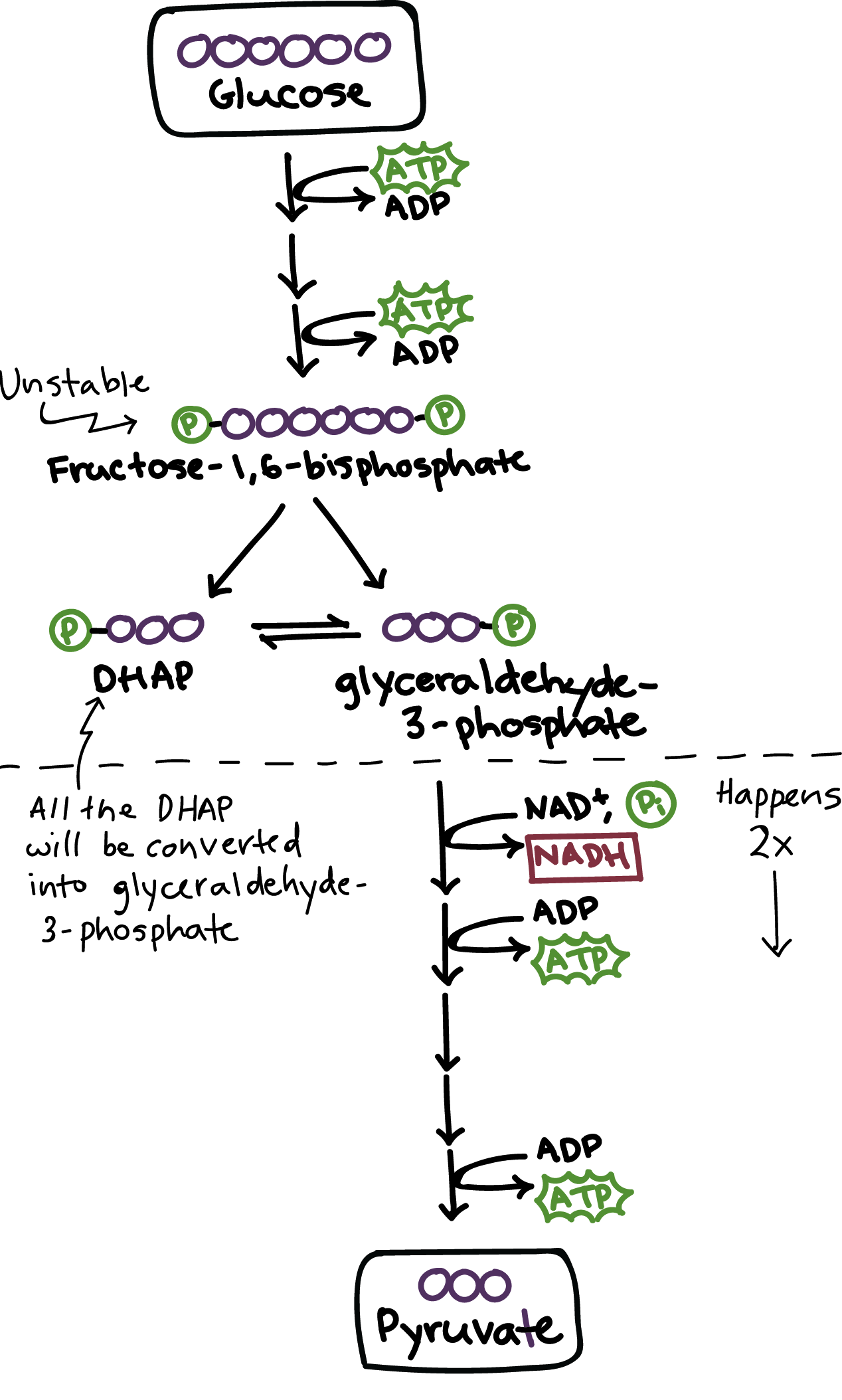
Break glucose (6C) into 2 pyruvate (3C)
Produce ATP and NADH
Does not require oxygen
Energy Investment Phase
The cell spends ATP to make glucose reactive.
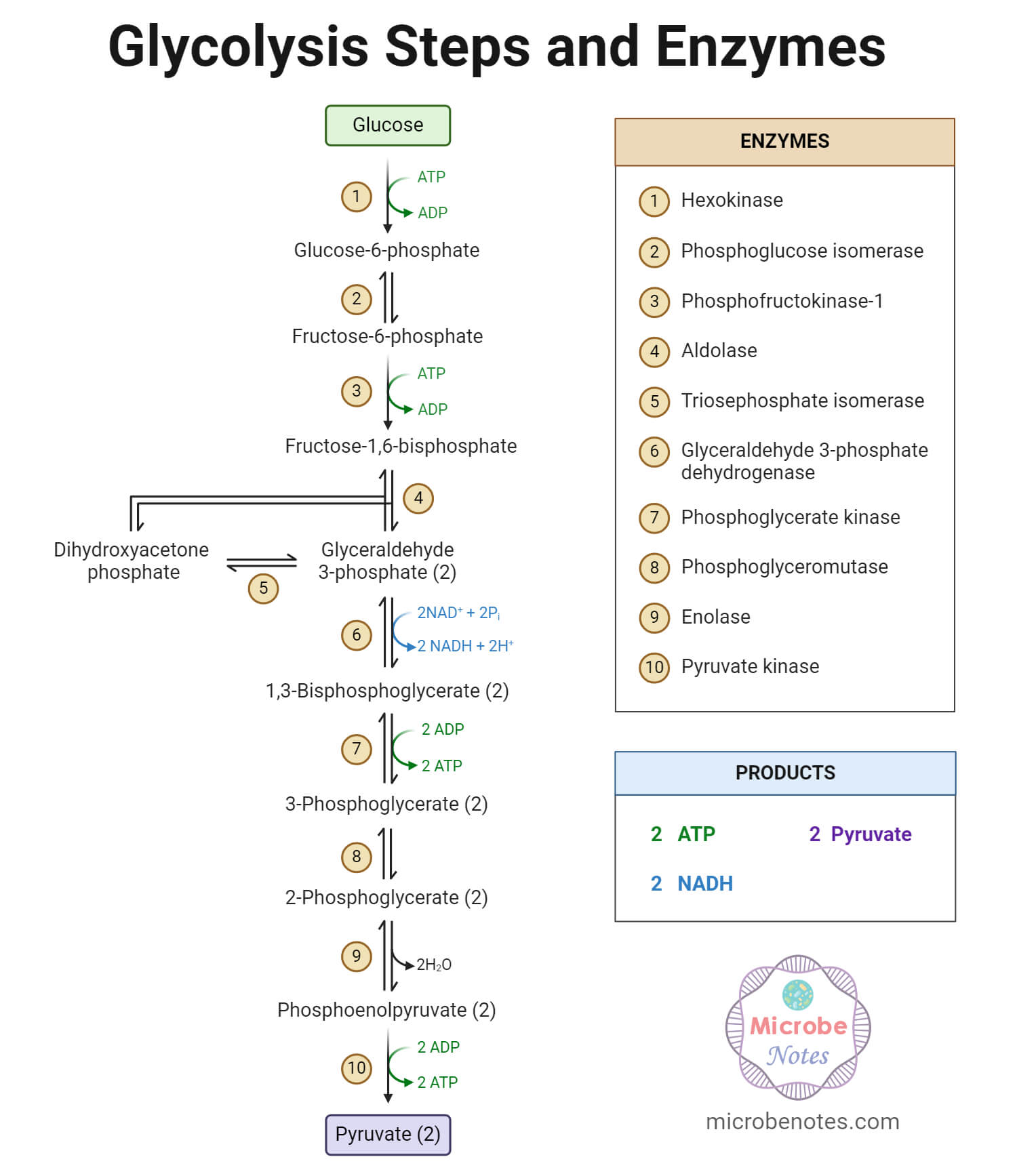
Glucose → Glucose-6-phosphate
Enzyme: Hexokinase
ATP → ADP
(Traps glucose in the cell)Glucose-6-phosphate → Fructose-6-phosphate
Enzyme: Phosphoglucose isomerase
(Rearranges the molecule to allow symmetry later)Fructose-6-phosphate → Fructose-1,6-bisphosphate
Enzyme: Phosphofructokinase (PFK)
ATP → ADP
⭐ Rate-limiting step (most regulated)
Splitting Phase
Fructose-1,6-bisphosphate → DHAP + G3P
Enzyme: AldolaseDHAP → G3P
Enzyme: Triose phosphate isomerase
(Now you have 2 G3P)
Energy Payoff Phase
Each step happens twice (once per G3P).
G3P → 1,3-bisphosphoglycerate
Enzyme: G3P dehydrogenase
NAD⁺ → NADH1,3-BPG → 3-phosphoglycerate
Enzyme: Phosphoglycerate kinase
ADP → ATP (substrate-level phosphorylation)3-PG → 2-PG
Enzyme: Phosphoglycerate mutase2-PG → PEP
Enzyme: EnolasePEP → Pyruvate
Enzyme: Pyruvate kinase
ADP → ATP
Net Yield (per glucose)
2 ATP (net)
2 NADH
2 pyruvate
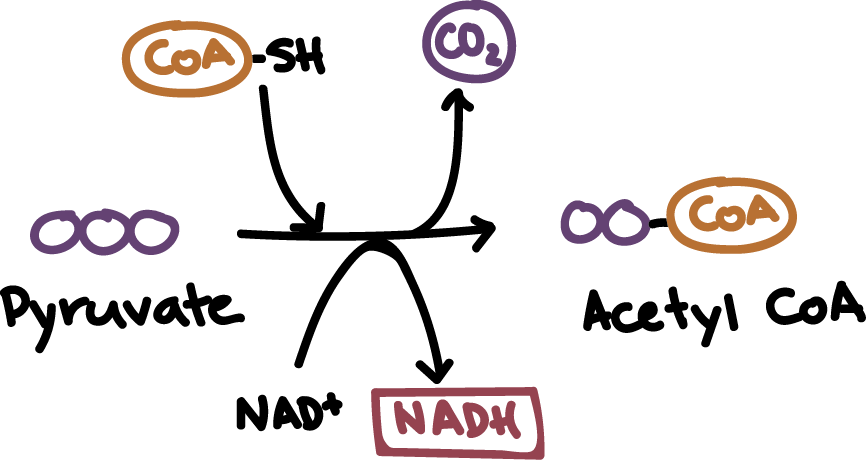
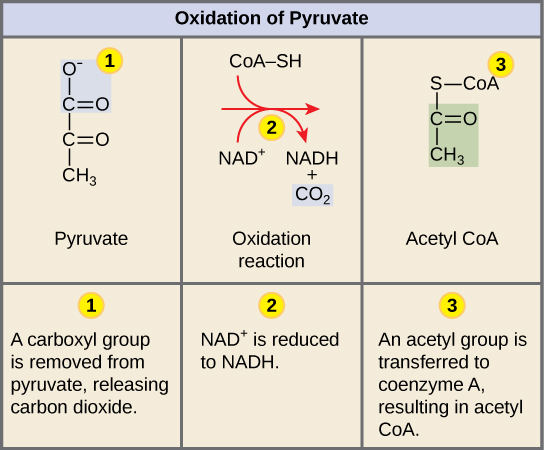
2. Pyruvate Oxidation (Link Reaction)
(Not always listed as part of Krebs, but AP loves it)
Location
Mitochondrial matrix
Reaction
Pyruvate (3C) → Acetyl-CoA (2C) + CO₂
Enzyme complex: Pyruvate dehydrogenase
Per glucose:
2 NADH
2 CO₂
2 Acetyl-CoA
3. Krebs Cycle (Citric Acid Cycle)
“Molecular wheel of oxidation”

Purpose
Fully oxidize acetyl-CoA
Load electron carriers (NADH, FADH₂)
Release CO₂
Location
Mitochondrial matrix
One turn (per acetyl-CoA)
Acetyl-CoA + Oxaloacetate → Citrate
Enzyme: Citrate synthaseCitrate → Isocitrate
Enzyme: AconitaseIsocitrate → α-ketoglutarate
Enzyme: Isocitrate dehydrogenase
NAD⁺ → NADH, CO₂ releasedα-ketoglutarate → Succinyl-CoA
Enzyme: α-ketoglutarate dehydrogenase
NAD⁺ → NADH, CO₂ releasedSuccinyl-CoA → Succinate
Enzyme: Succinyl-CoA synthetase
GDP → GTP (ATP)Succinate → Fumarate
Enzyme: Succinate dehydrogenase
FAD → FADH₂Fumarate → Malate
Enzyme: FumaraseMalate → Oxaloacetate
Enzyme: Malate dehydrogenase
NAD⁺ → NADH
Yield per glucose (2 turns)
6 NADH
2 FADH₂
2 ATP (or GTP)
4 CO₂
4. Electron Transport Chain + Chemiosmosis
“Turning electrons into ATP”
Location
Inner mitochondrial membrane
Electron Transport Chain
NADH and FADH₂ donate electrons
Electrons move through protein complexes
Energy pumps H⁺ ions into the intermembrane space
Key complexes:
Complex I (NADH dehydrogenase)
Complex II (succinate dehydrogenase)
Complex III
Complex IV (cytochrome c oxidase)
Final electron acceptor: Oxygen
O₂ + e⁻ + H⁺ → H₂O
Chemiosmosis
H⁺ flows back through ATP synthase
ADP + Pi → ATP
ATP Yield (approximate, AP Bio level)
NADH ≈ 2.5 ATP each
FADH₂ ≈ 1.5 ATP each
Total per glucose: ~30–32 ATP
Final AP Bio Summary Table
Stage | Location | ATP | NADH | FADH₂ | CO₂ |
|---|---|---|---|---|---|
Glycolysis | Cytoplasm | 2 | 2 | 0 | 0 |
Pyruvate Oxidation | Matrix | 0 | 2 | 0 | 2 |
Krebs Cycle | Matrix | 2 | 6 | 2 | 4 |
ETC + Chemiosmosis | Inner membrane | ~26–28 | uses | uses | 0 |
One-Sentence AP Exam Master Line
Cellular respiration converts glucose into ATP through glycolysis, the Krebs cycle, and oxidative phosphorylation, using redox reactions and chemiosmosis to efficiently harvest energy.
If you want, next we can:
Cellular Respiration – Summary Notes (AP Biology)
Purpose of Cellular Respiration
Animals obtain energy from food
Cellular respiration harvests this energy and stores it as ATP
ATP is the cell’s direct energy currency
Cellular respiration can be:
Aerobic (with oxygen)
Anaerobic (without oxygen)
Aerobic Respiration (Oxygen Present)
Overview
Aerobic respiration consists of three main stages:
Glycolysis
Krebs (Citric Acid) Cycle
Electron Transport Chain (ETC) + Chemiosmosis
1. Glycolysis
Location: Cytoplasm
Oxygen: Not required
Function:
Breaks 1 glucose (6C) into 2 pyruvate (3C)
Products:
2 ATP (net)
2 NADH
2 pyruvate
2. Krebs Cycle
Location: Mitochondrial matrix
Pyruvate enters after being converted to acetyl-CoA
Function:
Breaks down acetyl-CoA
Releases CO₂
Transfers high-energy electrons to carriers
Products (per glucose):
2 ATP
6 NADH
2 FADH₂
4 CO₂
3. Electron Transport Chain (ETC)
Location: Inner mitochondrial membrane
Function:
NADH and FADH₂ donate electrons
Energy from electrons pumps H⁺ ions across the membrane
Oxygen:
Final electron acceptor
Forms water (H₂O)
Chemiosmosis
Occurs during the ETC
H⁺ ions accumulate, creating a proton motive force
H⁺ flows back through ATP synthase
ATP synthase:
Rotates as protons pass through
Converts ADP + Pi → ATP
Produces most of the ATP in cellular respiration
Anaerobic Processes (No Oxygen)
Fermentation
Occurs when oxygen is unavailable
Purpose:
Regenerates NAD⁺ so glycolysis can continue
ATP yield:
Only 2 ATP (from glycolysis)
Types of Fermentation
Lactic acid fermentation
Occurs in animal muscle cells
Produces lactic acid
Alcoholic fermentation
Occurs in yeast and plants
Produces ethanol + CO₂
One-Line AP Bio Wrap-Up
Cellular respiration converts the chemical energy in glucose into ATP through glycolysis, the Krebs cycle, and the electron transport chain, with chemiosmosis producing most of the ATP.