Bio Quiz 4; Protien Structure+Mutations
Polymer: 4 major classes of macromolecules, such as carbohydrates, lipids, protiens, nucleic acids, etc.
-composed of 3 of the four classes of macro molecules, which form chainlike molecules called polymers
-repeated units of small molecules called monomers, ex: amino acids are the
Dr. M’s quiz notes
-Multiple choice, justification, and free response questions included
-Picture of a protein structure, identify what structure (primary, secondary, tertiary, quarternary) it is, and explain why deeply in detail
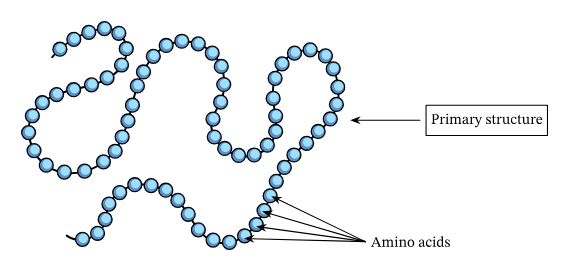
primary structure: unique sequence of amino acids connected by peptide bonds, not folded, straight line with curves, protien is synthesized
secondary structure: Hydrogen bonding at regular intervals along the polypeptide backbone, giving rise to folding, which can give rise to coils (alpha-helix) and folds (Beta-pleated sheets), hydrogen bonds if it’s polar.
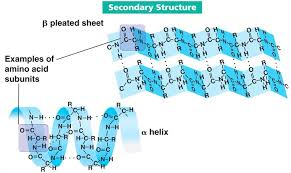
For hydrogen bond to happen, it has to be connected to hydrogen, oxygen, or flourine
R groups-the side chains
tertiary structure: formed with interactions between R groups or interaction between R group and polypeptide backbone, which cause intense folding
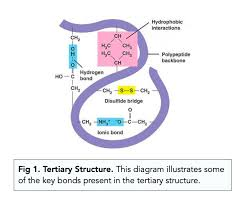
5 interactions that happen when talking about the tertiary structure:
-Hydrogen bonds between polar R groups
-Ionic bonds between charged R groups
-Hyrophobic interactions between hydrophobic, or nonpolar, R groups
-Hyrdrophilic interactions between polar r groups or the polar r group is in water
if non specific ones in picture, talk about all of them. If specific ones in picture, talk just about the ones shown
Which structure will give the most functional protien?
Tertiary, because it is folded
-Disulfide links between 2 sulfer atoms in the R groups, forming a bridge
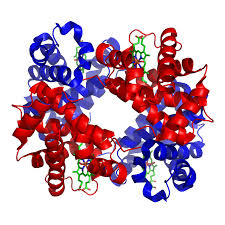
quarternary structure: 2 or more polypeptide chains aggregate (combine) to form the quarternary structure, which will be functional. Has all bonds incorporated.
Denaturation: When the proteins unravel, disrupting hydrogen bonds, ionic bonds, and disulfide bridges that maintain a protein’s shape, caused by alternations in pH, salt concentration, and temperature
Then can renature, meaning return to their fuctional shape, but it’s hard to renature in a crowded cell environment
Sulfer=sis
Protein core: The center of a protein
hydrophobic=disulfide bonds
The hydrophobic amino acids go to the center, hydrophilic on the outside WHEN PLACED IN WATER; hydrophobic core
The hydrophilic amino acids go to the center, hydrophobic on the outside WHEN PLACED IN HYDROPHOBIC ENVIRONMENT (tails in cell membane); hydrophilic core
Hemoglobin has 2 alpha chains (hyrdophilic) and 2 beta chains (hydrophilic). 2 are coiled, 2 are sheets
Mutations:
Frameshift: deletion+insersion
Substitution: missense+nonsense+silent
know what each mutation means