Conflict and Negotiation in the Workplace
Conflict
- the process in which one party perceives that its interests are being opposed or negatively affected by another party
- Conflict is ^^based on perceptions^^: it exists whenever one party ^^believes^^ that another might obstruct his/her efforts, whether or not the other party actually intends to do so
Levels of Conflict
- Intrapersonal Conflict: ^^occurs within the individual^^ because of actual or perceived pressures from incompatible goals or expectations
- Approach-Approach Conflict: occurs when a person choose ^^between 2 positive and equally attractive alternatives^^
- Avoidance-Avoidance Conflict: occurs when a person must choose ^^between 2 negative and equally unattractive alternatives^^
- Approach-Avoidance Conflict: occurs when a person must decide to do something that has ^^both positive and negative consequences^^
- Interpersonal Conflict: ^^occurs between 2 or more individuals^^ in opposition to each other
- Intergroup Conflict: ^^occurs between teams in an organization^^, such as when competing for resources
- Interorganizational Conflict: ^^occurs between organizations^^, common in terms of competitions and rivalry that characterizes firms operating in the same markets (e.g., Apple vs Samsung, Ford vs Toyota, disagreements between labor unions and the organization’s management, between government regulatory agencies and the subject of their surveillance, between organizations and outside activist groups)
Is conflict good or bad?
- Pre 1970s View
- Historically, experts viewed ^^conflict as dysfunctional^^
- Undermined relations
- Wasted human energy
- More job dissatisfaction, turnover, stress
- Less productivity, information sharing
- 1970s-1990s View
- Belief in ^^optimal level of conflict^^
- Some level of conflict is good because:
- Energizes debate
- Reexamine assumptions
- Improves responsiveness to external environment
- Increases team cohesion
- Optimal-Conflict Perspective
- More than 80 years ago, social worker and political science scholar ^^Mary Parker Follett^^ proposed the then-radical notion that ^^conflict can be beneficial.^^
- Optimal-Conflict Perspective holds that organizations are ^^most effect when employees experience some level of conflict^^ in discussions but that organizations become less effective when they have high levels of conflict.
- Emerging View
- 2 Types of Conflict
- Constructive Conflict: The type of conflict in which people ^^focus their discussion on the issue^^ while maintaining respect for people having other points of view (e.g., encouraging different positions so that ideas can be clarified, redesigned, tested for logical soundness)
- Relationship Conflict: The type of conflict in which people ^^focus on characteristics of other individuals^^, rather than on the issues, as the source of conflict (e.g., undermining the other’s argument by questioning his/her competency, attacking a person’s credibility, and displaying an aggressive response
- Goal: encourage constructive conflict, minimize relationship conflict
- Problem
- Difficult to separate constructive from relationship conflict
- Drive to defend activated when ideas are critiqued
Minimizing Relationship Conflict
- 3 conditions that minimize relationship conflict while engaging in constructive conflict
- Emotional Intelligence: When team members have high level of emotional intelligence, relationship conflict is less likely to occur
- Cohesive Team: The longer people work together, get to know each other, and develop mutual trust, the more latitude they give each other to show emotions without being personally offended.
- Supportive Team Norms: When team norms encourage openness, team members learn to appreciate honest dialogue without personally reacting to any emotional display during agreements.
Conflict Escalation Cycle
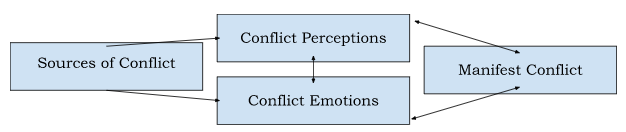
- Structural Sources of Conflict
- Incompatible Goals
- one party’s goals perceived to interfere with other’s goals
- Differentiation
- ^^Different values or beliefs^^
- Explains cross-cultural and generational conflict
- Task Interdependence
- ^^Conflict increases with interdependence^^
- Parties more likely to interfere with each other
- Scarce Resources
- ^^Motivates competition^^ for the resource
- Ambiguous Rules
- ^^Creates uncertainty, threatens goals^^
- Without rules, people rely on politics
- Communication Problems
- Increases ^^stereotyping^^
- ^^Reduces motivation^^ to communicate
- Escalates conflict when arrogant
Interpersonal Conflict Orientations
- Win-Win Orientation
- The belief that conflicting parties will ^^find a mutually beneficial solution to their disagreement^^
- This is achieved by a ^^blend of both high assertiveness and cooperativeness^^
- Win-Lose Orientation
- The belief that conflicting parties are drawing from a fixed pie, so that ^^the more one party receives, the less the other party will receive^^
- In win-lose orientation, one party achieves its desire at the expense and to the exclusion of the other party’s desires
5 Conflict Handling Styles
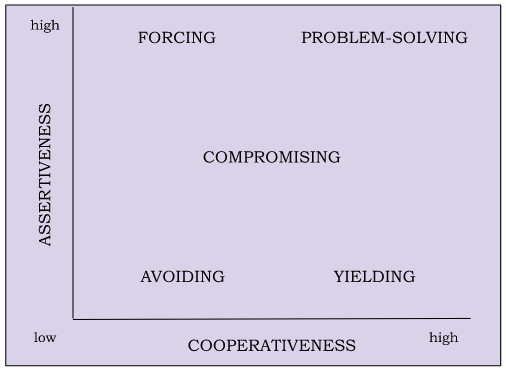
- Forcing/Competing Style: [assertive and uncooperative]
- ^^Always trying to win^^, one works against the wishes of the other party, sometimes by exercising authority to get a favorable conclusion
- May be used when ^^quick and decisive action is vital^^ or when ^^unpopular decisions must be taken^^
- Best when: you have a ^^deep conviction about your position^^, other party would take advantage of cooperation
- Problems: prolongs conflict and damages long-term relations
- Yielding/Accommodating Style: [unassertive and cooperative]
- ^^Letting the other’s wishes rule^^
- Smoothing over differences to maintaining superficial harmony
- May be used when ^^issues are more important to others than to yourself^^, or when you want to ^^build “credits”^^ for use in later disagreements
- Best when: other party has much more power; value or logic of your positions is imperfect
- Problems: ^^May be seen as weakness^^; increases other party’s expectations
- Avoiding Style: [unassertive and uncooperative]
- ^^Withdrawing from the situation^^ or pretending that the conflict does not exist
- Also involves ^^failing to participate^^ in the situation and/or staying neutral at all costs
- May be used when an ^^issue is trivial^^, when ^^more important issues are pressing^^, or when ^^people need to cool down temporarily and regain perspective^^
- Best when: ^^when relationship conflict is high^^; conflict resolution cost is higher than benefits
- Problems: ^^results to frustration; does not resolve conflict^^
- Problem-Solving/Collaborating Style: [assertive and cooperative]
- ^^Seeking true satisfaction of everyone’s concern^^ by working through differences, finding and solving problems so everyone gains as a result
- May be used to ^^achieve true conflict resolution^^ when time and cost permits
- Best when: parties are not perfectly opposing; parties have trust or openness; when issues are complex
- Problems: time-consuming, the other party may take advantage of information
- Compromising Style: [moderately assertive and cooperative]
- Working toward ^^partial satisfaction^^ of everyone’s concerns; ^^seeking “acceptable” rather than “optimal” solutions^^ so that no one totally wins or loses
- Best used to arrive at ^^temporary settlements^^ of complex issues or to arrive at expedient solutions when time is limited
- Best when: parties have equal power; quick solution is required; parties lack trust or openness
- Problems: sub-optimal solution where mutual gains are possible