Experimental Design
Experiments:
subjects randomly assigned to groups
composed of experimental group (this group is manipulated)
composed of control group (being compared to experimental group)
independent variables (manipulated)
dependent variable (measured)
provide evidence for causality (independent variable caused whatever change seen in the dependent variable)
Example:
subjects randomly assigned in this experiment, different doses of MDMA given to subjects + placebo given (control group), to see its influence on the concentration of oxytocin in the blood.
Correlational Studies:
2 variables measured in the same subjects
can be reffered to as predictor variable and outcome variable
NO MANIPULATION of variables (there is no independent variable)
DO NOT provide evidence for causality.
Example:
height at 2 years old can predict that somebody will become a certain height in adulthood. there was no manipulation to make the kid grow.
seeing the correlation between stress and cortisol level (positive correlation)
Designs:
Testing it in the same person (within-subject design)
Between subjects (not testing the same subject twice) (you’d wanna do this once because the independent variable is doing some permnanent effect) (for example, damaging a lesion of the brain to test its function)
Correlations:
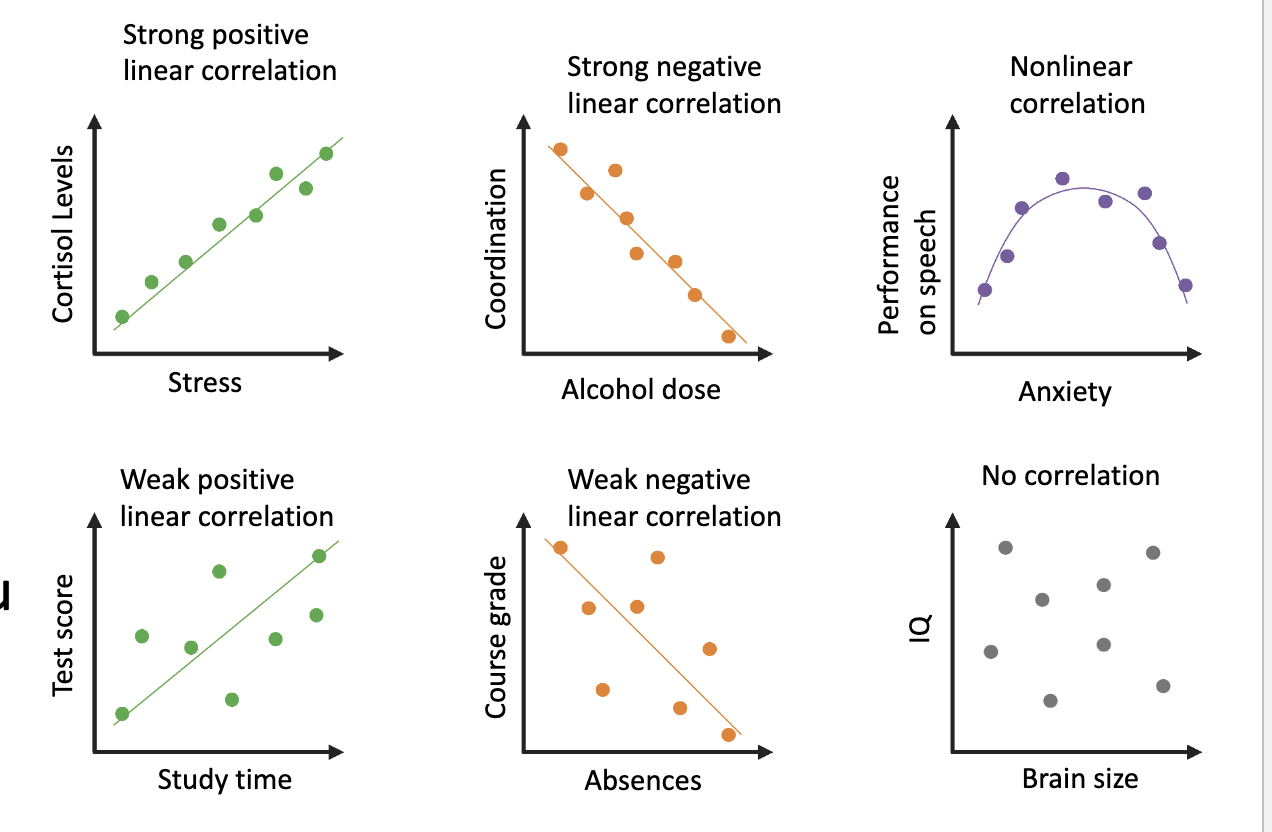
Positive: both measures increase or decrease together
Negative: one measure goes up and the other goes down
No correlation: no relationship
non linear correlation:
Directionality problem
physical exercise leads to more dendritic branching (don’t know cause)
3rd variable problem
overall health could be causing dendritic branching or increase in learning scores
Spurious Correlation
shark attacks go up during the summer, so does icecream sales. does the either cause the latter? no there is a 3rd variable (summer).
Determing causation when variables cannot be manipulated in humans:
Converging operations: using multiple correlational, experiemntal, and quasi experimental approaches
Quasi experimental: covid study on respiration (one population had covid, one didn’t)
experiments in animal models or cell lines
studies in humans (epidemiological, longitudinal)
Preponderance of the evidence: all the data points in the same direction
All the converging operations above suggest the same cause of a particular phenomenon
True experiments are not always possible! For example, converging operations was used to explain the causality between smoking and lung cancer. Another example is zika virus causing microcephaly.
Somatic & behavioral Vairables:
somatic means the body
objective measure of brain anatomy or physiology
ex. hippocampul volume
lesion
drug injection
hormone level
electrical stimulation
Behavioral variables
memory tasks
experiences (stressor)
Can be either IV or DV
Validity
internal validity: is the cause and effect relatinoship due to the IV or are other factors be at play
External validity: can this relationship be generalized to other populations