The Prince - Machiavelli
Machiavelli:
More infamous than famous, Machiavellian is now used as a term to describe cruel and calculated control (like a Machiavellian psychopath)
Machiavelli argues the outcome is more important than the means for justification, intention doesn’t matter
The term Machiavellian doesn’t always actually describe him well
The Prince:
Divided up into sections/chapters. Initially lists circumstances and gives advice on how to properly seize power and control over the land, later covers general advice from Machiavelli on how to be the perfect ruler
Most famous political work, first to disregard “rules”
Dedicated to Lorenzo de Medici, a politician. Done as an offering. Written with language that would be easy to understand, as opposed to language that sounds fancy just for the sake of being elegant
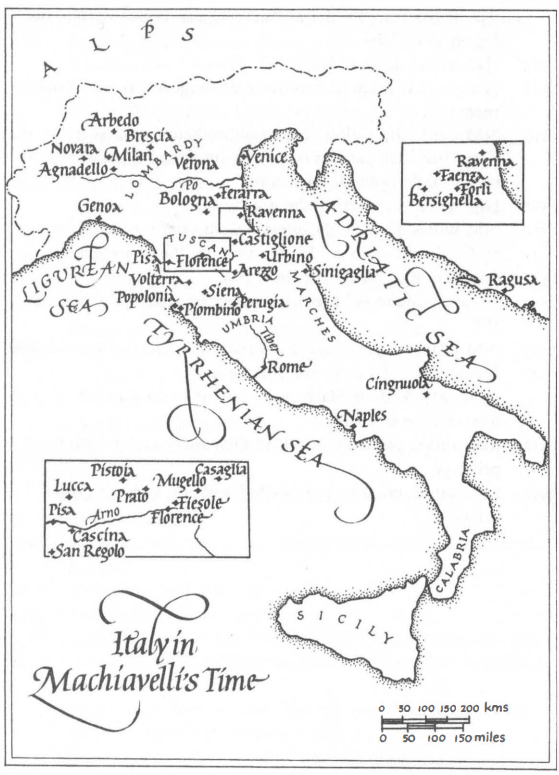
Follows much of Italian medieval geography/setting. No protagonist
Banned by the catholic church, as it encourages going against Christianity and different virtue (wanted virtu’). The Vatican was in the middle of a ton of waring states, The Prince encouraged this war, which was a threat to the Vatican
End of chapter 25 discussion question: Seize opportunity, hesitation is always bad, also women suck (page 101). He calls women property, taking them from another is worse than killing someone’s father (page 72). He believes women will never be able to be successful rulers. So much so that he doesn’t even provide examples for why he thinks so, it’s common sense to him and doesn’t need explaining, like the rest of the concepts.
“What makes him hated above all, as I said, is to be rapacious and a usurper of the property and the women of his subjects. From these he must abstain, and whenever one does not take away either property or honor from the generality of men, they live content” (p 72)
“when fortune varies and men remain obstinate in their modes, men are happy while they are in accord, and as they come into discord, unhappy. I judge this indeed, that it is better to be impetuous than cautious, because fortune is a woman; and it is necessary, if one wants to hold her down, to beat her and strike her down. And one sees that she lets herself be won more by the impetuous than by those who proceed coldly. And so always, like a woman, she is the friend of the young, because they are less cautious, more ferocious, and command her with more audacity.” (p 101)
Discussion questions:
Realism/Idealism:
P. 66, if you chose love over fear that love is superficial and fickle. They act out of obligation. With fear, they act because of something that might happen to hurt them, a threat
Morals can be irrelevant, as long as ruling is efficient
p 61, immorality is totally okay, for both moral and immoral ends
Do not be hated, it will cause conspiracy and talking behind your back. If you are feared, they won’t act against you
Anything is okay so long as the state is stable
Do not be merciful as it shows weakness, a crime will hurt many people in the community but killing a criminal only hurts the criminal
No one is a true embodiment of idealism, it is impossible for a human to be all good.
Virtu’/virtue:
Virtu’ is a way to control fortune, made up of the prince’s cunning and ability to determine things, innate abilities that make him calculating rather than generous, doing things for the state
Virtue is the ‘Christian’ definition, with aspects of kindness and generosity, doing things for the people
The Prince encourages virtu’ and not virtue, which is part of why the church banned it
Vices are anything not good for the prince and his state
Fortune: (see above section)
Military strength:
Your own arms are the best
Mercenary are the worst
If auxiliary must be used, they are less loyal. A win may not really be seen as your win if the army isn’t yours
p. 57, a state needs its own arms to be secure
p. 60, in times of peace a price should build their army and learn about subjects like history to see who succeeded and how the prince can use it to succeed. Don’t make the same mistakes. A prince should also hunt, to build reputation. Hunt and learn. Hunting gives you good standing in the army (reputation), knowledge of the terrain and how to navigate better during war, and getting physically fit.
Generosity:
p. 64, share the spoils of war (comitates), don’t take from your own people
Don’t be too generous, but selfishness is also bad
p. 69, be the fox to sus people out (sometimes with spies), be the lion and act to stop rebellion. Lion is power, fox is control
Advisors:
Only take advice when it is asked for, otherwise those giving the advice have personal interests they are trying to achieve by persuading the price to act a certain way
An unwise prince cannot be made by wise advisors
The best reflection of the prince is the state of his advisory
Ends justify the means:
How Many Are the Kinds of Principalities and in What Modes They Are Acquired
Everything is either a republic or a principality
Principalities
Hereditary (passed on my a bloodline)
New
Acquired and join an existing one, where people are used to being free or under another ruler. Acquired by arms or fortune/virtue
Of Hereditary Principalities
Republics can be ignored, in another literary work
Principalities used to a king are easier to rule
“I shall address myself only to the principality, and shall proceed by weaving together the threads mentioned above; and I shall debate how these principalities may be governed and maintained” (6)
Of Mixed Principalities
For the new principality, deemed mixed because some land was held before and some is new
Support of the people is necessary to stay in power
Easier rule comes if they speak the same language, or are used to rulers. Same applies to similar cultures
When language/culture of a newly acquired land is similar, all those of the existing power’s bloodline need to be eliminated and taxes/laws should not be changed
When culture/language differ, a ruler must go and live there, for longer possession of the land. Easier to fix issues (faster), and presence promotes fondness within the people
Alternatively to living in a new location, a colony may be established (better). Colony has arms to defend main principalities interests. Leave the existing powers of the colony dispersed and poor so they can’t challenge rule
When only arms are sent instead of colonies, more resources are lost and it isn’t worth it
Why the Kingdom of Darius Which Alexander Seized Did Not Rebel from His Successors after Alexander's Death
Alexander the Great conquered Asia and then shortly after died but the people didn’t rebel
With vast territory it is easier to rule if there isn’t bloodlines of smaller barons united under a prince, but rather appointed servants that can be moved as a prince wants. With the first scenario there is loyalty towards the “lesser lords” but with the second the Prince is highly admired by all.
Ultimate downfall for his territory came from regions in Europe whom had barons rather than servants
How Cities or Principalities Which Lived by Their Own Laws before They Were Occupied Should Be Administered
Three modes:
Ruin them: Destroy their resources and arms so they cannot initially revolt, by the time they are able the new prince is better established and liked
Go live there personally
Let them live by their own laws and take tribute to create an oligarchical state friendly to the new ruler: The region is used to their own ways and their ‘prince’, letting them keep it makes them fonder of the new prince (like with Sparta and Rome)
Of New Principalities That Are Acquired through One's Own Arms and Virtue
Completely new, no existing prince or state name/identity, making them easy to rule
The prince lives here as he has no other states to rule
Acquisition is generally harder than actually controlling it
“Those like these men, who become princes by the paths of virtue, acquire their principality with difficulty but hold it with ease” (23)
Defense from opposition can be tricky while the state is being established, other principalities can easily join forces
Of New Principalities That Are Acquired by Others' Arms and Fortune
When a principality is ‘gifted’ to one, the path is easy but there are issues governing. The prince is often someone who has no experience
Actions that can be taken to maintain security include (done within the Church after Alexander died):
Eliminating the bloodlines of those in power before
Win over the favor of those with more power above oneself, possibly subtly influence decisions
Exploit the power held
Acquire more and more power to have and maintain resources to defend against attack
“So whoever judges it necessary in his new principality to secure himself against enemies, to gain friends to himself, to conquer either by force or by fraud, to make himself loved and feared by the people, and followed and revered by the soldiers, to eliminate those who c an or might offend 15 you, to renew old orders through new modes, to be severe and pleasant, magnanimous and liberal, to eliminate an unfaithful military, to create a new one, to maintain friendships with kings and princes so that they must either bene fit you with favor or be hesitant to offend you” (32-33)
Of Those Who Have Attained a Principality through Crimes
Power can either be from nefarious actions or from popular support of the people (like with military leaders)
Even if evil actions are carried out, people will view a leader as positive if those cruelties are due to necessity and security and then stopped and turned into utilities for the citizens
Evil actions are perceived as bad by the people if cruelties grow in number as time goes on
“Hence it should be noted that in taking hold of a state, he who seizes it should review all the offenses necessary for him to commit, and do them all at a stroke, so as not to have to renew them every day and, by not renewing them, to secure men and gain them to himself with bene fits” (38)
Of the Civil Principality
For when a new prince is chosen from civilians, either due to many people liking them or a couple powerful people liking them
The desire to not be oppressed and the desire to be the one oppressing in these scenarios lead to 3 outcomes:
A prince gives in to the demands of the people and takes over, rule is easier to maintain. If people like them, they will obey
A prince chosen by a few powerful people surrounds themself with powerful people who love them, who protect them in hard times and don’t harm them
A price chosen by a few powerful people whom the people hate should gain favor of the people so they do not revolt
If a prince appoints magistrates, he should make sure they like him so they don’t carry out ill will
“For in every city these two diverse humors are found, which arises from desire neither to be commanded nor oppressed by the great, and the great desire to command and oppress the people.” (39)
In What Mode the Forces of All Principalities Should Be Measured
If a principality is small enough, it can be governed by just a prince. If large enough, power will need to be delegated among others
People aren’t quick to attack a principality with defenses
“I judge those capable of ruling by themselves who can, by abundance of either men or money, put together an adequate army” (43)
“Thus a prince who has a strong city and does not make himself hated cannot be attacked” (44)
Of Ecclesiastical Principalities
All principalities like this are acquired by fortune or virtue, being kept running by old religious rule
No matter how bad the prince is, they will keep him in power, as it is all they know and part of their religion
How Many Kinds of Military There Are and Concerning Mercenary Soldiers
it it is necessary for a prince to have good foundations for himself; otherwise he must of necessity be ruined
Kinds of militaries include the prince’s own forces, auxiliary, mercenaries, or mixed forces (rest of this chapter focuses on mercenaries)
Mercenary and auxiliary arms are useless as soldiers aren’t united, ambitious, unfaithful, have no loyalty, and are undisciplined. They run away when war comes but offer their services in time of peace for money
A prince should be captain himself of his forces in order to best command them, proxies shift loyalty and can lead to potential uprisings from disagreements between captain and prince
Of Auxiliary, Mixed, and One’s Own Soldiers
Auxiliary: Useless as they aren’t a prince’s forces but rather commanded by a foreign body to help, leading them to be disloyal and put forth less effort. When they lose you deal with consequences, when they win the lending state will take credit and you owe them
“because when they lose you are undone; when they win, you are left their prisoner” (54)
“In sum, in mercenary arms laziness is more dangerous; in auxiliary arms, virtue is” (55)
What a Prince Should Do Regarding the Miliary
Military is the only thing important to a prince, it allows already present ones from birth to maintain rule and those who aren’t born into it to rise through ranks to gain rule
Military rule can be via deeds and the mind
Deeds: Keeping an army well ordered and exercised, along with a prince hunting and staying in shape and keen to surroundings
Mind: Learning patterns of geography. This aids in understanding defense of one’s own state but also understanding new areas by comparison
“Thus, a prince should have no other object, nor any other thought, nor take anything else as his art but that of war and its orders and discipline” (58)
Of Those Things for Which Men and Especially Princes Are Praised or Blamed
The notable acts a prince carries out will eventually be tied to their personality, whether or not the outcome and intent match for the act
“it is so far from how one lives to how one should live that he who lets go of what is done for what should be done learns his ruin rather than his preservation” (61)
Of Liberality and Parsimony
It is good to be viewed as liberal, but when being liberal to be viewed as liberal it is bad. It should be used virtuously and then commonly goes unnoticed, but when purposely not showing any form of wealth they will have no more resources, leading to taxes and a negative reputation, and then running at any form of danger, which will lead people to view the prince as mean
Because a prince can’t be recognized for true liberality, they shouldn’t be fearful of being seen as mean
“So there is more wisdom in maintaining a name for meanness, which begets infamy without hatred, than in being under a necessity, because one wants to have a name for liberality, to incur a name for rapacity, which begets infamy with hated” (65)
Of Cruelty and Mercy, and Whether It Is Better to Be Loved Than Feared, or the Contrary
It is better to be merciful, but a prince shouldn’t obsess over legacy
It is safer to be feared than loved, but both is ideal
“each prince should desire to be held merciful and not cruel; nonetheless he should take care not to use this mercy badly” (65)
“The prince should nonetheless make himself feared in such a mode that if he does not acquire love, he escapes hatred, because being feared and not being hated can go together very well” (67)
“since men love at their convenience and fear at the convenience of the prince, a wise prince should found himself on what is his, not on what is someone else’s; he should only contrive to avoid hatred, as was said” (68)
In What Mode Faith Should Be Kept by Princes
More successful princes do not have a faith, but rather navigate based on their personal astuteness
Combat is either with laws (man) or force (beasts), but laws often aren’t enough so people resort to violence
It is best to act with negative qualities but appear as though a prince possesses none of them, only appearing good. People more easily trust what they see as opposed to what they experience
“men are so simple and so obedient to present necessities that he who deceives will always find someone who will let himself be deceived” (70)
“it is not necessary for a prince to have all the above mentioned qualities in fact, but it is indeed necessary to appear to have them. Nay, I dare say this, that by having them and always observing them, they are harmful; and by appearing to have them, they are useful, as it is to appear merciful, faithful, humane, honest, and religious, and to be so; but to remain with a spirit built so that, if you need not to be those things, you are able and know how to change to the contrary” (70)
Of Avoiding Contempt and Hatred
By avoiding hate, there is minimal danger to a prince
Being thought of as undeceivable is good
Things to not do:
Take women from men
Take properties from people
Things to do:
View actions as positive
Insist that judgements are irrevocable
Only fear the subjects and external powers
Ignore conspiracies against the prince if the people are in favor of the prince, as people will be offended if they beloved prince is overthrown
Be esteem by the great but not hated by the people
“a prince should esteem the great, but not make himself hated by the people” (75)
Whether Fortresses and Many Other Things Which Are Made and Done by Princes Every Day Are Useful or Useless
Instead of disarming subjects to prevent uprising princes tend to arm them instead so they have a form of arms
Disarming shows distrust and hesitancy, leading to the actual formation of it. This is bad and a prince shouldn’t do this, it also leads to a mercenary military (awful)
Disarming is good when a new state is added to an existing one, after acquiring it taking away their means of defense ensures longevity
Fortresses are good to defend from the people, they are bad when defending from other states
What a Prince Should Do to Be Held in Esteem
Using religion can be good, if people enjoy religion acting as if a prince does too might have him favorable
Showing off is good when it comes to talents
Given the opportunity, take stances on other princes as either friends or enemies, not choosing sides makes you a potential enemy for the victor or potential friend of the loser and obligated to aid them
A prince should admire others who the people like (virtues) and enjoy arts
A prince should hold discussions with the city’s clans/guilds
Of Those Whom Princes Have as Secretaries
Choosing capable ministers is important, if one holds themself of more importance than the prince they shouldn’t be trusted
The role of a minister is to make the prince look good
In What Mode Flatterers Are to Be Avoided
Only those who are wise should be able to speak their minds and the truth around the prince
Flatterers offer gifts and viewpoints that aren’t in the prince’s best interest
A prince should only take counsel when he wants it, not when others want to give it
Why the Princes of Italy Have Lost Their States
“these princes of ours who have been in their principalities for many years may not accuse fortune when they have lost them afterwards, but their own indolence; for, never having thought that quiet times could change” (97)
How Much Fortune Can Do in Human Affairs, and in What Mode It May Be Opposed
Simply being religious and chalking everything up to “fate” leads to quick loss of control and power, due to the belief that a prince has no say or control and they will then never take action and play everything safe