Events of the Cold War
Events of Cold War (1947-1991)
Start of a Cold War
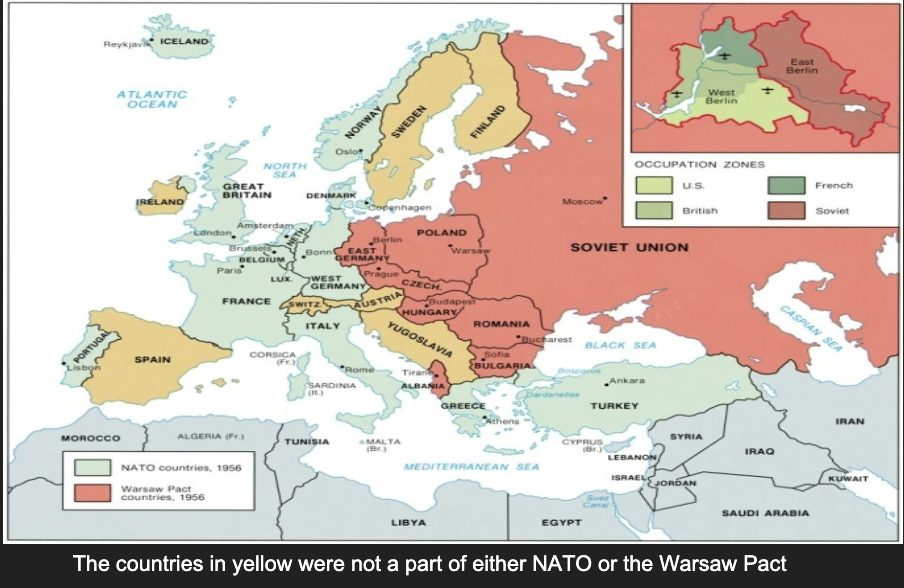
In reaction to this increased tensions between the U.S. and U.S.S.R, 10 Western European nations formed a defensive military alliance with the U.S. and Canada
- NATO (North Atlantic Treaty Organization)
The Soviet Union saw NATO as a threat and formed an alliance in return of Soviet Satellite Nations
- Warsaw Pact
NATO
NATO: North Atlantic Treaty Organization
- Defensive Military alliance of democratic countries
- Original members were US, Canada, Great Britain, France, Belgium, Italy, Norway, Denmark, Portugal
Warsaw Pact
Warsaw Pact:
- Defensive Military alliance of communist countries, in retaliation to the formation of NATO
- USSR, Albania, Bulgaria, Romania, Czechoslovakia, Hungary, Poland, East Germany (GDR)
NATO vs. Warsaw Pact Map
The Korean War
- An example of Containment policy, 1950-1953
- USSR and Communists occupied north of 38th parallel
- USA and Koreans who supported democracy occupied south of 38th parallel
In 1950, the Communist north invaded the south beginning the Korean war
- U.S. and allies quickly came to the aid of South Korea; China and the Soviets aided North Korea
- Truman saw this as a threat to his policy of containment and resolved to help South Korea resist the communist north (example of the use of the Truman Doctrine)
End of Korean War:
- By July 1953, the war ended in a stalemate
- Now, 38th parallel is the DMZ (demilitarized zone): splits North and South Korea to this day with high tension
- North Korea remains communist and South Korea is a democracy
Let the Arms Race Begin
- U.S. began to develop a thermonuclear bomb in January 1950
- Truman authorized work to begin
- New H-bomb (hydrogen bomb) would be 1000x more powerful than the Atomic bomb
- Soon after, Soviets created their own H-bomb
Dwight D. Eisenhower became president (1953-1961) and his administration sent a threat that the U.S. would retaliate immediately if attacked by Soviets
- Known as “brinkmanship” – willingness to go to brink of war
Deterrence: The threat of retaliation with nuclear weapons deterred their use
- MAD: Mutually Assured Destruction
Cold War in the Sky
In 1955, Eisenhower called for “open skies” policy allowing both countries to fly freely over each other’s territory
- Soviets rejected proposal
U.S. sent CIA secret high altitude planes (U2’s) over Soviets territory
1960, Soviets shot down a U-2 plane and caught the pilot
- This event caused deep mistrust between superpowers
More aspects:
- Affected science and education programs between superpowers
- 1957, Soviets developed intercontinental ballistic missile (ICBM)
- Used ICBM to push first unmanned satellite above earth’s atmosphere (Sputnik I)
- U.S. started to pour money into education, especially science
- Within months, the U.S. successfully launched its own satellite
- The next goal… go to the moon first!
The Berlin Wall
The Berlin Wall was a barrier constructed by Soviet occupied East Germany, starting on 13 August 1961.
- The wall was completely cut off (by land) democratic West Berlin from surrounding East Germany and from East Berlin.
- The barrier included guard towers placed along large concrete walls, which circumscribed a wide area (later known as the “death strip”)
The Eastern Bloc (the Soviet Union) claimed that the wall was built to protect its population from fascist elements conspiring to prevent the “will of the people” in building a socialist state in East Germany.
In practice, the Wall served to prevent the massive emigration and defection (people trying to flee for the Western world) that marked East Germany and the communist Soviet States during the post-World War II period.
Berlin will remain the center point of the cold war.
Revolution in Cuba
In 1959, a group of Cuban rebels led by Fidel Castro overthrew the U.S. supported Batista regime and installed a Communist dictatorship led by Castro
- Castro soon seized U.S. owned businesses in Cuba and nationalized them under the Cuban government. This caused American sugar mill owners to lose millions of dollars. This led President Dwight Eisenhower to implement an embargo (blocking trade) on Cuba that still exists.
- He also authorized $13.1 million dollars to be used by the CIA for use against Castro
- Relations between the U.S. and Cuba deteriorated quickly, and Cuba soon turned to the Soviet Union for economic and military aid.
Bay of Pigs
1961 Bay of Pigs: a failed invasion of communist Cuba – authorized by the new American President, JFK, John F. Kennedy (1961-1963)
- The CIA secretly trained and supplied a group of Cuban exiles who opposed Castro’s regime try to invade Cuba and overthrow him
- The exiles who tried to invade were vastly outnumbered by Castro’s troops and surrendered after 24 hours
- JFK refused to send troops to Cuba because he did not want to start world War III
The Cuban Missile Crisis
- 1962 Nikita Khrushchez (leader of the USSR) began to set up nuclear missiles in Cuba because the US had nuclear missiles in Turkey
- A U2 plane secretly took pictures of these missiles being built in Cuba
- Kennedy responded by instituting a Naval Blockade which angered the Soviets
- Kennedy demanded the missiles be removed from Cuba. Khrushchev did once JFK secretly agreed to remove missiles from Turkey
- US and USSR came too close to a nuclear exchange – the “brink” of war
- “Thirteen Days” was the length of this crisis
Containment continues in Vietnam
To continue on with the policy of containment, as tensions rose in 1963 in South Vietnam, as they protested their corrupt government, the US under the Presidency of John F. Kennedy offered aid to South Vietnam
- The US did this to prevent the further spread of communism in Southeast Asia as per the Truman Doctrine
The Rise of Ho Chi Minh
In the 1930s, Ho Chi Minh rose as a young nationalist leader in North Vietnam determined to free Vietnam from French rule
- He had previously approached leaders at the Treaty of Versailles to ask for help seeking Vietnam’s independence in order to make it a democracy and was turned away. He then was approached by Communists which led him to change his political philosophies.
Ho Chi Minh turned to communism and led strikes against the French who controlled SE Asia under imperialism
The French intended to regain control over their former colony and sought out help from the United States
The Vietnam War Breaks Out
Nationalists and communists joined together in the struggle against the french colonists
In 1954, the French surrendered to Ho Chi minh after a huge military defeat
The US and President Eisenhower worried about the “domino theory” in asia
- If one nation in southeast Asia falls to communism, the surrounding neighbors would follow
Vietnam War (1959-1975)
North Vietnam - Communists
- Backed by the Soviets
South Vietnam - Non-Communist
- Backed by the US
Major US Military involvement from 1964-1973
Collapse of Communism in the Soviet Union and Eastern Europe
- 1989-1991
- Soviet Economic Collapse
- Glasnost
- Perestroika
- Nationalism in the Warsaw Pact countries
- Tearing down of the Berlin Wall - 1989
- Breakup of USSR - 1991
- Expansion of NATO