Funari, PPA. 1993 - Graphic caricature and the ethos of ordinary people at Pompeii.
Popular Culture Studies
From its inception in the nineteenth century, popular culture studies have been marked by epistemological discussions regarding its subject.
Early folklore studies, dating back to the 1840s, identified 'learning of the people' with oral tradition (Sebillot 1973), primarily produced by illiterate peasants who disregarded elite standards.
Marcel Mauss defined popular culture negatively: 'Est populaire tout ce qui n'est pas officiel' (Popular is everything that is not official).
Example: Counting rhymes like 'One, two, come buckle my shoe'.
Critique of Mauss: Croce challenged early folklore studies in the late 1920s, eg. the stress on the opposition between Volkslied and Kunstlied (forms of German music - “folksong” and “art song”).
Mikhail Bakhtin: Popular culture includes jokes, comic rites (родной смех), magic, and insults. (Burke, 1989)
Only later did 'history from below' (Hill, 1989) produce monographs on medieval, modern, and contemporary popular culture.
'Cultural history of the poor' (Howkins, 1990) recognizes the subversive potential of popular culture but also the plurality of elite and popular cultures and their mutual independence.
“However, I do agree with Carlo Ginsburg (1986:108)that 'bipartition between popular and learned culture is more useful than a holistic model' which does not take full account of the specificity of people's expressions and thus considers them as derived from the ,dominant culture' (Trigger 1989:786)”
Uncertainty remains regarding the ontological definition of popular culture.
“The negative definition as non-elite cultures (Burke 1989b:15)is good enough in sociological terms but is it possible to define it ontologically?”
“Croce's opposition between elite experience, thought, and feelings with different expressive degrees and people's brief and direct ways perhaps is not completely plausible but at least his interpretation raises some important questions on their ontological differences. As class cultures are historically determined, any ontological definition depends on understanding the specifichistorical and social contexts through a microscopic analysis (Nicolet 1988:40)”
People's Culture and Ancient Society
Mikhail Rostovtzeff (1911) quoted Vitruvius' description of wall painting in rich houses, did not take into account upper-class bias.
Ordinary people's dwellings were excluded from the discourse.
R. Bianchi Bandinelli (1970) proposed a class analysis distinguishing 'senatorial' and 'plebian' trends.
'Crude popular realism' (Brendel 1979) referred to late working and middle classes, not ordinary people.
E. Lissberger (1930s): Epigraphical evidence suggests high literacy among ordinary people.
“Despite the pessimism of some scholars concerning our accessibility to common people's evidences (d. MacMullen 1990:186) or the characterisation of these as coarse and vulgar (Cebe 1966:372, referring to wall drawings), there has been an increasing awareness that commonly held views such as the so-called' ancient contempt for any manual activity' could not be applied to people's Weltanschauungen (worldview) (cf. MacMullen 1974;120, 202, with discussion of earlier studies; Wood 1989:137and passim).”
This suggests that the artistic expressions found in Pompeii, including graphic caricatures, reflect a complex interaction between social status and cultural values, ultimately providing insights into the lives and thoughts of ordinary individuals.
High literacy among ordinary Romans supports the idea that romanisation led to an ordinary koine comprising slaves and free wage laborers.
Pompeian graffiti highlight class-related ways of speaking and being.
Focus on caricatures to approach popular ethos through graphic representation and to limit the scope of research.
Satire and Caricature: Charged Symbolism
Aristotle: Comedy represents the 'worse types of men,' but the ridiculous consists in error or ugliness that is not painful or injurious (anodinon kai ou phthartikon, kharan ablabe).
Laughable situations offer opportunities to express criticisms openly.
Horace: 'ridentem dicere verum quid vetat?' ('What harm can there be in presenting the truth with a laugh?')
'ridiculum acri fortius et melius magnas plerumque secat res' ('Humour is often stronger and more effective than sharpness in cutting knotty issues')
Through mockery it is possible to speak out and thus to challenge current ideas and authorities. Therefore laughing (rictus or risus, Quint. 6,3) implies a particular openness in criticism, enabling ordinary people to safely reproach people in power.
Ridiculous situations are characterized by exaggerated features.
Overstatement is at the root of satira or satura, a Latin genre connected to lanx satura (plate full of fruits) and satura (sausage), signifying plentitude.
Caricature derives meaning from overloading (caricare) ridiculous representations.
Exaggeration enables easier understanding and avoids lengthy decoding by ordinary people.
Horace: 'you need terseness, to let the thought run freely on without becoming entangled in a mass of words that will hang heavy on the ear'
Exaggeration is a common feature of verbal messages at Pompeii: Floronius inscription (CIL IV 8767)
Pisani's (1973) interpretation: binet as binetas ('fucker').
'Floronius, fucker and soldier of the seventh legion, was here [sc. an inn] and no woman realised the fact … but they were only six and so they would be too small a number [sc. for this boastful male].'
Exaggeration could also induce the laugh through mockery as in this case (Della Corte 1954:329,no. 85id-m)
An anonymous person is mocked for having been waiter, potter, dealer in salted fish, baker, husbandman, bronze trinket dealer, retailer, and now dealer in small bottles.
to complete all possible activities there is left only one job: the cunnilingus professional (on the long-standing currency of the practice, cf. Adams 1987:135;Johns 1982:141;contra Foucault 1986:23-4; Veyne1986:47)
Graphic caricature (Bergson 1940:20-21) as a specific art form, although sharing some general features of 'low' art exaggeration, depends on unique symbolic popular frameworks related to wall drawing and human representation,
Symbolic and Stylistic Elements
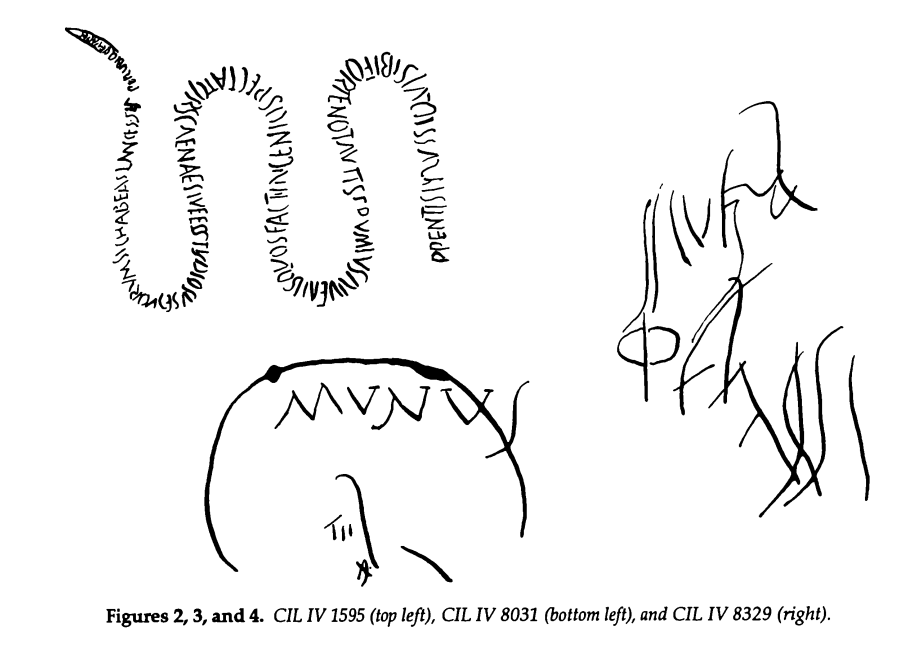
Comparing popular images like CIL IV 1595 (Fig. 2), 8031 (Fig.3) or 8329 (Fig. 4) with the few carmina figurata (Haeberlin1886) or technopegnia by erudite authors like Theocritus (Wendel 1920:159-164) and others in the Palatine Anthology, we are struck by the difficult and abstruse scholarly word play they use (Wilamowitz 1899:51).
In contrast to modem pop art, which recognised 'that the barrier erected between "high" and "low" art could no longer be maintained' (Wollen 1991:72) and particularly in opposition to the concrete (Teles 1977:22; Crespo and Bedate 1963), machine (Pignatari 1965:151) and constellation poetry (Gomringen 1953) or popcrete art (Santiago 1977:46), ancient elite figurative poems were very much out of ordinary people's reach.
But, if it is true that 'the place of symbolism in everyday life has tended to be neglected by both cultural historians (concerned with "works of art") and social historians (concerned with social "reality")' (Burke1989:3) - and we must add literary historians to the list (MacDonald 1991:238) - one must recognise that popular graphic symbolism remains almost completely unexplored (cf. Gigante 1979: 18).
Unfortunately, studies of 'elite' wall painting (Rostovtzeff 1919), wall drawing (White 1957), table picture (tabulae; Perris 1989:316), regional art (Dentzer 1962), Pompeian styles (Schefold 1972), and even comprehensive overviews on ancient painting imaginaire (Rouveret 1989) are difficult to use when dealing with popular scratchings.
Is it possible to understand, reading only Parliament speeches, the actual people's mind expressed in a graffitolike 'don't vote vomit'? (Melley 1976:104).
- Studies of 'elite' wall painting, wall drawing, table pictures (tabulae), regional art, Pompeian styles, and ancient painting are difficult to apply to popular scratchings.
Graphic Stylistic Expression
'style is power ... [and] to create style is to create an illusion of fixed and objective relationships. Style embeds event in interpretation but fixes that interpretation as event. It provides the potential for the control of meaning and thus for power' (Hodder 1990:46)
Thus style means power through patterns of the regular repetition of meaningful traits (Davis 1990:29)
Style functions iconically because people react symbolically without conscious effort.
Styles are ethnic and social, related to social stratification.
Reconstructing Graphic Rhetoric: Use available data to reconstruct graphic rhetoric, as direct evidence of popular ideas is absent.
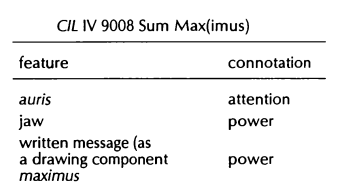
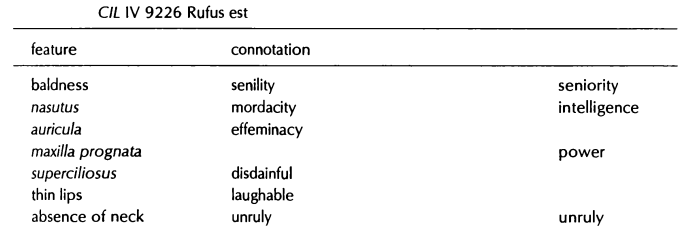
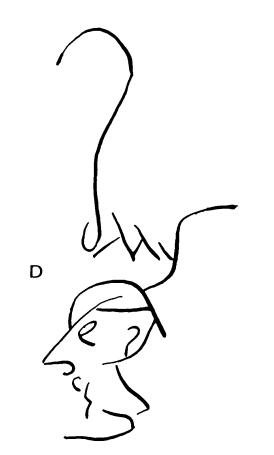
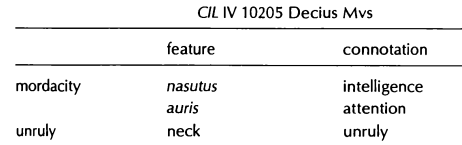
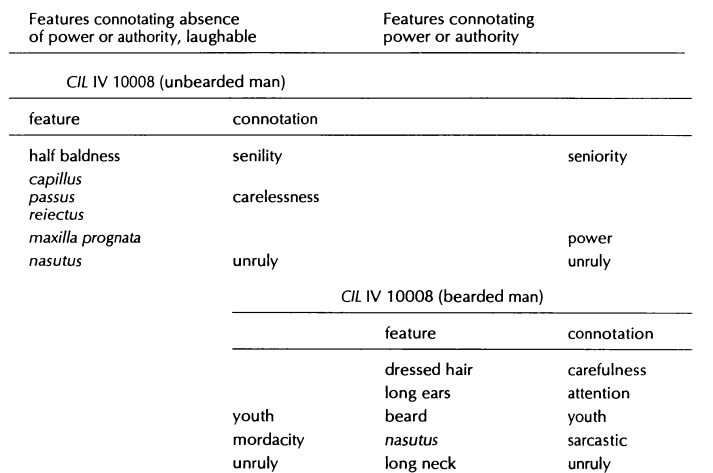
Semiotics of Physical Features: Define how Romans considered physical features meaningful. (Table 1)
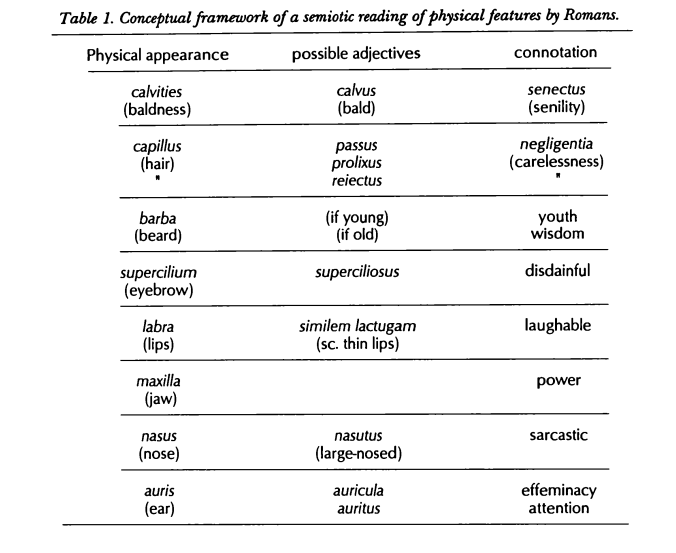
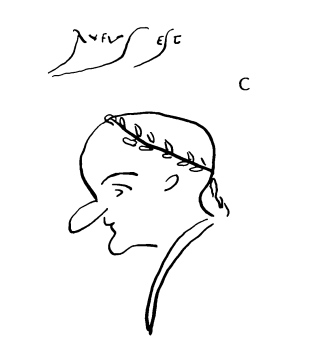
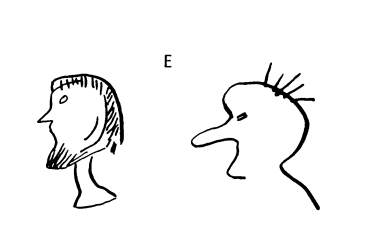
Baldness (calvities) was associated with age (Petronius Sat. 27; Suet. Galb. 20) and thus to both seniority and senility
Neglect was ascribed to excessive and undressed hair (capillus passus, prolixus, circum caput reiectus negligenter, Ter. Heaut. 2,3,49).
Beard was identified as a teenage feature (Cic.N.D. 1,30), while bearded grown-ups were tied to honorable images like that of philosophers (Pers. 4,1)
Youth/beard/hair meant greater physical power, but less status and authority, old age/shaved face/baldness implied senility but also seniority and the power associated with it (fable 2).
Abundant eyebrows meant someone haughty and disdainful (Sen. Ep. 123,ii).
Thin lips were laughable (Hier. Ep. 7,5: similem habent labra lactugam).
Jaw was associated with power (Suet. Tib. 21).
Large nose meant someone sarcastic (Mart. 2,54,5: nil nasutius hac maligniusque; Mart. 12,37,i).
Small ears denoted softness and effeminacy (Cic. Q. Fr. 2,14, 1,4).
Neck was ambiguous, associated with power, freedom, and life, but also with submission
Pompeian Caricatures as a Socio-Semiotic System
Architectural styles in Pompeian wall painting were individual decorative devices and at the same time collective in character and private in expression
The Neronian period, although short (cf.Segal 1991:81)/ was particularly distinguished by strong trends, in particular in the culture of nouveau-riche freedmen (Stockton 1990:145; cf. Petronius/ Satyricon) and introspection by local elites (Wilson 1990:379)..
It was in this context that Caricatures developed on Pompeian walls in opposition to upper-class expressions (Petro Sat. 29).
Graphic engravings followed their own inner logic and were structured like literary language.
Knowledge should be 'dispersed' among different graffiti.
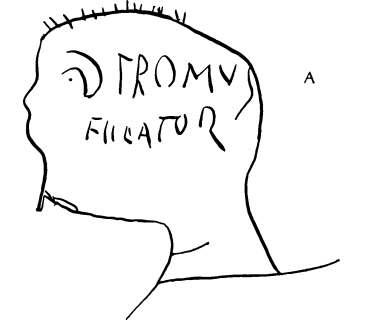
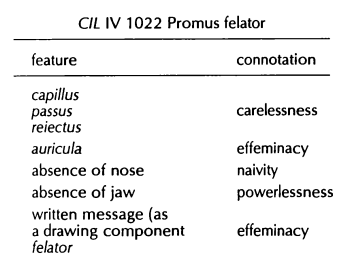
Self-portraits and imagines ridiculae enhance physical traits that would be interpreted as ridiculous or praiseworthy.
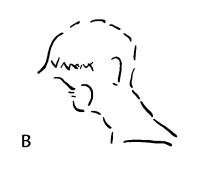
Self-portraits stress features associated with power, authority, attention, intelligence (Table 4).
Imagines ridiculae stress censorious connotations.Tables (4, 5, 6)Autonomy: There was a choice of defined traits framing a meaningful drawn structure.
Syntactical composition depends on exo-semiotic (cultural) connotations, specific associations of physical looks and implied behavioral meanings.
Ordinary people criticized those in power and used stylistic/symbolic creativity to carry out this critique.
Social Contradictions
Do not overestimate the power of ideological formations to control and manipulate people and underrate the ability of the lower classes to see through the ideologies by which elites seek to dominate them' (Trigger 1989:786; Rowlands 1983:111).
Graphic caricature enables us also to understand how ordinary people's ethos was deeply affected by contradictions, thanks mainly to the inhumanity of slavery as a social institution.
Slavery was at the heart of human oppression and the fact that 'all men are free or slave' (omnes homines aut Uberi sunt aut seroz) in Gaius' words (1, 3, 9) implied a process of human dispossession which reached popular strata. Differentiated from gladiatorial shows, represented in erudite paintings (PI. N. H. 35, 51-52), graffiti expressed ordinary supporters feelings about their heroes (Funari 1989:40-42, 63-66).
While within the elite there were mixed feelings about munera (Ville 1981), these shows of gladiators and hunting spectacles were very much at the heart of popular perceptions of life.
Free or slave gladiators proved that men could be put to death (cf. Sen. Ep. 87: comparare homines ad gladium) for people's pleasure. Ultimately, the private submission of men to men, as slaves to masters, was justified in the popular mind through the collective possession of men (gladiators) and their destruction for people’s entertainment
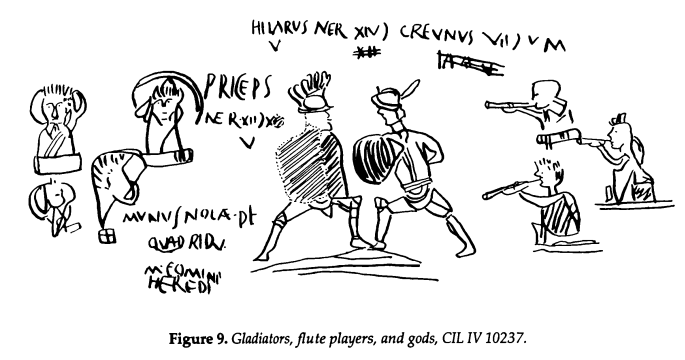
Gladiators' work and their death were to people what private slaves' work and death were to private masters. This process of men's dispossession of their humanity is expressed clearly in supporters' engravings (cf. CIL IV 8055-6; 10221; 10236).
Figures 8: Man and animal are represented as equals; Venustus' face and most of the lines used refer to weapons and clothes related to the fight - face-less fighter for people's amusement.
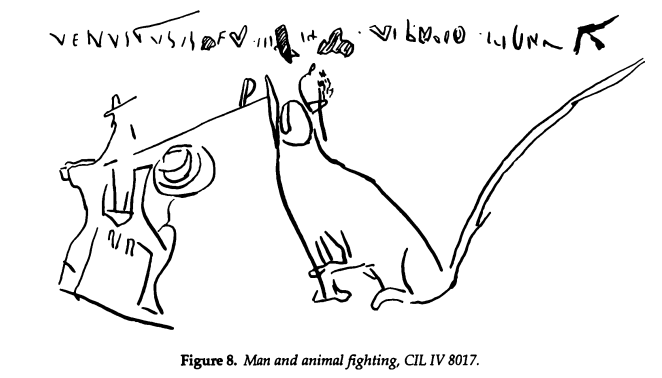
Figure 9 : Increasing human traits in figures: Gladiators and flute players up to the two visible upper Gods. People's perception of social standing was expressed unconsciously through their graphic semiotic system and contributed to the reinforcement of social bonds.
Verbal Phonic and Iconic Abstraction
Caricature at Pompeii was abstractionist, seizing in the same picture three interrelated levels: verbal, phonic, and iconic.
Example: CIL IV 8329, SSevera phelassss = severa felas = Severa, you suck; phonic expression (repetition of 's'); caricature of partners.
Abstraction shows that people's aisthesis (perception) and expression could reach high systemic levels of complexity and subjectivity.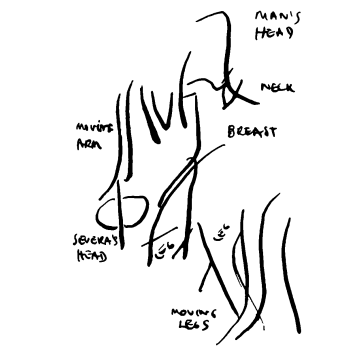
Key Aspects of Graphic Drawings
Specific semiotic system related to graphic wall drawing.
The system was symbolic and social: opposing erudite painting, expressing social contradictions, and differentiating class/status.
Caricaures = Autonomous symbolic devices used to criticized power (CIL IV 9226), reinforce social exploitation (CIL IV 10237), and express self-esteem (CIL IV 9008), interests (CIL IV 8017), and passions (CIL IV 8329).