Russia KT3
KT3- Lenin and the Civil War
- Consolidation of power
- Establishment of Sovnarkom (Council of People’s Commissars)
- Established on 26th Oct 1917
- Designed to be the main government organ of the Bolsheviks, directed by Congress of Soviets
- Shut down press and arrested Menshevik, SR and Kadet leaders
- Announced that it would pass legislation without approval of Congress of Soviets
- Key individuals like Lenin (chairman) and Trotsky (foreign affairs)
- Appeared democratic as members were product of chain of elections through soviets, but the soviets were dominated by Bolsheviks
- Opposition press shut down by Sovnarkom
- Use of MRC to arrest Menshevik, SR and Kadet leaders
- Decrees
- E.g. Oct 1917: Decree on Peace- demanding negotiations for peace opened immediately
- Nov 1917: Decree on the Rights of the People of Russia- claimed people of the Russian Empire had been treated badly by the
- previous regime and this would be put right in the following principles:
- - Equality and sovereignty of the peoples of Russia
- -The right of the peoples of Russia to free self-determination
- - The abolition of any and all religious privileges/disabilities
- - Free development of national minorities and ethnic groups inhabiting Russia
- Treaty of Brest-Litovsk
- March 1918, agreed only after Russia agree to hand over valuable territory
- Much land ceded, which contained valuable resources
- The terms:
- - Finland remained independent, it had been under the control of the
- Tsars since 1809
- - Estonia, Latvia and Lithuania became independent republics
- - Russian-held areas of Poland became part of independent Poland
- - Bessarbia handed over to Romania
- - Germans set up semi-independent governments in Belarus, Ukraine
- and Georgia
Impact- Russia lost 62 million people (1/6 population), 27% farm land, 26%
- railways lines, 74% iron ore and coal reserves
- - March 1918, agreed only after Russia agree to hand over valuable territory
- - Loss of 1/3 of population, 1/3 agricultural land, 2/3 coal mines, ½
- heavy industry, most oil and most cotton textiles
- National Minorities
- Decrees addressed the national minorities
- Certain principles set out and many promises made
- Expression of support for freedom, self-determination and independence
- Reinforcement of promises made in first Russian constitution
- State Capitalism
- Returned to by November 1917 as a way of dealing with demands of war
- State takes complete control of economy until it can be ‘safely’ handed over to the proletariat
- Reaction to crisis period, not part of the grand plan
- Series of decrees (see above)
- 2 more decrees (summer 1918 /spring 1919) to secure nationalisation- nationalisation with compensation for all business employing more than 10 people
- Nov 1917: Decree on Land- seizure and division of private landholdings then
- handed to the peasants
- Nov 1917: Decree on Workers’ Control- workers’ committees given extra powers
- to run factories
- Dec 1917: Formation of Supreme Economic Council (SEC), formed to manage key
- industries nationalise by the Bolsheviks
- Council of Labour and Defence
- Established in 1918, personally chaired by Lenin
- Responsible for the economy, including military supply production
- During Civil War, issues emergency decrees to maintain supplies for the Red Army
- Takes over nationalisation of business from the SEC
- The Cheka (secret police)
- Role was to seek out & destroy those who were against the achievements of the October Revolution
- Disbanded & rebuilt as State Police Administration (GPU) after the Civil War
- Establishment of Sovnarkom (Council of People’s Commissars)
- Force of dedicated Bolshevik supporters that had 2 main
- methods:
- 1. Go along with popular demands (e.g. give workers 8 hour day)
- 2. Build forces of terror and wipe out opposition
- By the end of 1917: Kadets arrested, outlawed and/or brutally beaten. SRs and
- Mensheviks also imprisoned. Bolsheviks intimated middle classes into submission.
- Legal system was replaced with revolutionary justice.
- Anyone deemed to be burzhui (bourgeois) liable for arrest. The abolition of titles
- and use of ‘comrades’ helped Bolsheviks present burzhui as enemies of the People. Disbanded & rebuilt as State Police Administration (GPU) after the Civil War
- Constituent Assembly.
- The primary objective of the Provisional Government was to lay the foundations for
- a Constituent Assembly, this they achieved. The draft for the Statute of Elections to
- the All-Russian Constituent assembly allowed for:
- - The right to vote for all citizens over 20, and all servicemen over 18
- - Proportional representation (one deputy elected from an electoral district for
- every 200,000 citizens.
- NOV 1917- Elections went ahead
- Bolsheviks- 175 seats, SRs 370 seats, Left SRs 40, Kadets, 17, Mensheviks 16,
- Jan 1918- first and last meeting of the constituent assembly
- Declared unlawful and unrepresentative by Lenin. A crowd of demonstrators in favour of the Assemble were fired on by soldiers loyal to the Sovnarkom.
- Bolsheviks could not achieve and consolidate power through the Constituent Assembly, so decided to take it by power and claim that the politicians (Octobrists and Kadets) were rigging democracy beforehand.
- REACTIONS
- Lenin was deemed a ‘cold-blooded trickster who spares neither honour nor the life
- of a Proletariat’ (Gorky) by other political parties, but the presence of the Red Guard pacified them. Furthermore, Peasants just wanted to to get on with
Why did the Civil War erupt in Russia?
- Bolshevik action and policies
- The following actions and policies, either deliberately or not, provoked a major backlash against Bolshevik rule.
- The reforming decrees: these favoured the bulk of the population at the expense of the wealthy minority especially landowners and the business classes.
- The Treaty of Brest-Litovsk: the loss of land was resented by patriotic Russians.
- The shutting down of the Constituent Assembly and the subsequent centralisation of administration: liberals, SR and Mensheviks viewed this as the end of any prospect of democracy being installed.
- The suppression of opposition: the banning of parties, control of the media, the establishment of the Cbeka and the use of the Red Army to prevent demonstrations reinforced the belief that one form of autocracy was being replaced by another.
- Opposition
- The main opponents of Lenin consisted of those who had come to reject the Bolshevik leaders’ ideology and policies over the long-term as well as after the events of October 1917 to January 1918. Despite the repression adopted by the Bolsheviks, the Mensheviks, SR and liberals did not disappear: they found ways of regrouping to launch a counter attack on those they despised.
- After Kerensky fled the Winter Palace, on 25 October 1917, he went on to organise an army made up of eighteen Cossack companies to attack Petrograd. The former Provisional Government leader hoped the Cossacks would be supported by soldier cadets and officers left in the capital who were disenchanted with the Bolshevik coup.
- At the same time as the planned Petrograd assault, garrison forces in sympathy towards Kerensky, attacked Bolshevik officials and troops.
- In January 1918, a Union in Defence of the Constituent Assembly _ was formed in an attempt to protect the new democratic body; about50,000 supporters gathered on the opening day of the Assembly to demonstrate their allegiance even though the Bolsheviks held public meetings.
- These revolts and demonstrations are often seen as the start of the Civil War. Although easily put down by the Bolsheviks, they were an indication that further trouble was likely. By the Spring of 1918, opposition groups located on the borders of Bolshevik controlled territory had become entrenched. The stage for a full-blown civil war had been set.
- Will of national minorities
- A number of national minorities, especially the Ukrainians and Georgians, were keen to maintain the independence they gained through the Treaty of Brest-Litovsk. Their fear was that once the First World War ended, the Bolsheviks might attempt to take back the territory they had ceded. When the outbreak of civil war occurred, national minorities started to mobilise against the Bolshevik Red Army: there was a realisation that the war, coupled with the German defeat in the First World War, meant there would be a good chance of independence being lost. The minorities, in the form of Green armies, proved to be strong opponents of the Bolsheviks and were a major reason why the civil war was so prolonged.
- Consequences of WW1
- By the time Russia was about to leave the First World War, it was clear that the Russian peoples had experienced immense suffering.
- A collapse of the transport system throughout Russia had led to a reduction in food supplies and a subsequent rise in food prices and starvation; by the end of March 1918, bread in Petrograd was being rationed at 50 grams a day (the lowest ever recorded level).
- Food shortages were made worse with the handing over of Ukraine, Russia’s biggest grain producing area, to Germany under the Treaty of Brest-Litovsk.
- Workers left the main industrial cities for the countryside in search of food; this posed a major threat to the Bolsheviks as their main power base was in urban areas. In the first six months of Bolshevik rule, about 1 million workers migrated. The metal industries of Petrograd were very badly affected: from October 1917 to April 1918, their workforces had reduced by 80 per cent.
- Some entrepreneurial peasants had started to hoard foodstuffs, especially grain, as they could not buy much with the money they might gain from selling it.
- Lenin responded to the living standards crisis by introducing ‘War Communism’.
Timeline of the Civil War:
JANUARY 1918 | Red Army established |
|---|---|
MARCH 1918 | Treaty of Brest-Litovsk |
APRIL 1918 | Kornilov’s army defeated in Don region. Lenin proclaimed war was about to end. British Marines were sent to support to anyone who was opposing the Bolsheviks. |
MAY 1918 | Czech legion revolted and became the focus for anyone who wanted to increase their military offensive against the Bolsheviks. SRs keen to ally with the Czechs. |
AUGUST 1918 | Trotsky made his intentions with the Red army clear as he shot any deserters. Bolsheviks also became concerned as more foreign troops arrived (inc. US support). |
SEPTEMBER 1918 | Directory government at UFA formed, made up of SRs and Czechs. The opposition become known as the White Army. |
NOVEMBER 1918 | Admiral Kolchak announced himself Supreme ruler of the White army |
DECEMBER 1918 – END OF 1921 | Red army (based mainly in Moscow) soaked up attacks from Whites in all directions |
OCTOBER 1919 | Red army makes major advances by the depth of winter, the most notable were against Denikin & Yudenich’s armies |
JANUARY 1920 | Admiral Kolchak resigned (and was then executed by the Bolsheviks) Ukraine (and other national minorities) demanded independence, providing further difficulties for the Reds. Although nationalist resistance soon seemed to be retreating as Estonia signed an agreement with Sovnarkom |
DECEMBER 1920 | Red forces drive out the last of the white troops |
APRIL 1920 | Polish armed forces attacked as far east as Kiev, Russian forces pushed them back to Warsaw |
OCTOBER 1920 | Armistice signed to end the Russo-Polish war |
MARCH 1921 | Treaty of Riga |
THROUGHOUT 1921 | Semi-independent peasant armies formed to oppose the Bolsheviks. Their aim was to gain more freedom from Bolshevik leaders. The protracted war ended with victory for Reds but forced Lenin and his associates to reconsider the future path that Russia needed to take |
Why did the Reds win the Civil War?
- Leadership
- All Red leaders were completely united behind Lenin’s vision. The Bolshevik party had been formed around Lenin’s ideas and he hand-picked members of the Sovnarkom to work alongside.
- Trotsky founded the Red Army in 1918 and made it into a highly successful fighting force. He travelled 65,000 miles during the course of the war on his personal armoured train.
- White Leaders like General Deniken and Admiral Kolchak were divided and distrustful of each other. Some were monarchists, others were socialists.
- Organisation, resources and logistics
- The Communists were also able to maximise the production of weapons through the introduction of War Communism. Under this economic system the Communists conscripted people to work in factories and used coercive tactics, such as fear of imprisonment, to force workers to produce more weapons.
- The Communists took over war production and centrally controlled all economic activity. Groups of elite workers were sent round the various economic sectors to deal with bottlenecks in production. Crucially, they were able to feed the cities through ‘grain requisitioning’.
- The Communists dominated the heartland of Russia - an area between Petrograd, Moscow and Tsaritsyn (now Volgograd) with a population of approximately 60 million. Moscow and Petrograd were important industrial centres and the area also included most of Russia’s railway network. This territory was continuous and unbroken by areas under opposition control.
- Harsh Bolshevik policies were unpopular with the working classes and the peasants, leading to the Kronstadt Mutiny and the Tambov Rising, where both groups turned against the Bolsheviks. There were up to 500,000 men in the White Army at any one time, compared to 3-5 million Reds.
- Strategy and tactics
- Some anti-communists forces fought amongst themselves, weakening their chances of defeating the Communists. Ukrainian nationalists, for example, fought both White and Red armies. A Green army was formed under Nestor Makhno.
- The Greens wanted to create a new type of society where political and economic control was in the hands of local groups of peasants. Makhno operated successfully against the Communists in 1918, only to be defeated by the Red Army in 1919.
- Foreign intervention should have worked in the Whites’ favour and it certainly did bring them supplies and weapons. But it was half-hearted and largely ineffective. It also gave the Bolsheviks a propaganda coup because they could present themselves as the defenders of Russian soil against foreign forces.
- Trotsky’s strategy was based on maintaining lines of communication within the Red Army, breaking the supply lines to White army groups and preventing White army groups from co-ordinating their activity. Integral to the above strategy was the tactic of controlling and maintaining the railways, especially in the areas around Petrograd and Moscow.
- Terror
- 500,000 deserters were arrested in 1919 and 800,000 were arrested in 1920. Often hostages were taken and several were shot to make an example, the rest were forced to re-join the Red Army.
- Peasants who tried to resist grain requisitioning were executed and villages Trotsky thought to be hiding political opponents were burned. Many civilians and would-be opponents were offered the choice between joining the Red Army or execution.
- Terror tactics turned some moderates against the Bolsheviks and may have been a reason why so many people joined the independent Green Army.
- Belief and commitment to the cause
- The level of indiscipline and corruption in the White armies was extraordinary. Denikin said: ‘| can do nothing with my army. I am glad when it carries out my combat orders.’ In Omsk (Kolchak’s base), uniforms and munitions supplied by foreign interventionist governments were sold on the black market, and officers lived in brothels in a haze of cocaine and vodka. Reds used ‘Agitprop’ propaganda to encourage soldiers and trains carrying soldiers were fitted with cinemas where propaganda films were shown. White leaders like Deniken did not see the potential of propaganda.
- The Whites were made up of different groups who had entirely different aims and beliefs — they could not agree on whether they were fighting for monarchism, republicanism or for the Constituent Assembly. This made it hard for them to co-operate and impossible to develop a political strategy.
- They were also split by their views on national minorities. Right from the start, Lenin set the Bolshevik party up to be obstinate and uncompromising in their views, they were not willing to work with any other party and even factionalism was banned in 1921. The argument can be made that this reduced the number of people who were willing to support them and made their victory more difficult than it needed to be.
- Death of the Tsar
- The Tsar, along with Tsarina Alexandra and their 5 children were shot and bayoneted to death at Ipatiiev house in Yekaterinburg on 17 July 1918. Their bodies were taken to Koptyaki forest, where they were stripped and mutilated. This was done so effectively that a White investigation in 1919 was unable to find the grave site and thus it could not become a shrine for monarchist forces.
- The death of the Tsar, meant that when the Whites captured Yekaterinburg, he could not become a rallying point for them and a potential turning point in the war. The argument can be made that by murdering 5 innocent children, the Bolsheviks risked turning ordinary people against them due to their unnecessary brutality.
- But the murders were covered up well and the Bolsheviks even allowed a rumour to spread that Anastasia survived. They only admitted to the murders in 1926, long after the war was over.
- War communism
- War Communism was the first version of the Soviet planned economy. All efforts would be directed to the demands of the army. As such, Russia began to nationalise large industries, militarise labour in essential industries, at height in 1920 replaced money with universal rationing. It aimed to abolish private trade, control labour, nationalize all large-scale industry, and at its height in 1920 to replace the money system with a universal system of state rationing.
- Believed that workers would work more efficiently when they were working for a cause rather than a system that made some rich and some poor.
- Banks and shipping were also nationalised and foreign trade was declared a state monopoly. This was the response when Lenin realised that the Bolsheviks were simply unprepared to take over the whole economic system of Russia.
- On June 28th, 1918, a decree was passed that ended all forms of private capitalism. Many large factories were taken over by the state and on November 29th, 1920, any factory/industry that employed over 10 workers was nationalised
- Important to note that even those at the top of the rationing still had very little food. Many in the professional class starved.
- On July 20th 1918, the Bolsheviks decided that all surplus food had to be surrendered to the state.
- Six principles of war communism:
- 1) Production should be run by the state - Private ownership should be kept to the minimum. Private houses were to be confiscated by the state.
- 2) State control was to be granted over the labour of every citizen - Once a military army had served its purpose, it would become a labour army.
- 3) The state should produce everything in its own undertakings - The state tried to control the activities of millions of peasants.
- 4) Extreme centralisation was introduced - The Supreme Economic Council led many initiatives. This had the right to confiscate and requisition. They had over 40 head departments (known as glavki) were set up to accomplish this. One glavki could be responsible for thousands of factories. The Commissariat of Transport controlled the railways. The Commissariat of Agriculture controlled what the peasants did.
- 5) Distribution of resources - The Commissariats took what they needed to meet demands. The people were divided into four categories – manual workers in harmful trades, workers who performed hard physical labour, workers in light tasks/housewives and professional people. Food was distributed on a 4:3:2:1 ratio. Though the manual class was the favoured class, it still received little food. Many in the professional class simply starved. On July 20th 1918, the Bolsheviks decided that all surplus food had to be surrendered to the state. This led to an increase in the supply of grain to the state. From 1917 to 1928, about ¾ million ton was collected by the state. In 1920 to 1921, this had risen to about 6 million tons.
- 6) War Communism attempted to abolish money as a means of exchange. The Bolsheviks wanted to go over to a system of a natural economy in which all transactions were carried out in kind. Effectively, bartering would be introduced. By 1921, the value of the rouble had dropped massively and inflation had markedly increased. The government’s revenue raising ability was chronically poor, as it had abolished most taxes. The only tax allowed was the ‘Extraordinary Revolutionary Tax’, which was targeted at the rich and not the workers.
- Grain requisition:
- July 1918, the Bolsheviks decided that all surplus (extra) food had to be surrendered to the
- state. This led to an increase in supply of grain to the state.
- The government decided that the Kulaks (wealthier peasants) were hoarding their grain. This
- was because they were refusing to sell the grain owing inflated prices in the face of lack of
- manufactured goods (factories closing). Requisition squads terrorised the countryside. There was no extra grain. Peasants attempted to hide some grain as they were often left with too little to sustain themselves. Those who refused were condemned as counter revolutionaries.
- Consequences of war communism:
- Forced requisitioning (taking) of agricultural produce. Grain requisitioning was the most hated policy as it involved taking away surpluses of food and grain, which meant there was a disincentive to grow more than was actually needed by an individual household. Often, majority of food was taken from the household to feed the army and urban workers. Overall result was famine in rural areas (esp. Between 1920-21)
- War led to power being more centralised than before. Power revolved around the Politburo and Orgburo. This meant that these very tightly knit party sub committees became the main organs of government.
- Nationalisation (state control) of larger enterprises and state monopoly of markets for goods and services. This caused unrest as it meant that individuals lost the freedom to produce and sell goods at a time, price, and place that suited them. They lost all ownership and hence control over the means of production, distribution and exchange.
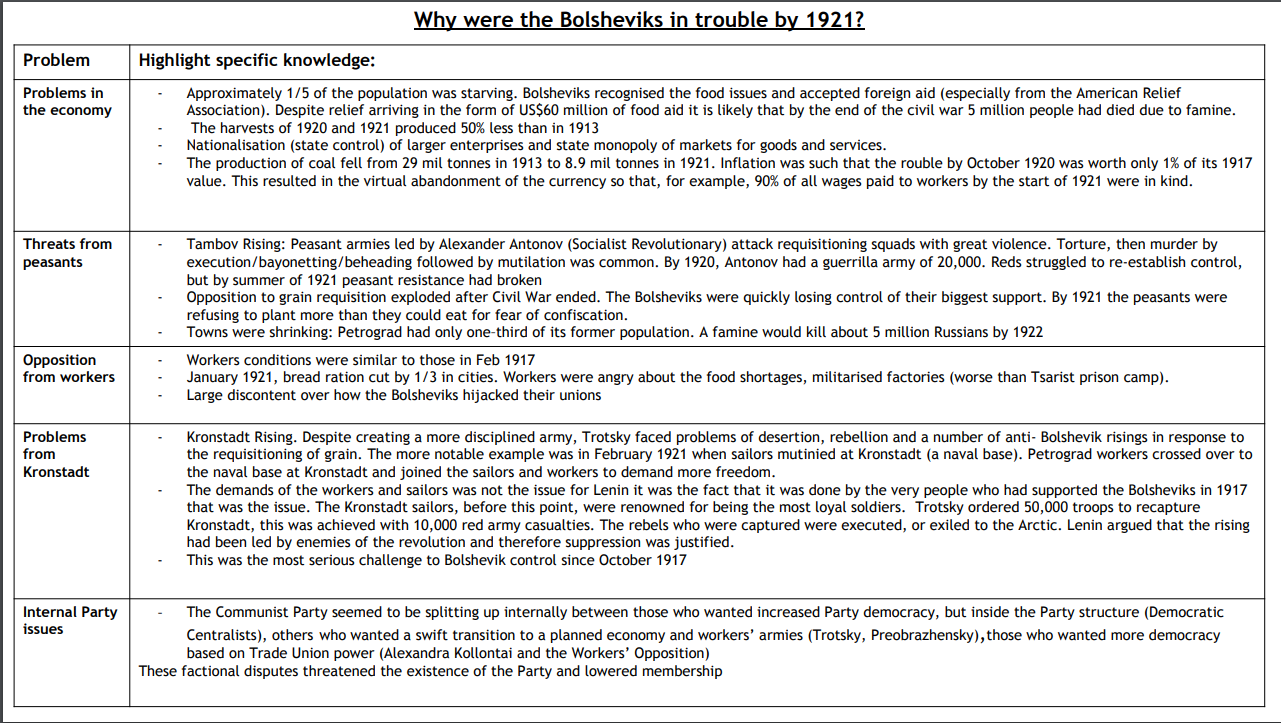
- Starvation occurred owing to the combination of grain requisitioning, drought and the disruption caused by the Civil War. The harvests of 1920 and 1921 produced 50% less than in 1913. Approximately 1/5 of the population was starving. Bolsheviks recognised the food issues and accepted foreign aid (especially from the American Relief Association). Despite relief arriving in the form of US$60 million of food aid it is likely that by the end of the civil war 5 million people had died due to famine.
- Krondstadt Rising. Despite creating a more disciplined army, Trotsky faced problems of desertion, rebellion and a number of anti- Bolshevik risings in response to the requisitioning of grain. The more notable example was in February 1921 when sailors mutinied at Kronstadt (a naval base). Petrograd workers crossed over to the naval base at Krondstadt and joined the sailors and workers to demand more freedom. The demands of the workers and sailors was not the issue for Lenin, it was the fact that it was done by the very people who had supported the Bolsheviks in 1917 that was the issue. Trotsky ordered 50,000 troops to recapture Kronstadt, this was achieved with 10,000 red army casualties. The rebels who were captured were executed, or exiled to the Arctic. Lenin argued that the rising had been led by enemies of the revolution and therefore suppression was justified. However, this was far from the truth and this was in the decision to lesson the harshness of War Communism and led to the introduction of the New Economic Policy, designed to end the famine and lessen opposition.
- Red Terror to deal with opposition- Workers angry at shortage of food and state violence. Calls for new Soviet Election, free press, Constituent Assembly and the overthrow of the Sovnarkom (6 months post-revolution). Some even wanted the Tsar. Anarchists who rejected the authoritarian control of the government. Left wing SRs protesting against Treaty of Brest-Litovsk. They turned to terrorism- attacking German ambassadors to sabotage Russian relationship with the Germans. They captured Dzerzhinsky, head of the Cheka in May and managed to shoot Lenin in August 1918. They put real pressure on the regime.
- Assassination attempt on Lenin prompted the Cheka to launch the Red Terror in the summer of 1918, butthis was an intensification of what was already happening. From June, SRs were arrested in large numbers, along with anarchists and members of other extreme left group. Mensheviks and SRs were excluded from taking part in soviets. Many Kadets were already in prison, others had fled to the south.
- Executions now became common. Prisoners were shot. 1918-1920 13,000 deaths (as a result of the Cheka) but real figures are around 300,000.
- Typhus spread rapidly amongst the lice-ridden troops and the civilian population.Over 1 million people are thought to have died from typhus and typhoid in 1920. Estimates suggest that around 450,000 were killed by disease over the period while 350,000 were killed in the fighting.
- Cossacks in the south assaulted and murdered whole villages of Jews in Pogroms during the civil war. They may have taken 115,000 lives alone in Ukraine. They claimed Jews supported the Bolsheviks.
- In the Donbass region, the whites routinely shot miners who were not producing enough coal. They even buried miners alive in Rostov.The war influenced the nature of the Russian government.
- The post war communist government consisted of men who served in the Red Army, the Cheka and other bodies. This style of leadership was carried into the new Russia. The emphasis was on orderliness, trustworthiness, comradeship and loyalty to the party. War communism illustrates the militaristic approach of the government. This approach divided the party. Bolsheviks set up concentration and labour camps to house all troublesome workers, peasants and middle classes.
- The Civil War largely nullified any positive impact of State Capitalism. Industrial output in a number of sectors fell. E.g. the production of coal fell from 29 mil tonnes in 1913 to 8.9 mil tonnes in 1921. Inflation was such that the rouble by October 1920 was worth only 1% of its 1917 value. This resulted in the virtual abandonment of the currency so that, for example, 90% of all wages paid to workers by the start of 1921 were in kind. Some services, such as tram rides, were free as it was impossible to pay for them. On top of this, millions were starving as a result of the famine of 1920 to 1921. The New Economic Policy was introduced to bring in stability even though it appeared to be a contradiction of all that the communists stood for. Defeat in the Polish campaign brought a similar kind of humiliation to the Bolsheviks as the Russo Japanese war did to N2. Once again, the Russian army was defeated by an army who on paper, were weaker. Bolsheviks moved towards a foreign policy of developing peaceful relations. Partial militarisation of labour- hated as people were forced to work solely to meet the needs of the war.
- The NEP ended the policy of grain requisitioning and introduced elements of capitalism and free trade into the Soviet economy. It was introduced in the Tenth Party Congress in March 1921. This was done, in Lenin's words, to provide “breathing space” for the Russian people. Ultimately, he recognised that the Bolsheviks had lost a large portion of their support base as a result of the methods they used during the Civil War. This loss of support had created fear in the Party that their power was under threat. Therefore, there was little choice to reject the NEP. Simultaneously, Lenin banned factions and splits within the Bolsheviks to minimise the chance of opposition. Under the NEP, Russian farmers were once again permitted to buy and sell their surplus goods at markets. They could also employ people to work for them. Those farmers who expanded the size of their farms became known as kulaks. The NEP also allowed some freedom of internal trade. Factories employing less than twenty people were denationalised and could be claimed back by former owners.
NEP:
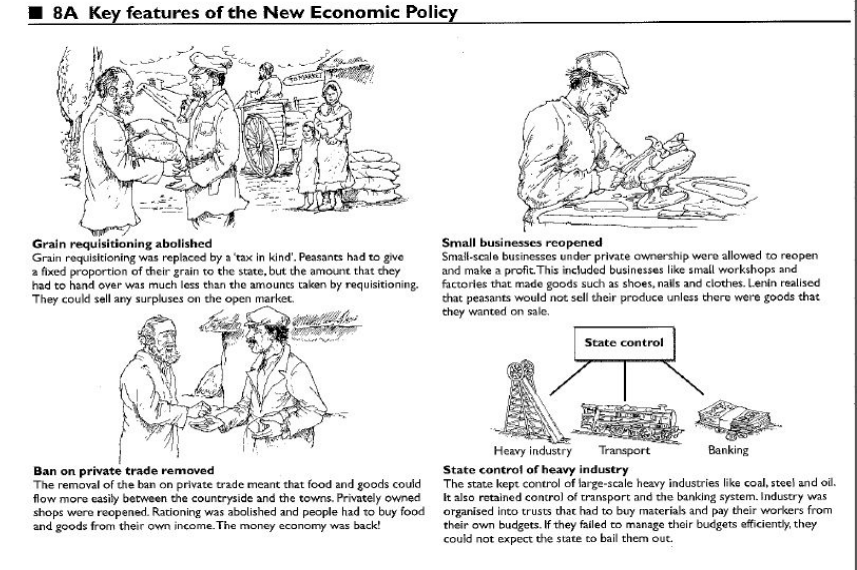
By 1926-27, most economic indices were at or near pre-war levels. But recovery via market forces was accompanied by the re-emergence of a “capitalist” class in both the countryside (the kulaks) and the towns (NEPmen), persistent unemployment among workers (some of whom referred to NEP as the “new exploitation of the proletariat”), and anxieties within the party about bourgeois degeneracy and the loss of revolutionary dynamism.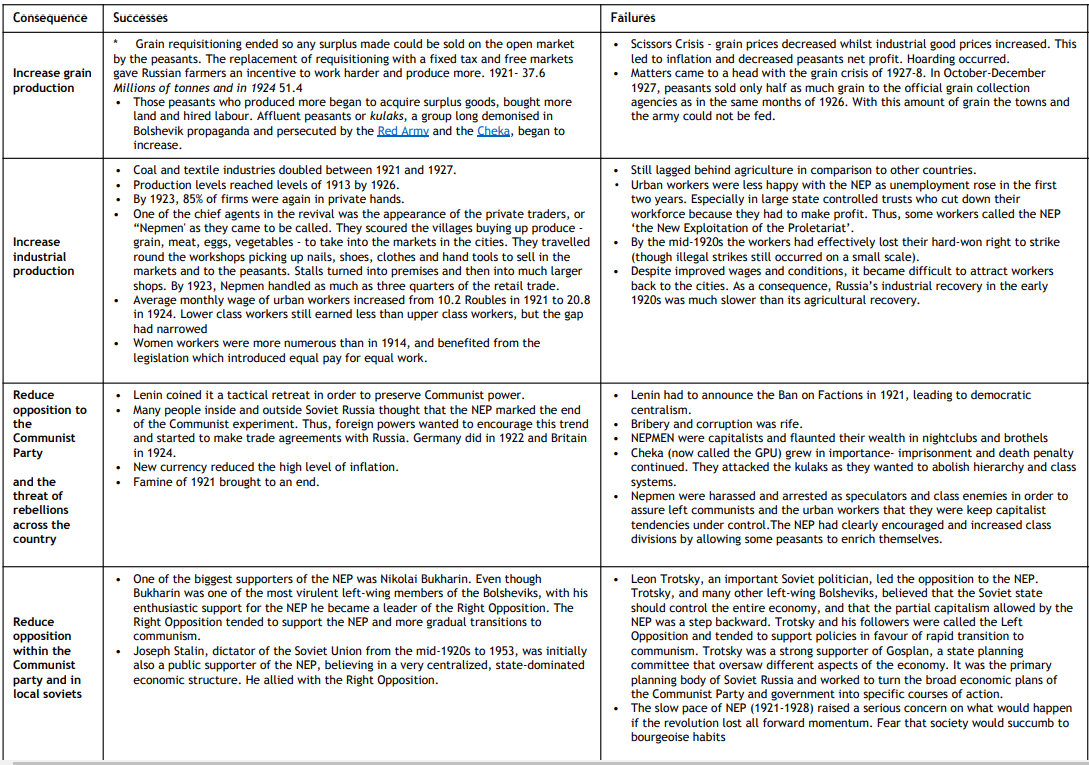
- Constitution - Two major constitutional changes
- 1.Constitution of 1918 created the Russian Soviet Federative Socialist Republic (RSFSR) Made up of Russia, parts of central Asia, Kazakhstan, Uzbekistan, Turkmenia Central control of all Russian affairs would be in the hands of politicians elected by the people of the RSFSR
- BUT all key government positions were held by senior Bolsheviks and administration was made up of the leading cadres
- 2. Constitution of 1924 formally established the United Soviet Socialist Republic (USSR)
- The Republic of Ukraine, Belonissia and Transcaucasia were formally brought under the new USSR. Under the USSR, each republic was allowed its own symbols of sovereignty (e.g. National flag) and their own government. BUT all governments were still answerable to Sovnarkom. This meant that Russia remained a one-party state and in reality these Soviet republics had little control.
- High control of the economy
- The government/ state control most of the economy.
- Lenin’s ‘Cult of Personality’
- Lenin being a key figure, father-like.
- One party state
- No other political parties are allowed.
- Party = government
- Only Communists could stand for election in the Soviets, so the Communist Party controls the government.
- All key government posts are held by senior Bolsheviks.
- If you wanted to be involved with government, you had to be a member of the Bolshevik Party. Membership numbers grow massively in post-Civil War period (from 730,000 members in 1921 to 1 million in 1928).
- Highly controlled Communist Party
- The Communist party itself is tightly controlled, and everyone has to toe the line of what Lenin wants.
- The more centralised and nepotistic the government becomes, the less democratic it becomes.
- Ban on factions &‘democratic centralism’
- Party members were no longer allowed to form groups independent from Lenin’s leadership. Decision made by Lenin and the Politburo were binding on all other Communists.
- Nomenklatura system
- From 1923. Bolshevik leaders wanted to ensure that all key personnel in public bodies were drawn from Bolsheviks orpro-Bolshevik workers. A list of 5500 designated party and govt posts was drawn up (the nomenklatura). Holders of these posts could only be appointed by the central party bodies, and overt loyalty counted more than expertise. The people in the nomenklatura (the keys posts) became an elite group.
- Opposition supressed
- Creation of a police state (Cheka, then GPU from 1922).
- Anyone opposing the government is harshly repressed, media in line with Communist ideas, censorship.
- Gulag system of labour camps established in Sept 1918 to contain opponents of the regime.
- USSR created – but little control for the republics
- A ‘union of soviet republics’ is created, but really these have minimal independent control and are ruled by the Communist government of Russia.
- Lenin’s legacy:
- Died 21st January 1924
- On 23 January, the coffin with Lenin's body was transported by train from Gorki to Moscow and displayed at the Hall of Columns in the House of the
- Unions, and it stayed there for three days.On 27 January, the body of Lenin was delivered to Red Square, accompanied by martial music.
- Transported by train to Moscow, the coffin was taken to the House of Trade Unions, where the body lay in state. Over the next three days, around a million mourners came to see the body, many queuing for hours in the freezing conditions.
- There assembled crowds listened to a series of speeches delivered by Mikhail Kalinin, Grigory Zinoviev, and Joseph Stalin, but notably not Leon Trotsky, who had been convalescing in the Caucasus.
- Trotsky would later claim that Stalin had given him the wrong date for the funeral. Afterwards the body was placed into the vault of a temporary wooden mausoleum (soon to be replaced with present-day Lenin's Mausoleum), by the Kremlin Wall.Despite the freezing temperatures, tens of thousands attended.
- A wooden tomb, in Red Square by the Moscow Kremlin Wall, was ready on January 27, and later that day Lenin's coffin was placed in it. More than 100,000 people visited the tomb in the next six weeks
- As of 2022, his body remains on public display in Lenin's Mausoleum on Red Square.
- Lenin’s strengths and weaknesses:
- ln politicising all aspects of life in Russia, Lenin prevented the nation from an open, progressive
- Society.
- Lenin was a ‘conviction’ politician. Throughout his career he stuck in the belief that the imposition of Marxist ideas was the only way for a more just, fair and equal society to come about in Russia.
- Conviction and commitment led him to disregard the human cost of his methods. His ruthless approach led to unnecessary suffering and created a set of grim precedents.
- Lenin had an ability to inspire dedicated support from party members and intense loyalty from government and party colleagues.
- Despite his Marxist convictions, Lenin was also flexible in his thoughts and actions. For
- example, he initially believed that a revolution in Russia could be achieved only with the
- support of workers and not peasants. When peasants started to show ‘revolutionary
- behaviour’, such as seizing land from the nobility, Lenin changed his mind and acknowledged that rural protesters had an important role to play in political change.
- Exploiting the authoritarianism he inherited from the tsarist system, Lenin made the Bolshevik state more oppressive than its predecessor. refusing to acknowledge the legitimacy of any other political Viewpoint than his own Lenin stifled any possibility of genuine democracy developing in Russia
- Lenin was so single-minded about Marxism that he refused to accept that there were possible alternatives to achieving a more just society. This caused opposition to him gaining momentum, including within his own party. Opposition to Lenin also strengthened when he banned other political parties.
- Above all, Lenin was a person of great intellect. He was adept at converting some of the more abstract ideas of Marxism into something that could be understood by workers and peasants. In response to the context he found himself working in, he developed his own ideology of Marxism-Leninism.
- When Lenin died in 1924, he was held in total reverence by party members.
- He had driving sense of self-belief that allowed him to overcome opposition within and outside
- his party.
- Fellow Bolsheviks displayed much loyalty towards their leader, even when they disagreed with him. This suggests Lenin’s intellectual abilities coupled with his pragmatism were admired and respected.
- Lenin was an opportunist; he knew when to take advantage of the weaknesses shown by his opponents, especially the Mensheviks and the Provisional Government.
- By outlawing all other parties, Lenin made Violent conflict unavoidable.
- Lenin used considerable force, with the resultant human casualties, if it meant he was to achieve his aims. Generally, Lenin could be seen as much of an oppressor as the tsars (hence, he, along with Stalin has been referred to as a ‘Red Tsar’).
- When Lenin experienced what others would have seen as setbacks, such as being exiled, he saw these as opportunities.
- He refused to be deterred by reversal and failure, surviving through exile, civil war, economic collapse, famine or foreign invasion.
- Lenin’s economic, social and political reforms could be seen to have set Russia backwards, but much depends on how the costs and benefits of capitalism are viewed, as opposed to those of Communism.
- Lenin had total ruthlessness in pursuit of his revolutionary objectives.
- He had a remarkable sense of political opportunism, which enabled him to lead his minority party into power in 1917 and then establish a Communist state.
- Lenin’s self-belief proved invaluable in helping him deal with opposition.
- While occasionally willing to adjust economic policy for expediency, Lenin’s basic hostility to capitalism denied Soviet Russia the opportunity to achieve sustained growth. '
- Lenin had a gift for interpreting abstract ideas and turning them into a meaningful ideology. He shaped Marxist notions in such a way that made Communism one of the dominant ideologies for the 20th C
- Lenin
- At the 10th Party Congress in January, Lenin dictated a series of fragmentary notes which became known as his testament. In the Testament, Lenin addresses his concern of the way the revolution has progressed.
- He also addressed three problems, all of which concern Stalin: Nationalities question- what sort of union treaty should be signed. In particular the Bolsheviks relation with Georgia, Lenin criticised Stalin for his Great Russian Chauvinism towards national minorities.
- Once the Red Army had reconquered old Imperial borders e.g. Ukraine, Central Asia etc Stalin proposed that the non- Russian republics should join Russia as autonomous regions, effectively depriving them of the right to formally withdraw from the union. Lenin felt that they should have this right
- . The entire Central Committee of the Georgian Communist Party resigned in protest of Stalin’s policy. Although Lenin vehemently opposed Stalin, and attempted to intervene, his illness got in the way and this made Stalin get his way. Make leading party organs more accountable.
- He proposed to democratise the central committee by adding 50-100 new members from the lower party organs to open up the Politburo to the scrutiny of the Central Committee. Succession (the most contentious issue).
- Lenin preferred a collective leadership and he pointed out faults of major party leaders. Lenin made it clear that Stalin needed to go. Lenin suffered a third stroke and struggled with his speech. His testament was not read out in the 12th party congress in April 1923.
- Trotsky
- Trotsky was a brilliant orator and administrator. He was the main figure head that led the Bolsheviks to victory as he was in charge of the Red Army. He was also a member of the Politburo.
- However, he was unpopular within the party. This was because of his Menshevik past, his pride and arrogance. He would much rather be a leader than a follower- when Lenin was ill he wanted his succession to be collective leadership rather than an individual as he was concerned with self interests of leaders.
- Trotsky, wrote an ‘Open letter to the Central Committee’ in which he accused it of suppressing democracy in the Party and claimed that this explained the recent workers’ strikes in Soviet Russia and the failure of the revolutionary movement in Germany, whose workers were disillusioned with the Communists.
- Support for Trotsky came from ‘Group 46’ leading Bolsheviks, including Piatakov and Smirnov, whose Declaration formed the basis of the left opposition against the triumvirate between 1923 and 1927. This gave Trotsky’s enemies the evidence they needed to accuse him of factionalism (ban on factions was introduced in 1921).
- They also accused him of ‘Bonapartism’, a charge that relied on his reputation for high handedness. Trotsky defended himself by arguing that he rejected Lenin’s offer of high office once in October 1917 (as Commissar of the Interior) and again in 1922 (as Deputy Chairman of Sovnarkom) on the grounds that it was unwise to have a Jew in such a senior position given the problem with anti Semitism in Russia.
- However, this did not succeed, Trotsky was accused of factionalism. Many wanted to expel him from the party but Stalin (wanting to be the voice of reason) opposed this and allowed him to remain however, knowing that Trotsky’s career as a major political force had been finished. And the party was now increasingly in the hands of Stalin. Trotsky left office in January 1925 and was expelled from the party in 1927.
- Stalin
- Stalin appeared to be more qualified due to his multiple roles during the civil war- he was Commissar for Nationalities, Commissar for Rabkrin (workers and peasants inspectorate), member of the Politburo and the Orgburo (Organisational Bureau), and the Chairman of the Secretariat, so that he had gained a reputation for modest and industrious mediocrity. Stalin was made to feel inferior amongst the Party’s more cosmopolitan and intellectual leaders.
- He was a secretively vengeful man, he never forgave and forgot. He was especially resentful of those Bolsheviks who minimised his role in 1917- in particular Trotsky. Stalin became the Secretary of the Party in April 1922.
- Stalin's popularity grew from his control of the Party apparatus in the provinces. As the Chairman of the Secretariat, and the only Politburo member in the Orgburo, he could promote his supporters and obstruct his opponents.
- During 1922 alone, more than 10,000 provincial officials were appointed by the Orgburo and Secretariat. They were to be his main supporters in his struggles for leadership.
- During Lenin’s absence the government was run by the triumvirate (Stalin, Kamanev and Zinoviev) which had emerged as an anti Trotsky bloc. When Lenin became ill with a second stroke, Stalin took control of Lenin’s recovery and restricted all visitors to only 5/10 minutes a day.
- After the death of Lenin in 1924, Stalin was keen to take over but collective leadership was in place. Stalin made a speech one week after Lenin’s death pledging to complete the revolution began by Lenin. It was not until the 1930s that Stalin was able to have a full dictatorship.