The History of the Universe
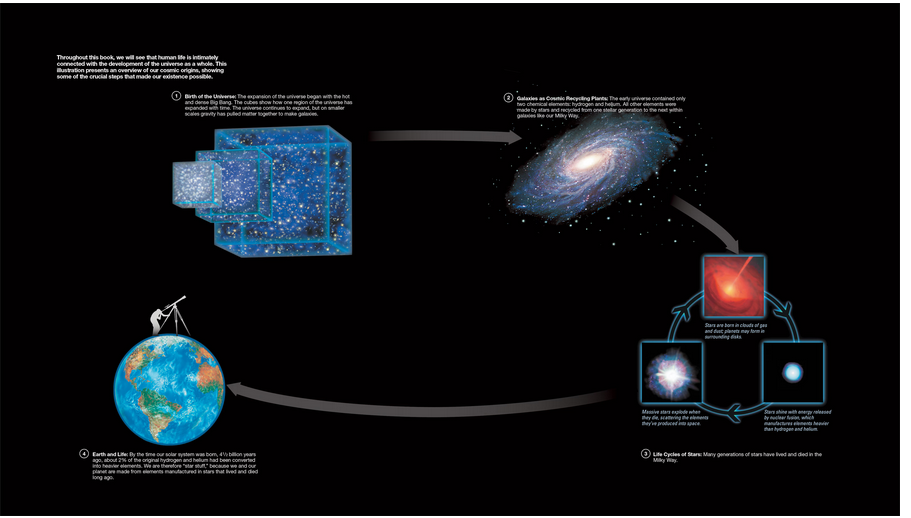
The Birth of the Universe
The expansion of the universe began with the hot and dense state known as the Big Bang, approximately 13.8 billion years ago. The universe continues to expand, but on smaller scales gravity has pulled matter together to make galaxies.
☉Galaxies are carried along with the expansion of the universe. as space itself stretches, making them increasingly distant from one another over vast cosmic timescales. This vastness leads to a phenomenon known as redshift, where light from distant galaxies appears stretched, resulting in longer wavelengths, which helps astronomers measure the rate of expansion.
☉ The universe as a whole has continued to expand ever since the Big Bang (average distance between galaxies is increasing with time), but on smaller size scales, the force of gravity has drawn matter together
That is, while the universe as a whole continues to expand, individual galaxies and galaxy clusters (and objects within them such as stars and planets) do not expand.
That is why the average distances between galaxies grow with time, but objects such as people, Earth, the solar system, and the Milky Way Galaxy remain stable in size.
☼ Evidence indicates that the Big Bang produced essentially only the elements hydrogen and helium, and all other elements were made subsequently by stars
This stellar nucleosynthesis process is critical for understanding the composition of the universe, as heavier elements like carbon, oxygen, and iron are formed through nuclear fusion in the cores of stars and released into space when these stars die.
☼ Super structures are the largest known coherent structures in the universe, encompassing groups of galaxies and galaxy clusters that are held together by gravity.
These super clusters are arranged in colossal networks that look like the inside of a sponge.
Stars
Life Cycle of Stars: Stars are born in interstellar clouds, produce energy and new elements through nuclear fusion, and release those new elements in interstellar space when they die.
1) Stars are born in clouds of gas and dust; planets may form in surrounding disks
A star is born when gravity compresses the material in a cloud to the point at which the center becomes dense enough and hot enough to generate energy by nuclear fusion,
2) Stars shine with energy released by nuclear fusion, which ultimately manufactures all elements heavier than hydrogen and helium
The star “lives” as long as it can generate energy from fusion and “dies” when it exhausts its usable fuel.
3) Massive stars explode when they dies, scattering the elements they’ve produced into space.
a star blows much of its contents back out into space
the most massive stars die in titanic explosions called supernovae.
4) The returned matter mixes with other matter floating between the stars in the galaxy, eventually becoming part of new clouds of gas and dust from which future generations of stars can be born
Galaxies therefore function as cosmic recycling plants, recycling material expelled from dying stars into new generations of stars and planets.
☉We are “star stuff”—made of material that was manufactured by stars (that loved and died before the birth of our Sun) from the simple elements born in the Big Bang.
Cosmic Calendar
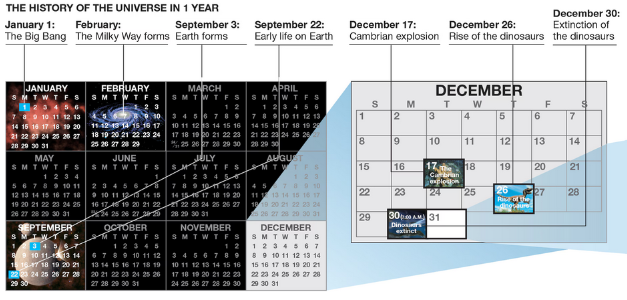
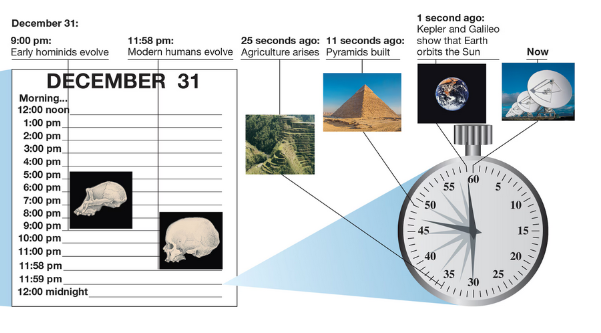
The cosmic calendar compresses the 14-billion-year history of the universe into 1 year, so that each month represents a little more than 1.2 billion years.
☉The solar system's age of 4 ½ billion years therefore puts its birth in early September.
☉ Life apparently arose on Earth within less than a billion years after that, which means it was still in September (because each month on the cosmic calendar represents about 1.2 billion years).
☉ Early humans arose just a few million years ago, which therefore means just a few hours before the present moment (the stroke of midnight)
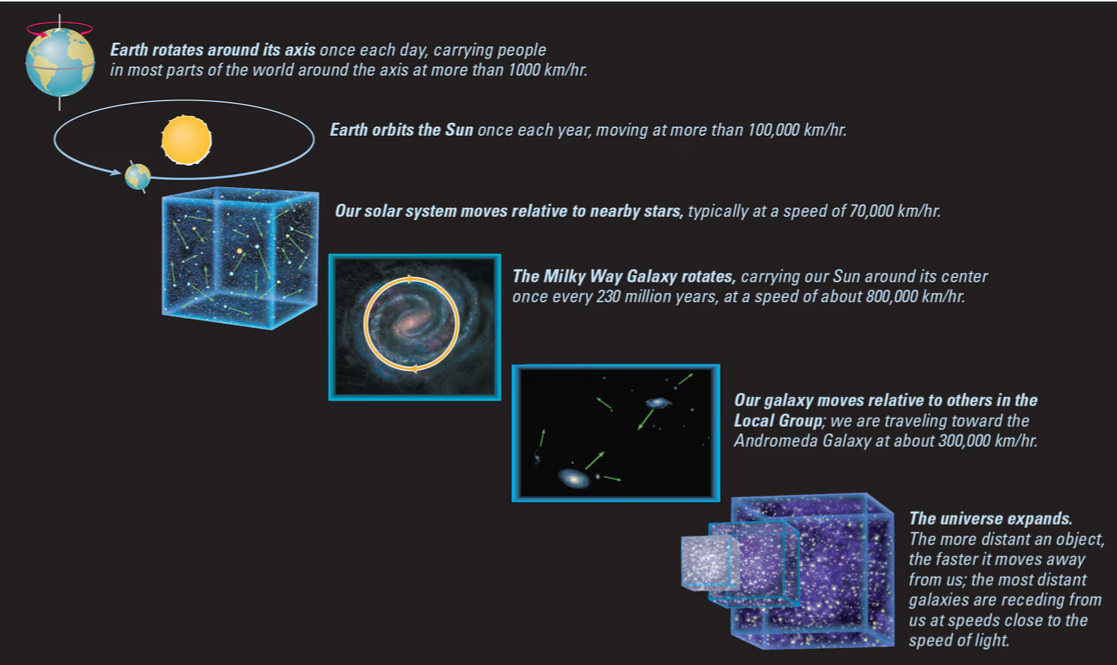
How is Earth Moving Through Space?
☉ As Earth orbits the Sun, it also travels through the Milky Way galaxy, navigating through the gravitational pull of nearby stars and interstellar matter.
☉ The most basic motions of Earth are its daily rotation (spin) and its yearly orbit (or revolution) around the Sun.
☉ Earth rotates once each day around its axis, which is the imaginary line connecting the North Pole to the South Pole.
☉ Earth rotates from west to east- which means counterclockwise as viewed from above the North Pole.
which is why the Sun and stars appear to rise in the east and set in the west each day.
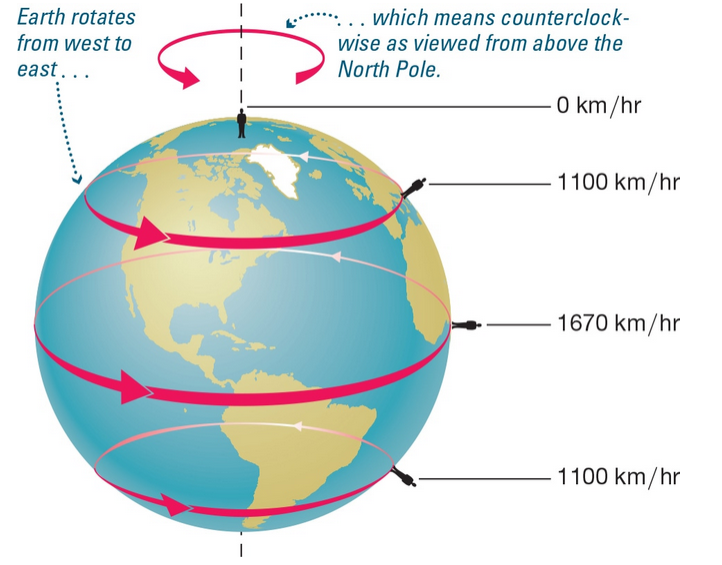
☼The closer you are to the equator, the faster you travel with rotation.
☉ Earth rotates once each day and orbits the Sun once each year. Its average orbital distance, called an astronomical unit (AU), is about 150 million kilometers.
Earth’s orbital distance varies slightly over the course of each year
The orientation of Earth’s axis in space gradually changes due to a motion known as precession. However, the rate of precession is so slow that it would take several centuries before the change was noticeable to the naked eye.
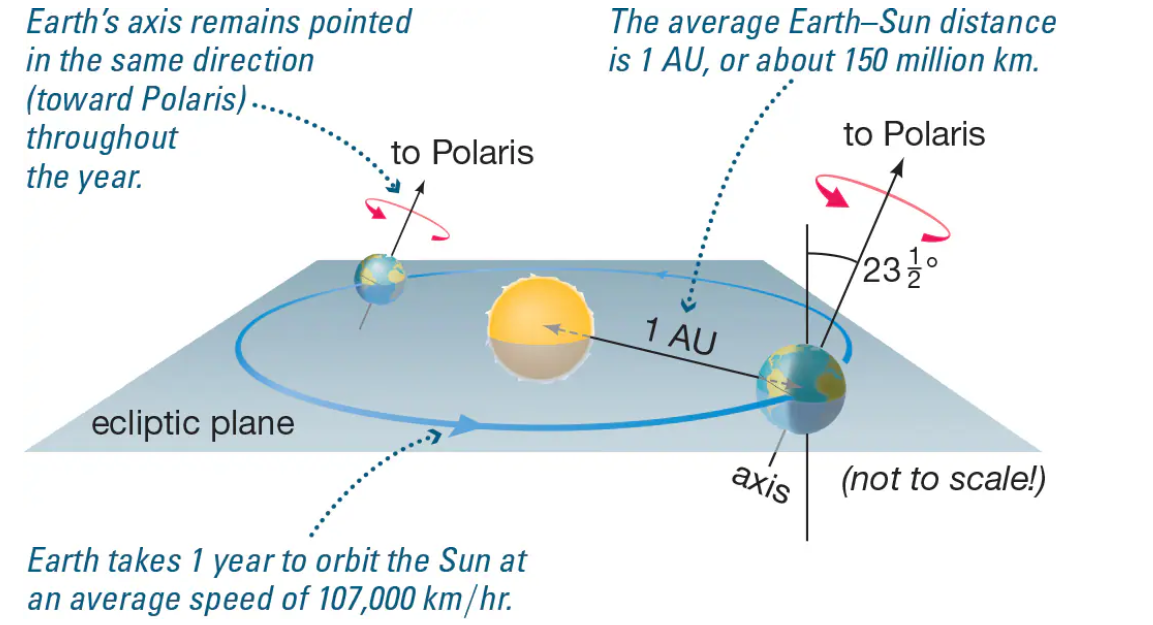
☉ Earth's orbital path defines a plane called the ecliptic plane (a flat plane).
☉ Earth’s axis is tilted by 23½° from a line perpendicular to the ecliptic plane.
This axis tilt happens to be oriented so that the axis points almost directly at a star called Polaris, or the North Star.
Earth’s axis does not noticeably change its orientation in space over the course of each year, so it remains pointed toward Polaris at all times.
☼ Strong evidence indicates that Earth and the other planets were born in a spinning disk of gas that surrounded our Sun as it formed, and Earth rotates and orbits in the same direction as the disk was spinning.
Motion Within the Milky Way Galaxy
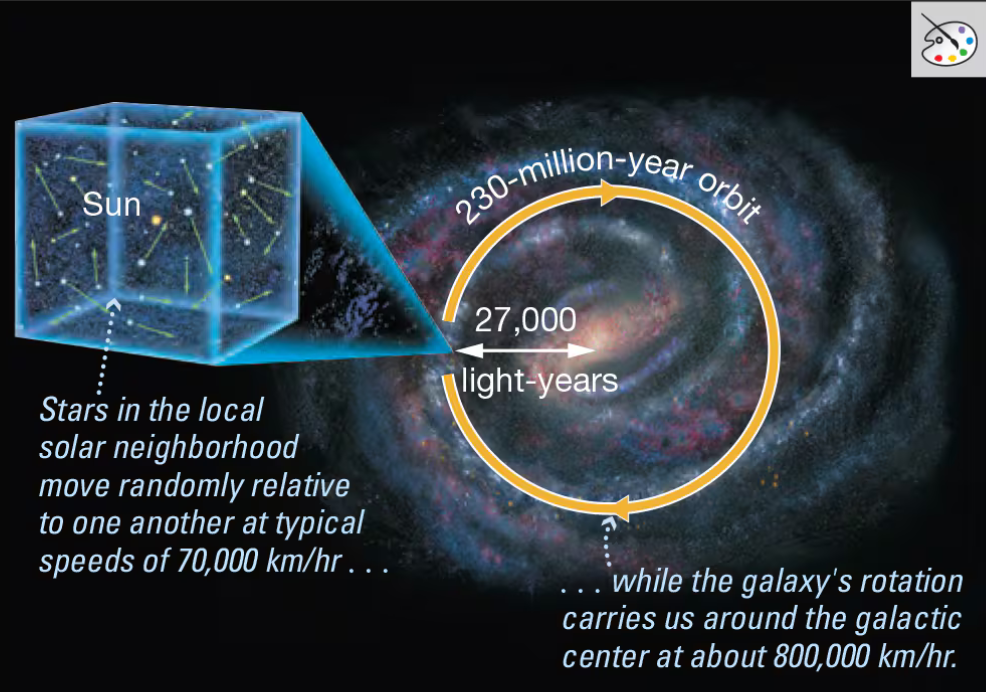
☉ Our solar system is moving relative to nearby stars in our local solar neighborhood, the region of the Sun and nearby stars.
☉ Stars within the local solar neighborhood (like the stars of any other small region of the galaxy) move essentially at random relative to one another.
☉ Our sun moves randomly relative to the other stars in the local solar neighborhood
at typical relative speeds of more than 70,000 km/hr
stars are so far away that we cannot easily notice their motion
it orbits the galaxy every 230 million years
☼ Our solar system, located about 27,000 light-years from the galactic center, completes one orbit of the galaxy in about 230 million years.
☉ The billions of galaxies in the universe also move relative to one another.
☉ Within the local groups some galaxies are move away from us and some galaxies are moving towards us, influenced by gravitational interactions and the expansion of the universe.
Edwin Hubble found two astonishing facts looking outside our Local Group using the Hubble Space Telescope
1) Virtually every galaxy outside the Local Group is moving away from us.
2) The more distant the galaxy, the faster it appears to be racing away.

☼The entire universe is expanding
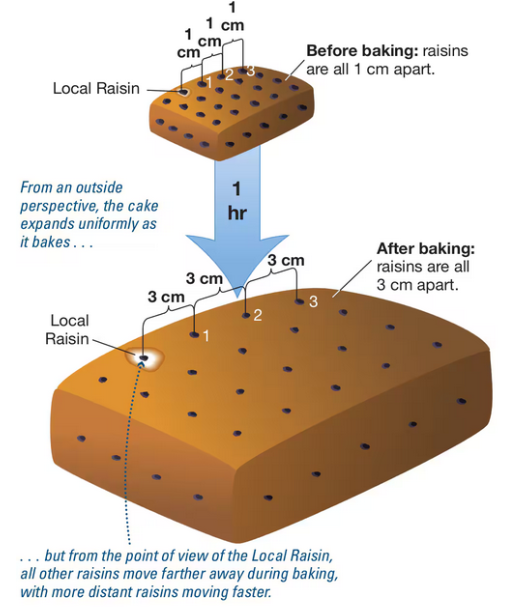
An expanding raisin cake offers an analogy to the expanding universe. Someone living in one of the raisins inside the cake could figure out that the cake is expanding by noticing that all other raisins are moving away, with more distant raisins moving away faster. In the same way, we know that we live in an expanding universe because all galaxies outside our Local Group are moving away from us, with more distant ones moving faster.
☼ Distant galaxies are all moving away from us, with more distant ones moving faster, indicating that we live in an expanding universe.
More distant galaxies move away from us faster because they are carried along with this expansion
The faster the rate of expansion, the more quickly the galaxies reached their current positions, and therefore the younger the universe must be.
☉ Human can’t actually see the expanding of the universes since the distance are too vast for any motion to be noticeable in a time scale of human life
we measure the speeds of galaxies by spreading their light into spectra and observing what we call Doppler shifts
Modern Challenges in Astronomy
Dark Matter and Dark Energy
Black Holes'
Origins of Spacetime, Origins of Matter, and
Origins of life