Deciduous Teeth
General Info About Deciduous Teeth
Smaller than permanent teeth.
Whiter enamel compared to permanent teeth.
Enamel and dentin layers are thinner.
Pulp chambers are larger relative to tooth size.
Roots are shorter and more slender.

Morphology of Primary Maxillary Teeth (1-5)
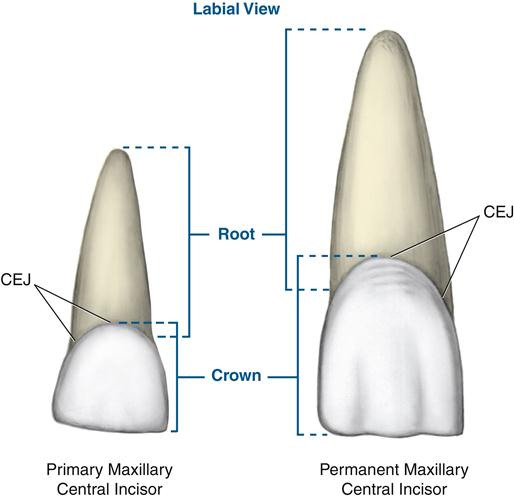
Central Incisor
Appearance: Wider mesiodistally than incisocervically.
Roots: Single, conical root.
Identification: Prominent cervical ridge on the labial surface.
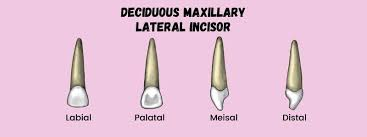
Lateral Incisor
Appearance: Similar to central incisor but smaller and narrower.
Roots: Single, conical root, slightly longer than central incisor root.
Identification: More pronounced cingulum than central incisor.
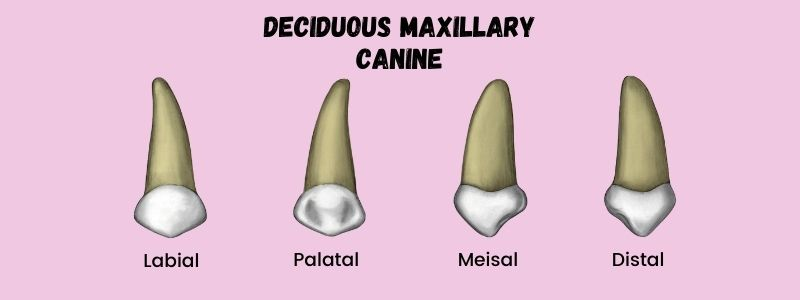
Canine
Appearance: Long, sharp cusp.
Roots: Single, long root with labial and lingual ridges.
Identification: Distinct cusp and well-developed cingulum.
First Molar
Appearance: Resembles a premolar but with a more prominent buccal bulge.
Roots: Two divergent roots (buccal and lingual).
Identification: Occlusal outline is more rhomboidal, with a prominent mesiobuccal cusp.

Second Molar
Appearance: Resembles the first permanent molar but smaller.
Roots: Three roots (mesiobuccal, distobuccal, and lingual).
Identification: Has a cusp of Carabelli (small cusp on the mesiolingual cusp).

Morphology of Primary Mandibular Teeth (1-5)
Central Incisor
Appearance: Smallest tooth in the primary dentition, symmetrical.
Roots: Single, narrow root.
Identification: Relatively flat labial surface.

Lateral Incisor
Appearance: Wider and slightly longer than the central incisor.
Roots: Single root, slightly curved distally.
Identification: Incisal edge slopes distally.

Canine
Appearance: Long, pointed cusp.
Roots: Single, long, and slender root.
Identification: Distal cusp ridge is longer than the mesial cusp ridge.

First Molar
Appearance: Unique shape, mesial cusps are taller than distal cusps.
Roots: Two roots (mesial and distal), widely separated.
Identification: Oblique ridge runs from mesiolingual to distobuccal cusp.

Second Molar
Appearance: Resembles the first permanent molar but smaller.
Roots: Two roots (mesial and distal).
Identification: Five cusps (three buccal, two lingual).

Eruption and Exfoliation Ages
Tooth | Primary Eruption (Months) | Primary Exfoliation (Years) | Permanent Eruption (Years) |
|---|---|---|---|
Maxillary Central Incisor | 8-12 | 6-7 | 7-8 |
Maxillary Lateral Incisor | 9-13 | 7-8 | 8-9 |
Maxillary Canine | 16-22 | 10-12 | 11-12 |
Maxillary First Molar | 13-19 | 9-11 | 6-7 |
Maxillary Second Molar | 25-33 | 10-12 | 12-13 |
Mandibular Central Incisor | 6-10 | 6-7 | 6-7 |
Mandibular Lateral Incisor | 10-16 | 7-8 | 7-8 |
Mandibular Canine | 17-23 | 9-12 | 9-10 |
Mandibular First Molar | 14-18 | 9-11 | 6-7 |
Mandibular Second Molar | 23-31 | 10-12 | 11-13 |
Calcification Ages
Primary Teeth
Begins: In utero, around 4-6 months of fetal life.
Completed Root Formation: Approximately 1.5 to 3 years after eruption.
Permanent Teeth
Begins: Around birth to 3 years, depending on the tooth.
Completed Root Formation: Approximately 2-3 years after eruption, varying per tooth.