Tools of Biologists
Types of Microscopes
Optical Microscope - One Lens only
Compound Microscope - 2 lens and has limited resolution
Dissecting Microscope
Objects appear normal
very low power
kinda crappy
Electron Microscope
very fancy and expensive
on a VERY fine scale
specimen must be thinly sliced
no living samples!!
500,000x
scanning and transmission scope
only in black and white
Microscopy - The use of or investigation using a microscope
Microscope Units
micrometer (micron) = 1/1000 of a millimeter
Compound Microscope
specimen must be thin enough for light to pass through
magnification determined by ocular lens x objective lens = magnification
more magnification mean more light
object appear upside down and backward
never use coarse and high power knob together
always start with the lowest magnification and work our way up
Mounts
wet mount = don’t touch specimen with water dropper. any water bubble, just tap the slide.
wet mount stain = adding stain or colored dye to increase details of a specimen
Microscope Study Methods
Fixing - cutting specimens and soaking in fixative
embedding - submerge specimens in liquid wax
sectioning - using a machine called a micro tone and making extra thin slices
centrifugation - when substances are separated by density
micro dissection - a teeny tiny version of a dissection that include tiny tools to!!
spectrophotometry - measuring an amount of light
chromatography - method of separating chemicals
Formulas
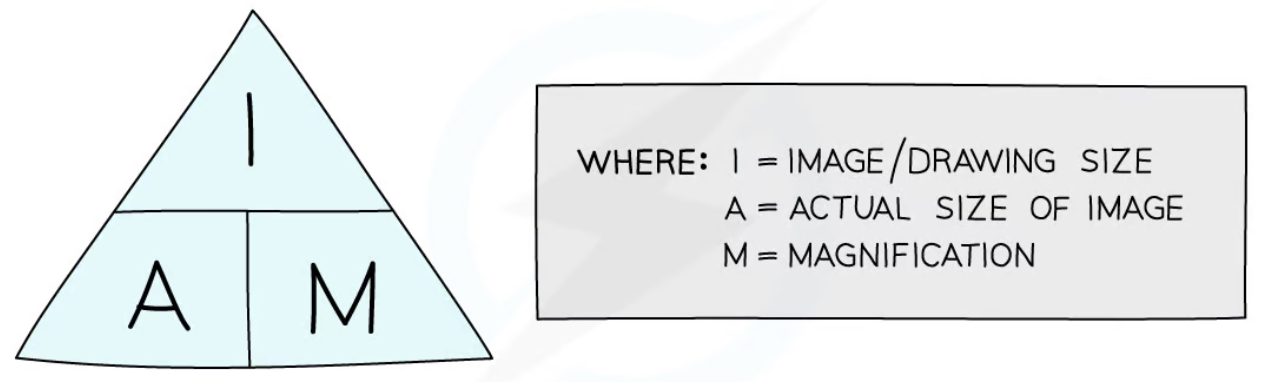
Field of View
Is represented as “i” on the triangle
when under low power, use a millimeter rules and measure diameter against the slide
then you can convert to micrometers (move decimal 3 to the right or multiply by 1000)
when the magnification increase, the FOV decrease
how to find FOV
low power magnification dived by the high power field of view
WHICH IS THE SAME AS high power FOV divided by low power
Finding Object Size on Microscope
Represented as ‘a’ on the triangle
estimate! (decide the diameter of FOV by the number of object that can fit across it)
Total Magnification
Is represented as “m” on the triangle
Multiply the actual size and image size
HOWEVER, you can also just multiply the ocular lenses together
example; 10x(4x)40x = 1600x (total mag)