Iterative sequences
Iterative sequences are like recurrence relationships. In an iterative sequence each term is used as the input to the rule to find the next term.
There are 2 types of iterative sequences: converging or diverging
converging is one which tends to towards a particular value/limit
diverging is one which doesn’t tend towards a limit and is more random
To help identify which it is, a diverging sequence on a calculator will end abruptly and come with a calculation error. While for converging, the number will eventually stop changing as the calculator cannot get a more accurate reading.
example question: Use converging iterative sequence to find a root (2.d.p.) of the equation x3 - x2 - 1 = 0
step 1: rearrange the equation to make x the subject x = ∛x2 + 1
step 2: write it in the form of an iterative sequence xn+1 = = ∛(xn)2 + 1
step 3: Using any starting point for x0 ,keep going till the sequence converges to the answer
answer: x = 1.47
(this technique only works for converging sequences)
COBWEB + STAIRCASE DIAGRAMS
when plotting iterative sequences on a graph, you may be asked to ‘show the behaviour’ or ‘add cobweb/staircase diagrams’ to it. This means drawing a cobweb/staircase diagram on the graph depending on whether its converging or diverging.
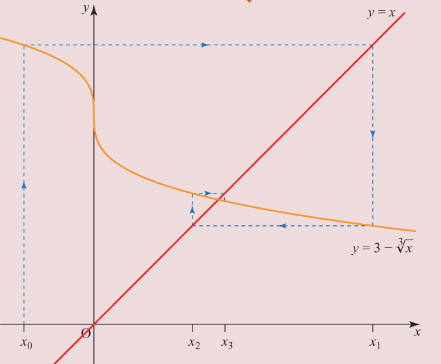
cobweb diagrams
Cobwebs are for converging sequences, you start from x0 and draw up until you meet a line then turn 90o towards the next line etc. The idea is that you will always hit a line at a term of x, until you reach the limit, and it sort of creates a cobweb shape
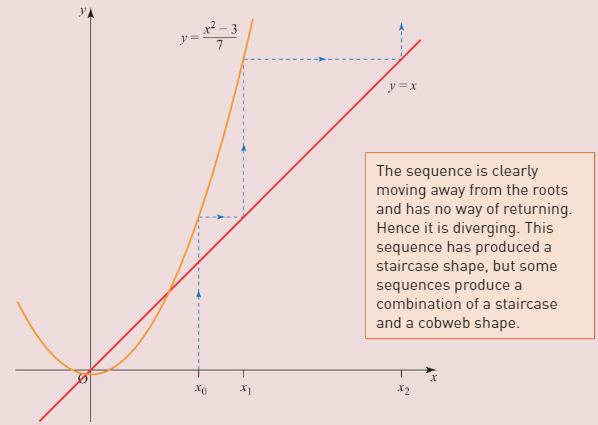
staircase diagrams
Staircases are for diverging sequences, you start from x0 and draw up until you meet a line then turn 90o towards the next line etc. The idea is that you will always hit a line at a term of x, until the line goes beyond the graph, and it creates a staircase shape