Lecture 4 - Textbook Practice Questions
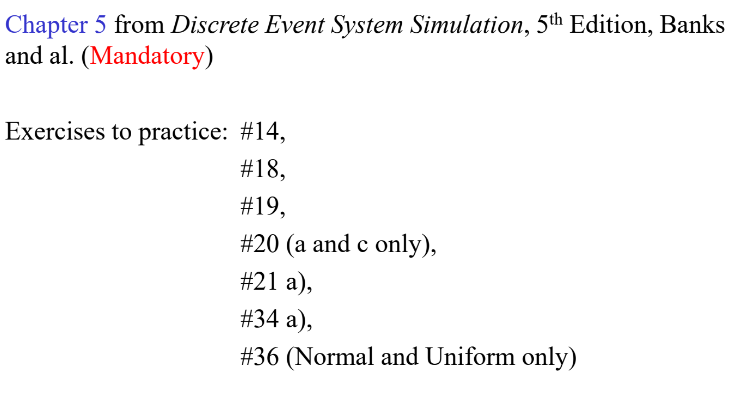
Q14
Distribution: Exponential Distribution
lambda = 0.4
a) X = lifetime of a satellite

P(X>5) = 1 - P(X<5)
       = 1 - F(X<5)
       = 1 - 0.865
       = 0.135


F(X) = 1-e^-(lambda)(x)  //IMPORTANT


F(5) = 1 - e^(-0.4)(5) = 0.865
b) P(3<X<6)
P(3<X<6) = F(6) - F(3)
= 0.909 - 0.699
= 0.21
F(6) = 1-e^((-0.4)(6)) = 0.909
F(3) = 1-e^((-0.4)(3)) = 0.699Q18 (Poisson Process - skipped)
Poisson proccess
X=1/week
P[0 accidents in 1 week]
P(0) = ((e^-1)(-1^0))/0! = 0.368
[P(c)]^3=0.5
Q19

Mean = 1/λ
10000 = 1/λ
λ = 1/10000

a) X = Time of failure for a component
Memoryless property = 5000 hours (not 15000)

P(X>=15000|X>10000) = P(X>=5000)

P(X>=5000) = 1 - P(X<=5000)
           = 1 - F(5000)
           = 1 - 0.393
           = 0.607

F(5000) = 1-e^((-1/10000)(5000)) = 0.393


b) Identical to part a (due to the memoryless property)
Q20 (a & c only)

a) P(X<=12) = F(12) = q-e^((1/48)(12))
                    = 0.22

c) Expected lifetime = E(X)

E(X) = 1/λ = 48 months (due to memoryless property)
Q21a
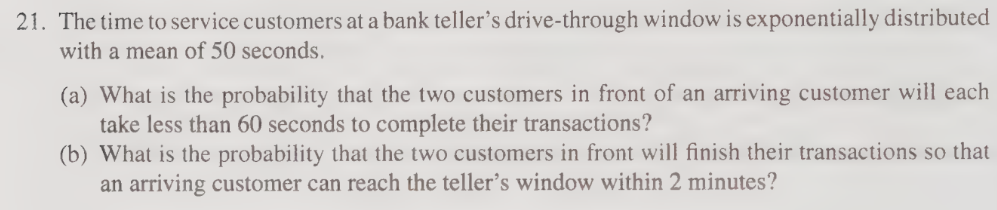
X = Service time

a) P(X<60) = F(60) = 0.698 [for 1 customer]
           = F(60)^2 [for 2 customers]
           = 0.48
Q34a
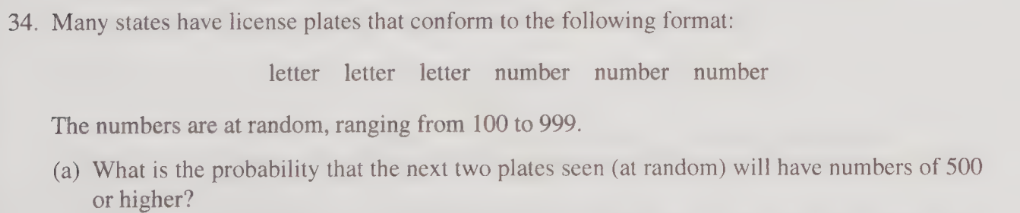
Range = Rx = (100, 999)

P(X>500) = 1 - P(X<500)
         = 1 - F(500)
         = 0.556 [for 1 plate]
 0.556^2 = 0.3086 [for 2 plates]

F(500) = (x-a)/(b-a)
       = (500-100)/(999-100)
       = 0.556
Q36 (Normal and Uniform only)
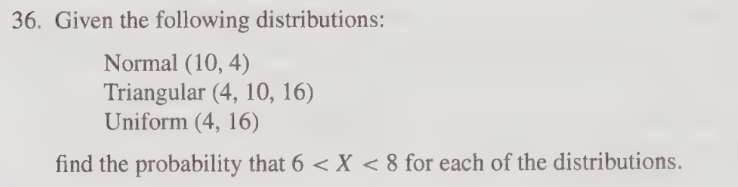
Normal (10,4)
(use the z table to get the values back into the original numbers)

P(6<X<8) = F(8) - F(6)
         = 0.1587 - 0.0228
         = 0.1359

Find these values in the z-table:
F(8) = (8-10)/2 = -1
F(6) = (6-10)/2 = -2

There are no negative values in the z-table...
Use the symmetrical property of the normal distribution to find the values...
F(8) = 1 - F(1) = 1 - 0.8413 = 0.1587
F(6) = 1 - F(2) = 1 - 0.9772 = 0.0228