Surgery Lecture 1 & 2: Pre-op, Intra - op, Post - op
Purposes of Surgery
Diagnostic: Confirms diagnosis through exploration.
Ablative: Removes a diseased body part (e.g., amputation).
Palliative: Relieves symptoms without curing (e.g., debridement of tissue).
Reconstructive: Restores function or appearance (e.g., hip plate insertion, breast reconstruction).
Curative: Cures the condition (e.g., mass removal from intestine).
Preventative: Prevents future problems (e.g., double mastectomy for high-risk women).
Transplant: Replaces malfunctioning organs (e.g., heart, lungs).
Constructive: Restores function due to congenital anomalies (e.g., atrial septal defect).
Cosmetic: Alters personal appearance.
Classifications of Surgeries
Elective: Not necessary for life, can be scheduled at convenience.
Urgent: Necessary to prevent additional health issues.
Emergent: Essential to save life or preserve a body part.
Perioperative Nursing (beginning to end)
Encompasses all phases: pre-operative (educate before surgery), intraoperative (during surgery), and post-operative (after surgery eval and educate).
Preoperative Phase (before surgery)
Focus on assessment (health status, demographics, vital signs).
Teaching initiates, includes patient and family.
Lab tests and informed consent are obtained.
GI prep includes NPO status.
Consider latex allergies.
Skin prep involves hair removal, use of sterile solutions.
Respiratory Preparations: Teach incentive spirometry usage.
Cardiovascular Preparations: Promote turning, coughing, deep breathing, leg exercises, and ambulation post-op.
Consider cultural factors and ensure interpreter availability if needed.
Patient teaching comes before surgery unless very emergent/life saving.
Intraoperative Phase (during surgery)
Use timeout protocols to confirm the patient and procedure.
Ensure: the right patient, right role, right surgery.
Roles: scrub nurse (sterile environment, assist surgeon) and circulator (advocates for patient).
Postoperative Phase PACU (after surgery)
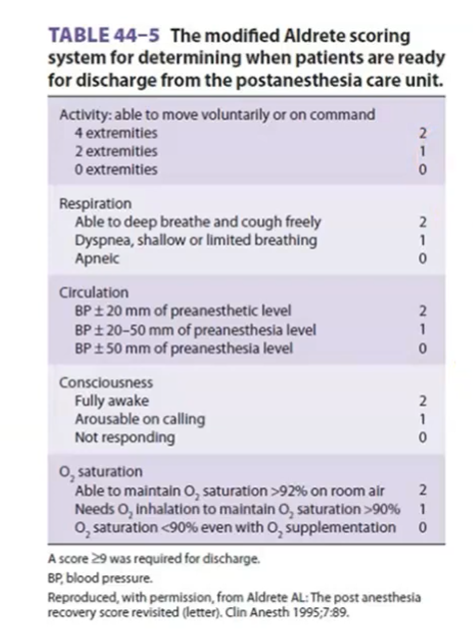
Occurs in PACU: Monitor patient's condition, discharge criteria via Aldrete score (≥9 for discharge).
Alderete Score: A scoring system used to evaluate a patient's readiness for discharge from the PACU, assessing parameters such as activity, respiration, circulation, consciousness, and oxygen saturation.
Factors influencing recovery: physical condition, nutritional status, psychosocial needs.
Issues such as recovery speed in older patients and stress management.
Assess for pain frequently, noting vital signs and any abnormal findings.
Nursing and Assessment Considerations
Physical Condition
Affects tolerance to surgery, slower responses in younger and older patients.
Look for signs of stress and assess communication.
Nutritional Status
Protein is crucial for recovery. Assess dietary needs (e.g., TPN, gluten-free, diabetic, cultural).
Psychosocial Needs
Address and acknowledge common fears of surgery and consider socioeconomic and cultural factors (Asians don’t show pain).
Consider socioeconomic status regarding medications and care. (Afford medical care needed?)
Understand refusals like blood transfusions from certain groups (Jehovah witness).
Special focus on older adults: slower recovery, higher risk factors, component care. (higher risk of aspiration, atelectasis, pneumonia, and delirium).
Risk of thrombosis formation, infection, longer teaching time, higher risk of disorientation.
Preoperative Assessment
Includes thorough head-to-toe assessment, health history and a complete and accurate list/medication review. (Document)
Ensure informed consent is obtained BEFORE medications are given.
Pre-op teaching for patient and family.
Informed consent: required BEFORE procedure, patient my be competent, must agree to procedure, is aware of the risks, benefits, and alternatives (explained by health care provider). The nurses roll is to act as witness only.
Roles of Anesthesia
Anesthesia: absence of all sensation
General Anesthesia: Induces unconsciousness, used for major surgeries.
Regional Anesthesia: Sedates and numbs specific body areas; used in C-sections or joint surgeries, epidural, nerve block, spinal).
Local Anesthesia: Loss of sensation in a specific area while patient remains aware. (injected: lidocaine or topical, ie piercing.)
Conscious Sedation: Moderate sedation with preserved airway, often used in procedures like endoscopy. (Combo of sedatives, tranquilizers, anesthetics).
Nursing Role in Conscious Sedation
Knowledge of physiology, be aware of complications and intervene in adverse reactions, maintain airway and oxygenation.
Ensure the presence of resuscitation equipment, be alert to patient deterioration. (Patient can deteriorate quickly).
Understand cardiac dysrhythmias
Understand principles of pharmacology
Nursing Roles in Surgery
Circulating: Prepare equipment, conduct assessment, ensure sterile environment
Scrub Nurse: Ensure proper equipment, assist surgeon, maintain counts of instruments (sponges, needles…) Observe progress, handles instruments.
Postoperative Nursing Care
IMMEDIATELY - Conduct a thorough assessment upon receiving the patient from PACU.
Monitor vital signs, incision site, and pain management. (Respirations, pale skin, weak thready pulse, restlessness)
Be responsive to abnormal findings. Contact provider.
Regular assessments every 15 minutes until PACU discharge.
Shock Assessment
Watch for tachycardia, restlessness, weakness, and cyanosis post-op and pale and moist skin.
Compare findings to preoperative baseline.
Monitoring the Surgical Patient/Incision Monitoring
Keep track of bleeding, drainage, and monitor for dehiscence (splitting or busting open) and evisceration (protrusion of organ).
Be aware of color, exudate (fluid leaking out of blood vessels), temperature, wound edges, separation, coughing and distension.
Dehiscence issues occur early (3-14 days post-op), and evisceration requires immediate care.
Pain Assessment
Frequent pain evaluation, utilizing the OPQRST method.
Subjective Data - Patient reports pain, pain scale assessment
Objective Data - Increased pulse rate, restlessness, moaning, guarding (visual proof)
OPQRST:
O - Onset: When did the pain start? What were you doing at the time?
P - Provocation/Palliation: What makes the pain worse or better? Are there specific movements or activities that aggravate the pain, or is there anything that alleviates it?
Q - Quality: How would you describe the pain? Is it sharp, dull, throbbing, or burning? Providing a clear description can help in understanding the nature of the pain.
R - Region/Radiation: Where is the pain located? Does it radiate to other areas of the body? Identifying the exact location can be crucial for diagnosis.
S - Scale/Severity: On a scale of 1 to 10, how severe is the pain? This helps in assessing the impact of the pain on the patient's daily activities.
T - Time: How long does the pain last? Is it constant, intermittent, or does it occur at specific times?
Venous Stasis
Assess for strength of pedal pulses
Assess for edema in legs
Asses for aching in legs
Assess for redness in legs
Assess for skin color
Asses skin temperature
Urinary Function Assessment
Monitor for voiding within 6-8 hours; catheterize if necessary.
Assess for fluid balance. (deficit: dehydrated, excess: too much fluid)
Level of Consciousness (LOC)
Check orientation and ability to follow commands and follow simple tasks for neurologic assessment.
Have patient state who (name), where (place), time, year and follow 2 simple tasks (stick out tongue, squeeze hand).
Check Motor Status
Hand and arm strength
Foot and leg strength
Sitting ability
Nursing Diagnoses for Surgical Patients
Consider diagnoses like ineffective airway clearance, risk for infection, and impaired mobility.
Check for breathing patterns, fear, knowledge deficit, impaired tissue integrity, pain, and impaired communication.
Discharge Planning
Include wound care (cleaning, when sutures/stitches can be removed) , medications (current, new, ones no longer taking) , activity guidelines (as tolerated, bed rest, weight bearing…) , and signs of complications.
Emphasize importance of follow-up appointments and when to call a health care provider (fever and signs and symptoms of infection).