ORIGIN OF THE SOLAR SYSTEM
Solar System
- Where is our solar system?
• It’s our galaxy that called “the Milky Way” and that bright light is our solar system. All the stars we see in the night sky are in our own galaxy. It is called the milky way because it appears as a milky band of light in the sky.
→ Our solar system is made up of a star, eight planets and countless smaller bodies such as dwarf planets, asteroids and comets.
→ The order of the planets in the solar system, starting nearest the sun and working outward : Mercury, Venus, Earth, Mars, Jupiter, Saturn, Uranus, Neptune.
Geocentric view
→ Proposed by Ptolemy and Aristotle, claims that the Earth is the center of the universe.
Heliocentric view
→ Proposed by Nicolaus Copernicus, stated that the sun is the center of the Solar System.
Planets in the Solar System
- Mercury
○ The fastest and smallest planet in our solar system.
○ It takes 88 Earth days to make a full rotation around the sun.
○ It orbits around the sun with a speed of 47 Kilometers per second.
○ No known natural satellites/moons
- Venus
○ The hottest planet in the solar system.
○ The 6th largest planet.
○ It takes 225 Earth days to orbit the sun.
○ No known natural satellites/moons.
- Earth
○ The planet we live on with a suitable climatic condition, supports life in all forms.
○ Orbits around the sun every 365 days
○ Natural satellite/moon: The moon
- Mars
○ Red planet, have largest dust storms, largest mountain/volcano in the solar system called Olympus
○ Orbits the sun every 687 days.
○ It is thought that it once had an atmosphere, eventually lost about 4 billion years ago due to meteor strikes.
- Jupiter
○ The largest planet with the shortest day, 1 day in Jupiter = 9 hours 55 minutes.
○ Orbits the sun every 4,333 days.
○ Currently has 79 known moons, some including Europa, Callisto and lo.
○ Has 4 known rings smaller than Saturn’s
- Saturn
○ Famous feature of Saturn is ‘Ring system’ which is composed mostly of ice particles.
○ Has the largest rings in the Solar System; over 30 rings.
○ Orbits the sun every 10,756 Earth days or 29.4 Earth years.
○ Has 82 known moons, Titan, Rhea and Enceladus.
○ Saturn has periodic storms and can be seen with a telescope on Earth.
- Uranus
○ Coldest planet in the solar system (-224 degree Celsius)
○ Orbits the sun every 30, 687 Earth day or 84 years.
○ 27 known moons, Titania, Ariel and Umbriel.
○ Has 13 known rings around the planet.
- Neptune
○ The ‘Ice Giant’
○ Farthest planet in the solar system.
○ Orbits around the sun 60,190 Earth Days
○ Neptune has 14 known moons and 6 known rings.
Dwarf planets
Similar to planets, however, they are much smaller than regular planets and orbits a star. Their orbit around the sun is unclear, filled with objects such as asteroids.
Known Dwarf Planets
Dwarf planets are relatively new classification, just only formed in 2006 by the International Astronomical Union (IAU)
- Pluto
○ Originally thought to be our solar system ninth planet but later was reclassified as a dwarf planet in 2006.
○ Discovered in the 1930’s
○ Largest dwarf planet in our solar system
- Ceres
○ Located in the asteroid belt in between Mars and Jupiter.
- Eris
○ Discovered in 2005
- Makemake
○ The dwarf planet was discovered in 2005
- Haumea
○ Discovered in 2004
○ Part of the Kuiper Belt.
Nebular Hypothesis
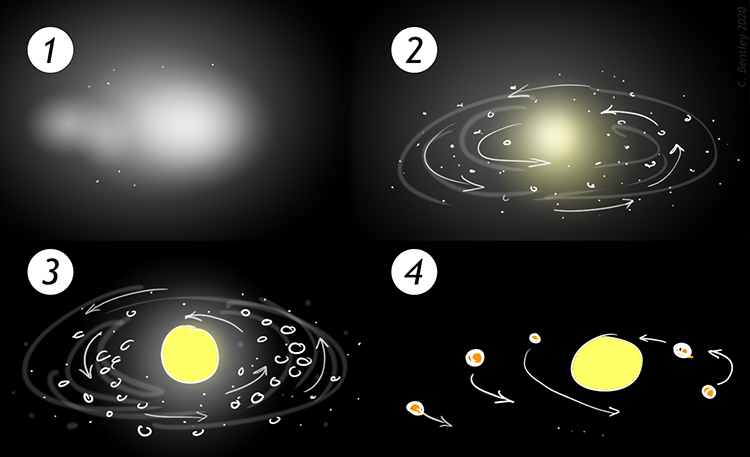
→ The idea that a spinning cloud of dust made of mostly light elements, called a nebula, flattened into a protoplanetary disk, and became a solar system consisting of a star with orbiting planets.
→ A great cloud of gas and dust rotated slowly in space and shrank under the pull of its own gravity.
Encounter Hypothesis
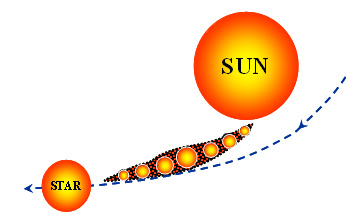
→ A rouge star passed close to sun and stripped material from both the sun and rogue star, fragmented into smaller lumps forming planets.
Rogue Star - The stars from other galaxy that escaped the gravitational pull of its own galaxy.
Protoplanet Hypothesis
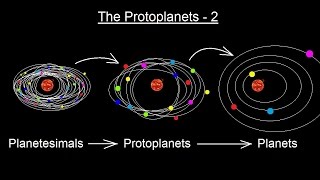
→ A hypothetical eddy in a whirling cloud of gas or dust that becomes a planet by condensation during formation of solar system.
→ It refers to the hypothesis that suggests that a great cloud of gas and dust rotated slowly in space and shrank under the pull of its own gravity.
→ the present working model about the formation of the solar system.
Planetesimals - The large-sized asteroids aggregates.