ADHD
* KNOW STIMULANTS AGE GROUPS * see part 3 summary questions
Having difficulty in efficiently activating this part of the brain (DLPFC) cuts across many psychiatric disorders that share the symptom of executive dysfunction, not just ADHD but also schizophrenia, major depression, mania, anxiety, pain, and disorders of sleep and wakefulness
dorsal anterior cingulate cortex (dACC) - inattention/inability to focus
Other areas of prefrontal cortex that are hypothetically functioning inefficiently in ADHD are the orbital frontal cortex (OFC), linked to symptoms of impulsivity, and the supplementary motor area, linked to symptoms of motor hyperactivity
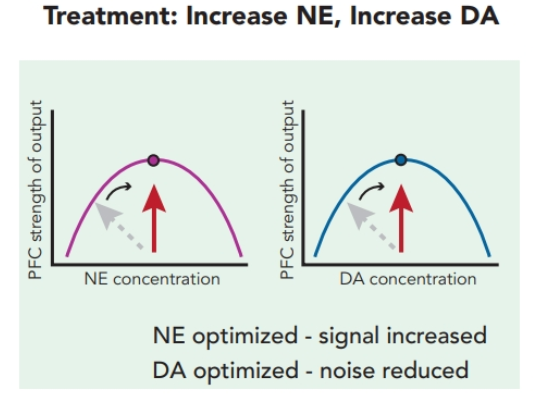
PFC - NE and DA need to be just right to achieve the right TONE for neurotransmitter presence in the PFC. Too much or too little inc cog problems or is ineffective respectively. DA has a phasic burst fxn as well, used to reinforce reward feelings
Treatments
Treating ADHD may also have to await improvement from mood and anxiety disorder treatments, with ADHD cognitive symptoms seen as more of a fine-tune adjustment to a patient’s overall symptom portfolio.
Tx adults is rare bc it’s an afterthought if tx the mood or anxiety disorder are tx and cognitive ADHD sx still exists.
The modern, sophisticated psychopharmacologist keeps a high index of suspicion for the presence of ADHD in mood, anxiety, and substance abuse disorders especially in adults, always aiming for complete symptomatic remission in patients under treatment.
Nicotine subjectively improves ADHD symptoms, especially in patients who are not treated for their ADHD. Nicotine enhances dopamine release and enhances arousal, so it is not surprising that it may be subjectively effective for ADHD symptoms. May be a factor when considering tx
ADHD w/ tic can be difficult, tic need less DA, ADHD needs more. Challenging but can do combo.
For comorbid ADHD w/ anx, dpn, substance abuse, NET inhib or a2 agonist can be helpful
Methylphenidate - NE/DA reuptake inhib. Binds to NETs/DATs allosterically and are brought in presynaptically instead of monoamines
Amphetamine- is a competitive inhibitor and pseudosubstrate for NETs and DATs, binding at the same site that the monoamines bind to the transporters. Can be abused to get high bc they get transpo’d in then hijack the vmats displacing DA which floods back into the synapse
minimum threshold for ADHD therapeutic action, probably around 50–60% DAT occupancy (LOOK UP INSOMNIA FOR SAME)
Best pharm use of stimulants in tx ADHD (and daytime sleepiness) targets both NETs and DATs rather than raising the dose to get predominantly DAT effects, many of which will be unwanted
Noradrenergic Treatment of ADHD
Atomoxetine (selective norepinephrine reuptake inhibitor (NRI)) - Blocking NETs in the prefrontal cortex increases both DA and NE in the prefrontal cortex and is why NET inhibitors are thought to work in ADHD. there are few NE neurons and NETs in nucleus accumbens, inhibiting NET does not lead to an increase in either NE or DA there and is why NET inhibitors are thought not to have reinforcing, abuse, or addiction potential.
Bupropion - weak NRI and also a weak DAT inhibitor known as a norepinephrine–dopamine reuptake inhibitor (NDRI)
Several tricyclic antidepressants (TCAs) have notable NRI actions, such as desipramine and nortriptyline, amox is the one approved tho
actions from long-term NRI actions give 24-hour symptom relief
Alpha-2A-Adrenergic Agonists -
Alpha-2-adrenergic receptors are present in high concentrations in the prefrontal cortex, but only in low concentrations in the nucleus accumbens. Low NE interacts w/ a2, high a1.
Guanfacine - selective for α2A receptors. only controlled release version approved\
Clonidine - relatively nonselective agonist at α2 receptors, with actions on α2A, α2B, and α2C receptors. In addition, clonidine has actions on imidazoline receptors, thought to be responsible for some of clonidine’s sedating and hypotensive actions (care of hypotension)
Both clonidine and guanfacine, especially in the controlled-release formulations, are used “off-label” for the treatment of conduct disorder, oppositional defiant disorder, and Tourette syndrome
viloxazine (NRI), mazindol (DAT inhib), and centanafadine (5HT-NE-DA reuptake inhib) are in testing/development