⛰️ The Rock Cycle
⛰ The Rock Cycle
The rock cycle is a model that describes how the three main types of rocks (igneous, sedimentary, and metamorphic) are formed, altered, and recycled over long periods of geologic time. This cycle involves the formation and destruction of rock throughout Earth's history.

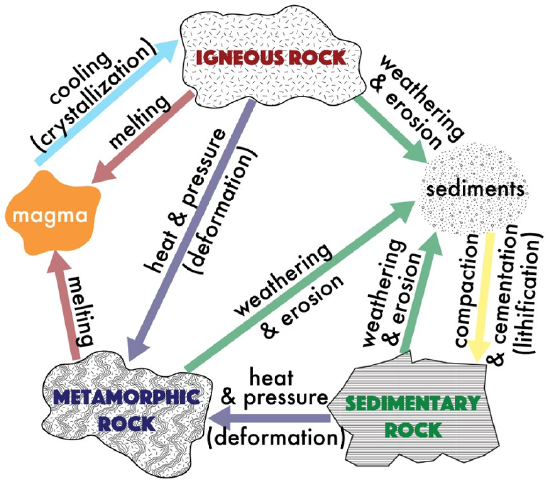
Early Earth Example
On early Earth, the surface rocks were primarily igneous, formed from cooling magma.
Over time, weathering and erosion broke these rocks down into sediments.
The sediments were transported to oceans, buried, and lithified into sedimentary rocks.
In areas with converging tectonic plates, heat and pressure metamorphosed the igneous rocks into metamorphic rocks, which were then uplifted to form mountains.
These metamorphic rocks were also broken down into sediments and transported to new sedimentary basins.
In subduction zones, rocks were returned to the mantle, potentially sinking to the core-mantle boundary (D'') and later rising as a mantle plume.
The plume would melt, creating a volcano and forming new igneous rocks, restarting the cycle.
Earth's Recycling Process
The rock cycle represents Earth's continuous recycling of geologic material. Mineral grains from Earth's early history (over 4 billion years ago) can still be found in ancient sedimentary rocks today. The Jack Hills Conglomerate in Australia contains detrital zircon grains that are over 4.4 billion years old.
🔄 Rock Cycle Processes
Here's an overview of the processes involved in the rock cycle:
Rock Type | Process | Resulting Rock Type |
|---|---|---|
Magma | Cooling | Igneous Rock |
Igneous Rock | Melting | Magma |
Igneous Rock | Weathering & Erosion | Sediments |
Sediments | Compaction & Cementation (Lithification) | Sedimentary Rock |
Igneous Rock | High Heat & Pressure (Metamorphism) | Metamorphic Rock |
Sedimentary Rock | High Heat & Pressure (Metamorphism) | Metamorphic Rock |
Sedimentary Rock & Metamorphic Rock | Weathering & Erosion | Sediments |
Metamorphic Rock | Melting | Magma |
⏳ Weathering and Erosion
The rock cycle involves the production of sediments through weathering.
Weathering describes the processes that transform rocks into sediment.