Urban Issues and Challenges: Opportunities and Challenges in Lagos
Challenges
Slums and Squatter Settlements
66% of people in Lagos live in slums.
At least 85000 people live in Makoko, a large slum in eastern Lagos.
Issues in slums include poor quality housing and poor sanitation.
People live in slums because they cannot afford the high cost of housing.
Access to Clean Water, Sanitation, and Energy
60% of people in Lagos have no reliable water connection.
Water sellers sell water at inflated prices to those with no other option.
Up to 15 households can share one toilet.
Human waste often contaminates water supplies, causing cholera.
There is not enough energy to power everywhere at once, so neighbourhoods must take turns.
Illegal, unstable electric connections are common.
Access to Healthcare and Education
There are not enough healthcare facilities to cope with the growing population.
Treatment is often expensive and many cannot afford it.
There are not enough schools.
School fees are often too expensive for poor families.
Parents lose an income if they send a working child to school.
There is only one primary school in Makoko.
Environmental Damage
More than 9000 tonnes of waste are produced every day.
60% of rubbish is not officially collected.
Olusoson dump contains toxic waste.
Industrial emissions and waste disposal are unregulated, causing pollution.
Traffic contributes to air pollution.
Air contains nitrous oxide and volatile organic compounds.
Traffic Congestion
The average commuter spends more than 3 hours in traffic every day.
There are over 5 million cars.
Public transport is very limited.
Unemployment and Crime
60% of people work in the informal sector, with no legal protection.
Informal vendors can have their stalls destroyed at any time.
Police are insufficient.
Many slums are policed by vigilante “area boys”.
Opportunities
Access to Healthcare
There are more hospitals in Lagos than in rural areas.
Education
90% of children attend school in Lagos.
Only 60% of children attend school in rural areas.
There are 20000 schools in Lagos’ state.
Tertiary Sector Jobs
Lagos is home to many banks, government departments and law firms.
Wages in Lagos are 4x higher than in rural areas.
Better Public Transport
The Lagos Mass Rail Transit System opened in 2022.
Access to Electricity
Two new power stations are planned to ease the energy shortage.
Makoko floating school
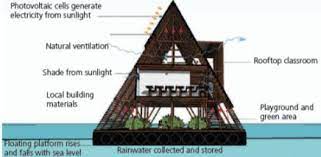
The Makoko Floating School was built in 2013 using local materials such as timber and wood. Its aim was to provide education to 100 students in Lagos. The school was also free in order for some of the poorer people to attend. It was powered using solar panels areas.
Economic Benefits
Jobs - Residents are more likely to get a good job due to their education. The school also provided job opportunities for staff (teachers, support staff etc),
Social Benefits
Education - Free education for around 100 students.
Skills - Stodents learnt skills which could be used both at home and in workplaces.
Space - The School itself was a space used by residents for meetings and events,
Emironmental Benefits
Local Materials - The school was built using local materials, this meant no harm caused for the environments and repairs were easy
Solar Panels • Solar panels were used for energy, this was very sustainable.
Water - The school collected rainwater and used it for its water needs.
The Makoko Floating School collapsed after a storm in 2016. Makoko residents plan to rebuild a stronger version